
Voice search marketing helps healthcare brands prepare for spoken, conversational questions across search assistants and voice-enabled devices. The goal is not to chase a shiny new channel. It is to make accurate answers easier for people and search systems to find. That starts with a strong healthcare SEO foundation.
Healthcare searches can carry urgency, uncertainty and location intent. A person may ask, “Where is an urgent care center open near me?” or “What kind of therapist helps with panic attacks?” Your content should answer the question clearly without diagnosing, promising an outcome or skipping important context.
Why voice search changes the shape of healthcare queries
Typed searches are often compressed into a few words. Spoken queries tend to sound more like complete questions. They may include details about symptoms, insurance, hours, distance or what happens next. Voice search optimization therefore overlaps with SEO, answer engine optimization (AEO), local search and patient education.
That shift is bigger than any one device. It reflects a broader change in how people expect search to respond.
“Search behavior is changing fast. What we are seeing right now is a fundamental shift in how patients find healthcare providers.”
— Kelly Burgess, BURG+CO. Marketing’s founder, CEO and a certified SEO specialist
For healthcare marketers, the practical takeaway is simple: Build pages around real questions and trustworthy answers, then make the path to care easy to understand.
6 voice search marketing strategies healthcare brands can use
If you’re trying to incorporate voice search into your digital marketing, here are a few approaches worth trying:
-
Map natural-language questions to patient inten
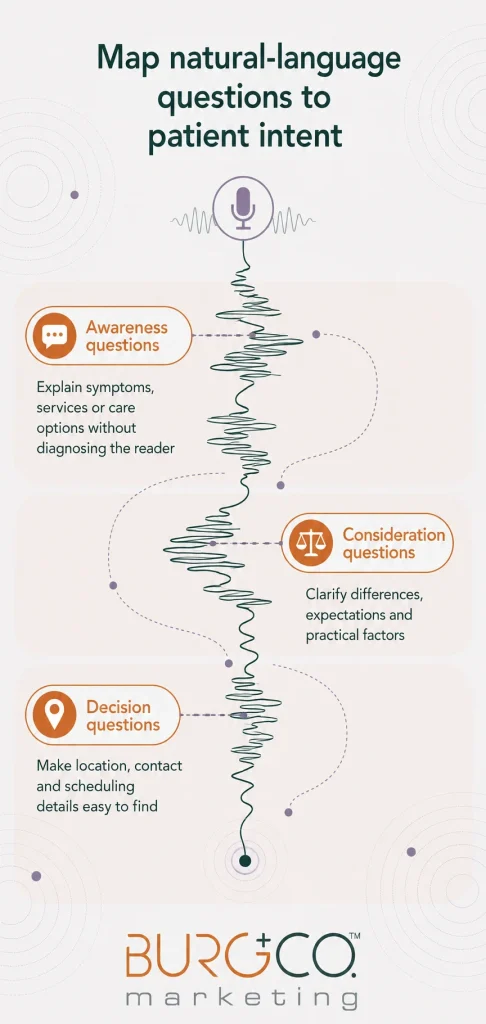
Review search data, call-center questions and intake-team feedback. Group spoken-style queries by awareness, consideration and decision intent. A question about symptoms needs education. A question about nearby hours or insurance may need a location or service page.
A simple intent map can separate the job each question needs to do:
- Awareness questions — Explain symptoms, services or care options without diagnosing the reader
- Consideration questions — Clarify differences, expectations and practical factors
- Decision questions — Make location, contact and scheduling details easy to find
-
Put a direct answer near the top
Open important pages with a brief answer to the main question. Then add qualifications, examples and next steps. This structure helps busy readers and makes the page easier for search systems to interpret. It also follows Google’s guidance to create helpful, reliable, people-first content.
-
Strengthen location and business information
Keep each location’s name, address, phone number, hours and services consistent across your website and listings. Build useful location pages instead of thin copies. Add accurate local business or medical business structured data using the most specific applicable subtype when it fits the organization and page.
-
Build question-led content clusters
Create a focused service page, then support it with articles, FAQs and videos that answer related patient questions. Link those pieces together so people can move from a quick answer to deeper education or a clear next step.
-
Make pages easy to use on mobile
A voice query often leads to a screen. The landing page should load quickly, use descriptive headings and show the most useful action without a scavenger hunt. Keep phone numbers, directions and appointment options easy to find.
-
Use structured data carefully and measure the full journey
Valid structured data may help search systems understand a page, but it does not guarantee selection as a voice answer. Google’s speakable markup remains a beta feature with narrow eligibility, so it should not become your entire strategy. Track visibility, calls, direction requests, forms and qualified patient actions together.
Use this qualitative guide to connect each tactic to a useful review question.
| Strategy area | What to review | Useful signal |
| Intent | Natural-language questions by journey stage | Relevant page impressions and visits |
| Answers | Concise answer plus context and next step | Engagement with key content |
| Local | Accurate profiles, listings and location pages | Calls and direction requests |
| Experience | Mobile speed, clarity and conversion paths | Qualified forms and calls |
The strongest metric depends on the page’s job. A service page should not be judged by the same action as an educational article.
A relevant client perspective
A healthcare marketing leader’s experience also shows why domain knowledge and close collaboration matter when search behavior changes. This individual experience is context, not a promise of typical results.
“As a healthcare marketing executive, I’m most interested in partnering with external service providers and vendors who just ‘get it’. And that’s Burg + Co.! Our company has partnered with Burg + Co for nearly a year, and in that time they’ve helped my company and I strategize and execute marketing initiatives that have not only increased ROMI, but they’re an absolute delight to work with. Each member of their team thinks and works on behalf of their client, and I’ve come to rely on their collective domain expertise regarding digital marketing best practices. Cannot recommend Burg + Co. enough. KB and her team are an impressive outfit, and I’m thrilled to continue working with them. 5-stars, all around!”
— Kateigh Axness Williams
Voice search is one part of a larger discovery journey. The useful question is not whether your brand has “done voice.” It is whether your search presence gives people accurate, accessible answers when and where they need them.
Effective voice search marketing connects technical SEO, natural-language content, local visibility and conversion strategy. BURG+CO. can help your team prioritize the questions that matter, strengthen the pages behind the answers and measure whether visibility supports meaningful patient action.
Discover the difference a strategic digital marketing partner can make. Schedule your complimentary consultation with BURG+CO. now.
FAQs about voice search marketing
What is voice search marketing?
Voice search marketing is the practice of making digital content easier to discover for spoken, conversational queries. It usually combines SEO, local search, clear content and structured data.
How is voice search different from typed search?
Spoken searches often use complete questions and more context. Typed searches may be shorter, but both can reflect the same patient need and should support one search strategy.
Why does voice search matter for healthcare providers?
People may use voice when they need a quick answer, nearby care or hands-free help. Clear, accurate content can make a healthcare brand more useful during those searches.
Does schema markup guarantee a voice search result?
No. Structured data can help search systems understand a page, but it does not guarantee that the page will be chosen or spoken as an answer.
What should healthcare brands measure for voice search?
Review search visibility alongside calls, direction requests, forms and qualified inquiries. Use page intent to decide which action matters most.
Do healthcare brands need separate pages for voice search?
Usually not. Start by improving existing service, location and educational pages so they answer natural-language questions clearly.
Can FAQ content support voice search?
It can. FAQ content works best when it answers real patient questions, stays concise and connects readers to fuller information when needed.
How does local SEO relate to voice search?
Many spoken searches include local intent, such as “near me,” hours or directions. Accurate profiles and useful location pages support that discovery.
Should healthcare content target long-tail keywords?
Long-tail phrases can reflect specific questions and intent. Use them naturally, but write for the person’s need instead of forcing an exact phrase.
How often should a voice search strategy be reviewed?
Review it when services, locations, patient questions or search features change. Ongoing measurement can show which pages need clearer answers or stronger next steps.