

When you create a digital marketing strategy as a mental health professional, you’re likely aiming to spread the awareness of your treatment far and wide. You want to make sure that you help as many people as possible take control of their mental health and recognize their abilities to improve their quality of life. However, when you own a practice, it’s often more important to narrow down your target audience to those in your surrounding areas.
Not only do you want to make sure your digital marketing is seen solely by people in areas you’re licensed to practice in, but you also want to establish yourself as an authoritative community resource. Local search engine optimization (SEO) helps you accomplish both of these goals.
Local SEO is the process of optimizing your site so that it appears on the maps and relevant search engine results pages in the areas that you serve. For mental health professionals, like therapists, focusing on local SEO helps you to thrive in the digital-first healthcare landscape we live in today. People turn to search engines to find answers to questions that you can provide.
If you’re trying to figure out how to measure the success of your local SEO efforts, we’re here to guide you. We’ll talk about the metrics you should be paying attention to as well as how BURG+CO. can help you grow and succeed as a local mental healthcare provider.
Key metrics to measure local SEO success for therapists
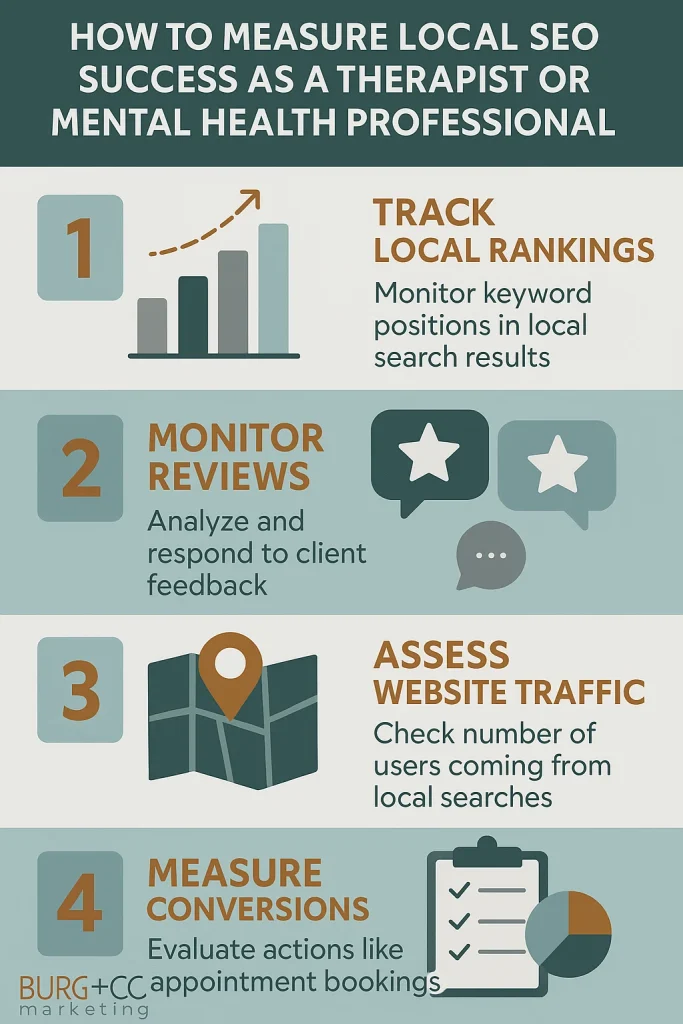
There’s a time and place in digital marketing for throwing spaghetti at the wall and seeing what sticks, but measuring those results isn’t one of them. It’s best to take a lot of the guesswork out of the equation when it comes to analyzing results.
By taking a look at exact numbers, you can get a tangible picture of your local SEO to determine what’s working and what needs to be tweaked in the next campaigns.
Here are a few of the key performance indicators (KPIs) that can help you see how your local SEO is doing:
Website performance metrics
You’re using local SEO strategies to attract people to your site, meaning its performance can help you see the results of those efforts. Here are some KPIs that reflect how your website is being impacted by your local SEO:
-
Organic traffic from local searches
You want to see who’s coming to your site because it grabbed their attention on the results pages, not because it was a paid advertisement that was targeted specifically for them. By seeing what traffic you’re gaining organically, you can determine if your site is being listed in a high-quality, engaging manner.
-
Bounce rate and average session duration
Take a look at how many people clicked off after just one page because they possibly felt like the listing was misleading or the site wasn’t user friendly. You should also see how long people stayed on your website. If they didn’t explore for more than a minute or so, that says something about how engaging and valuable your content is.
- Conversion rate
All metrics are important in their own way, but the conversion rate is usually at the top of the priority list. Even though having people visit and explore your site is important, you want to see how many people actively try to further their connection with your practice (e.g., filling out a contact form or booking an appointment).
Google Business Profile metrics
Your Google Business Profile (GBP), previously known as Google My Business, is the search engine listing that gives people the basic information about your practice. With local SEO strategies, you can boost the likelihood of appearing in the Google Map Pack, to help visibility in your area. Here are some GBP metrics worth keeping an eye on:
-
Views on profile and listings
Knowing how many people actually see your profile gives you an idea of how well you’re aligning with what the algorithm is looking for, such as quality photos and accurate information across web listings. If you’re not getting in front of enough eyes, then it’s time to tweak your approach.
-
Number of direction requests
It’s always a good sign when people inquire about your practice’s location after looking through your GBP. It means that they’re showing genuine interest beyond passive research. The quantity of direction requests on your profile showcases your relevancy and how accurately it appeals to your target audience.
-
Clicks to call or visit the website
Engagement with your Google Business Profile can show how effectively it showcases your practice’s value to potential patients. With the number of times that your profile’s “call” or “website” link is clicked, you’ll see how many people have the intention to become a quality lead.
Local rankings and visibility
Every local SEO effort is meant to help get your name in front of as many of your community members as possible. By taking a look at how you’re performing on relevant search engine results pages, you can get a more solid picture of how present your brand is on the search engine. Here are a couple of KPIs to keep an eye on:
-
Keyword rankings for local therapy-related terms
It’s helpful to track the up-and-down movements of your rankings for keywords that are relevant to your mental health practice. The higher your site ranks, the more visibility the keywords will bring. By tracking the rankings, you’ll be able to see what content is working and what is falling flat.
You can also compare your rankings to competitors’ to see if there is a new angle you can work or a keyword that is slipping through the cracks.
-
Visibility across maps and local search packs
Your brand’s visibility is key to bringing in new patients and broadening your awareness. There’s a visibility score that can be calculated with specific rank tracking tools, such as Semrush. It’s calculated by considering how often your site appears for relevant keywords and how high it ranks on those search engine results pages.
By seeing an exact number that sums up your visibility, you can use the data to back up your next local SEO decisions, whether that number needs a boost or maintenance.
Want to attract new patients to your website as a therapist? BURG+CO. can help with your local SEO
Being a mental health professional means spreading the awareness of concerns that can impact someone’s quality of life, such as anxiety and depression. While you want to spread that awareness far and wide, focusing on local SEO means targeting that awareness to your community and showing neighbors how you can help them become the best version of themselves.
If you’re not sure if your local SEO is doing their job, BURG+CO. can help. Our expert SEO team will track and analyze important SEO metrics to help you make informed decisions in your digital marketing campaigns. Through our regular reporting, you’ll never feel out of the loop and you’ll always know exactly where you stand.
Our team has years of experience in helping healthcare brands improve their digital presence to attract new patients and retain existing ones. If you’re looking to perform better in search engine results and attract more potential patients to your site, we’re ready to talk to you to see how we can help.
Want expert support with your digital marketing? Connect with BURG+CO. today to explore how we can help your healthcare brand grow.