
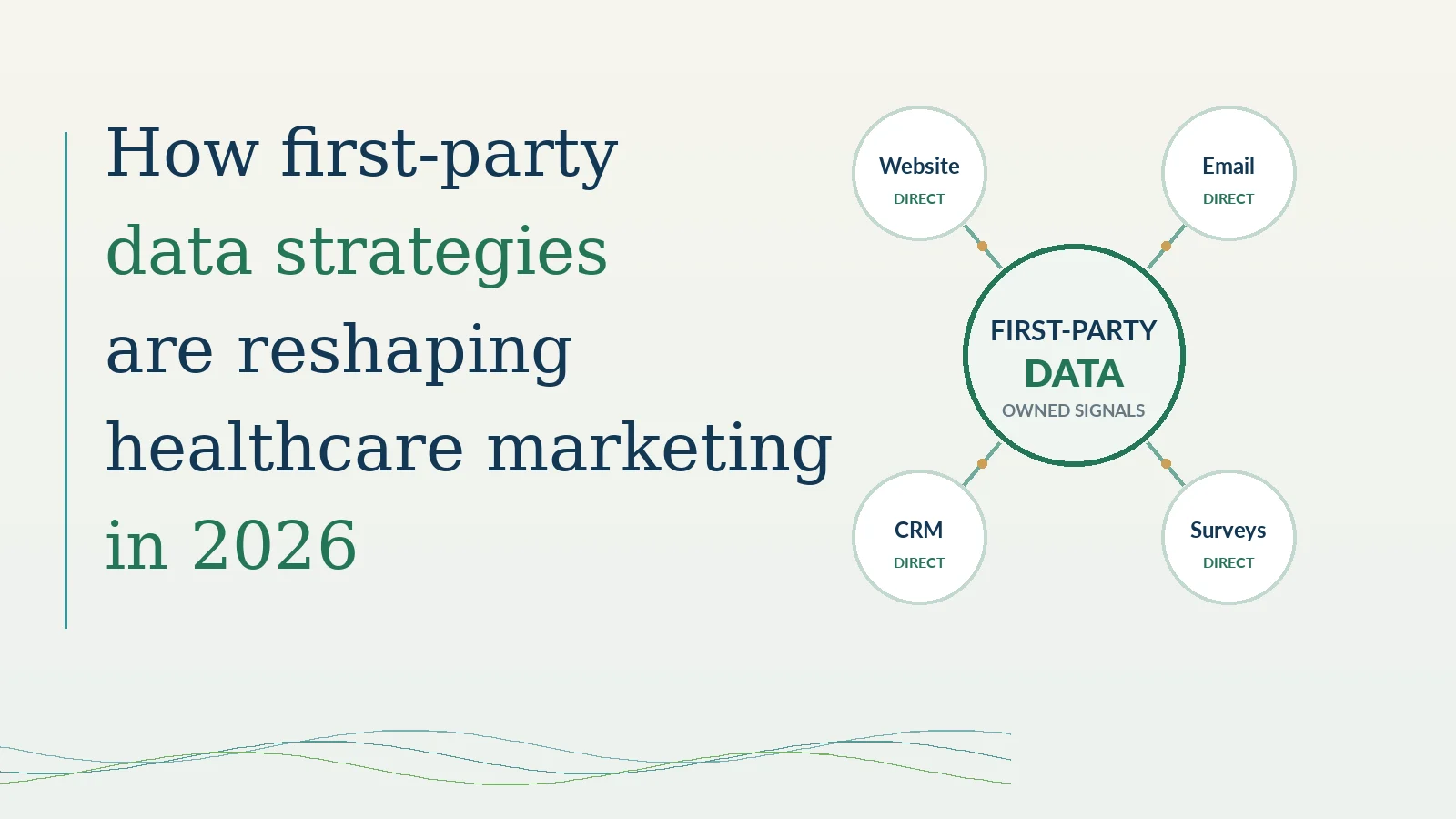
Healthcare marketing has no shortage of data. The harder question is whether your team can trust and govern that data. You also need to use it in a way that serves people. In 2026, first-party data deserves more attention. It gives healthcare organizations a clearer view of their own digital experiences instead of starting with an audience profile built somewhere else.
That does not make first-party data automatically private, compliant or ready for every marketing use. Healthcare organizations still need to consider what they collect and why. They also need to know where the data moves and which rules or platform policies apply.
What is first-party data in healthcare marketing?
First-party data is information your organization collects directly through interactions with people across channels you own or manage. Depending on the organization, that may include prospective patients, current patients, caregivers, referral partners and other audiences.
Common examples include:
- Website engagement — Pages viewed, navigation paths and call-to-action interactions
- Email activity — Opens, clicks, topic engagement and communication preferences
- Inquiry data — Calls, forms, chat interactions and lead-source information
- CRM activity — Referral source, service interest, location interest and follow-up stage
- Surveys and preference centers — Answers people intentionally provide
Zero-party data is more specific. It describes information a person intentionally volunteers, such as a stated preference. First-party data is broader. It can also include behavior your organization observes through direct interactions.
The useful question is not, “How much first-party data can we collect?” A better question is, “Which data helps us make a better decision?”
Why a first-party data strategy matters more in 2026
A first-party data strategy is a plan for collecting, governing, connecting and using direct audience information. For healthcare marketers, that plan can keep every available signal from being treated as equally useful.
A stronger strategy can help teams:
- Understand real audience questions — See where people need more clarity
- Improve content relevance — Prioritize topics, formats and next steps based on observed needs
- Strengthen measurement — Connect marketing activity to meaningful actions
- Reduce dependence on outside audience assumptions — Evaluate data closer to its source
- Create better feedback loops — Use performance to guide the next round of strategy
First-party does not mean free to use
This is where healthcare marketers need a healthy amount of restraint. Data being “first-party” describes where it came from. It does not decide whether a specific use is permitted.
HHS’s Office for Civil Rights maintains guidance for HIPAA-regulated entities that use online tracking technologies. The guidance notes that a federal court vacated part of an earlier HHS interpretation involving certain unauthenticated webpages. Marketing, privacy, legal, security and IT teams should review data flows together. A label alone is not enough.
Organizations outside HIPAA may still have other obligations. The FTC’s Health Breach Notification Rule applies to certain vendors of personal health records and related entities that are not covered by HIPAA.
Platform rules matter, too. Google Ads currently treats health as a sensitive interest category. It restricts advertiser-curated audiences for health-sensitive promotions. Even a lawful internal data use may not fit a specific ad product.
A practical first-party data map for healthcare marketers
A data inventory does not need to become a 47-tab spreadsheet that only one person understands. Start with the systems that influence real marketing decisions.
| Data source | What it can reveal | Possible marketing use | Review before use |
| Website engagement | Questions, paths and friction points | Content and UX priorities | Tracking setup, sensitivity and vendor data flows |
| Email engagement | Topic interest and communication behavior | Content planning and cadence | Consent, preferences and sensitive inference |
| Calls and forms | Inquiry source and next-step behavior | Attribution and conversion analysis | Data minimization, access and PHI considerations |
| CRM interactions | Location, service interest and follow-up stage | Journey reporting and handoffs | Permissions, role access and retention |
| Surveys or preference centers | Stated needs and communication choices | Segmentation and experience design | Purpose notice and minimum collection |
The table is a planning guide, not a compliance determination. A data point can become sensitive when it is combined with identity or clinical context. Care-seeking behavior can also change the risk.
Build a first-party data strategy
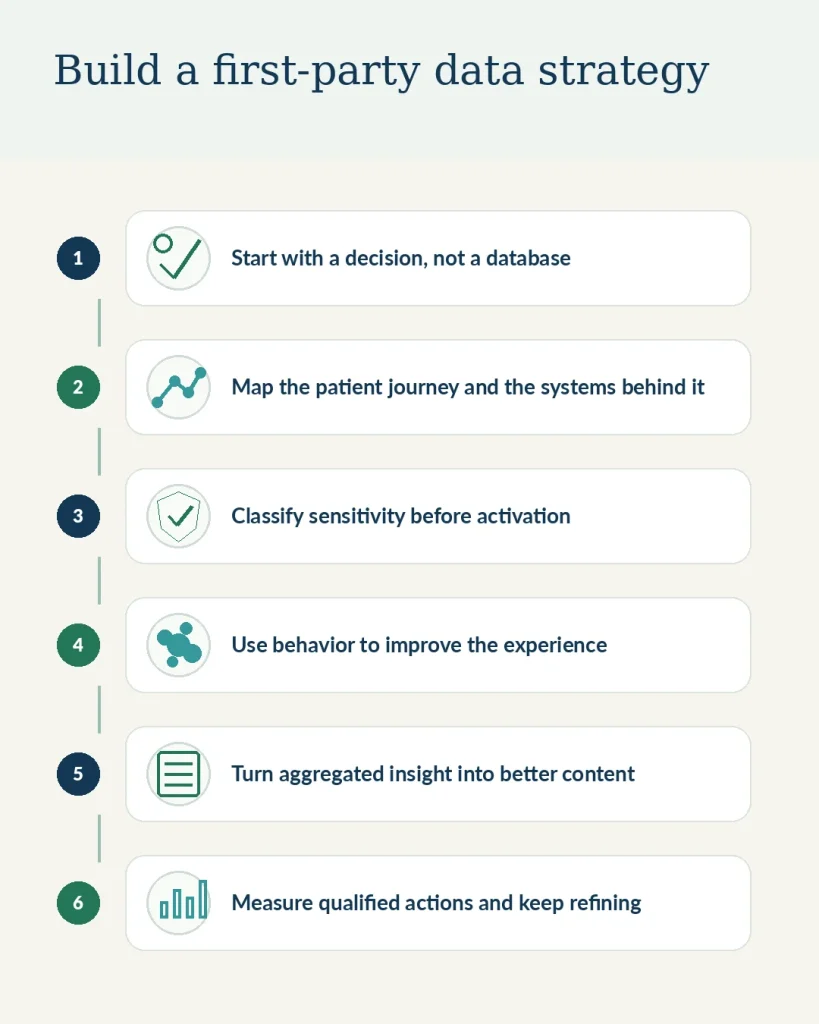
Creating a strategy is a process that requires hitting multiple checkpoints, including:
-
Start with a decision, not a database
Define the question you are trying to answer. Maybe a service page gets traffic but few inquiries. A clear question tells you which data matters. It also shows which data is digital clutter.
-
Map the patient journey and the systems behind it
List where people interact with your brand. That may include search, social, your website, call center, forms and follow-up. Identify which systems collect data at each point. Then identify who owns them.
A disconnected patient journey often creates disconnected reporting. Mapping both helps your team see where context gets lost.
-
Classify sensitivity before activation
Separate general marketing signals from information that could identify a person. Pay special attention to data that may reveal health interests, care-seeking behavior or clinical information. Bring privacy, legal and security stakeholders into the review before moving data between systems or platforms.
-
Use behavior to improve the experience
First-party behavior is useful when it helps you fix the experience people already have. Heatmaps, navigation paths, form completion and page engagement can help identify where users may hesitate or where the next step is unclear. They can also show where the next step is unclear.
Behavioral data becomes much more useful when it helps your team understand the experience behind the numbers.
“Heatmapping and user journey analysis help show how real users interact with your site.”
— Kelly Burgess, BURG+CO. Marketing’s founder, CEO and a certified SEO specialist
Use that insight to test clearer page structure, better calls to action or more useful information. Keep the improvement focused on the user’s task. You do not need the biggest possible profile.
-
Turn aggregated insight into better content
First-party data can make content marketing smarter without making content creepy. Search queries, site-search terms, call themes, FAQ engagement and page paths can reveal recurring questions. They can also surface content gaps.
For SEO, AEO and GEO, the opportunity is not to feed identifiable patient information into an AI tool. Use appropriately aggregated insight to find recurring questions. Then publish clear, structured and trustworthy answers.
That can inform:
- Service-page explanations — Clarify details people need before a next step
- FAQ content — Answer recurring questions in plain language
- Location content — Address market-specific needs without thin duplicate pages
- Educational articles — Build deeper resources around complex questions
- Video topics — Turn high-interest questions into accessible expert explanations
-
Measure qualified actions and keep refining
A first-party data strategy should help you make decisions, not simply produce dashboards. Choose measures that match the job of each page or campaign.
A data-driven content strategy might review relevant search visibility and engagement with key information. It can also track movement toward appropriate next steps. A conversion page may need closer review of qualified calls, forms or appointment requests.
Retire fields nobody uses. Fix broken handoffs. Update definitions when services, markets or patient needs change.
Make reporting useful enough to act on
Good first-party data can still fail inside a bad reporting process. Teams need shared definitions and clear ownership. They also need enough context to understand why a number changed.
A client described the value of transparent reporting and collaborative decision-making this way:
“We partnered with Burg & Co for about two years, and they were an outstanding team to work with from start to finish. One of the things we appreciated most was how clear and actionable their reporting was — it made it easy for us to understand performance, track progress, and make informed decisions. Whenever we needed additional clarification, they were always responsive and took the time to explain things in a way that made sense for our team. Beyond their technical expertise, what really set them apart was their approach as a partner. They were genuinely invested in our success, brought thoughtful recommendations to the table, and consistently made us feel supported. It never felt like we were just another client — they truly operated as a trusted extension of our marketing team.”
— Katarina McDoom, Recruitment & Marketing Specialist at Forever Fit Physical Therapy & Wellness
That experience is one client’s perspective, not a promise of typical results. It shows why data becomes more useful when people can understand it. Teams also need room to question it and connect it to decisions.
BURG+CO. Marketing helps healthcare organizations connect analytics, content, website experience and search strategy around the full patient journey. If your data is scattered across dashboards, your team may be unsure what to prioritize.
Discover the difference a strategic digital marketing partner can make. Schedule your complimentary consultation with BURG+CO. now.
FAQs about first-party data
What is first-party data in healthcare marketing?
First-party data is information a healthcare organization collects directly through channels it owns or manages. Examples can include website interactions, inquiry sources, email engagement, CRM activity and information people choose to provide.
How is first-party data different from zero-party data?
Zero-party data is information someone intentionally gives your organization, such as a stated preference or survey response. First-party data is broader. It can include both volunteered information and behavior observed through direct interactions with your organization.
Is first-party data automatically HIPAA compliant?
No. “First-party” describes the source of the data, not its compliance status. Healthcare organizations should consider what the information contains, how it is collected, who can access it, where it is shared and which legal or platform requirements apply.
What first-party data should healthcare marketers prioritize?
Start with data tied to a clear decision. Website behavior, inquiry sources, content engagement and communication preferences may all be useful when they answer a defined marketing question. Collecting more information simply because you can usually creates more noise.
How can first-party data support SEO, AEO and GEO?
Aggregated first-party insights can reveal recurring questions, confusing pages and information people seek before taking a next step. Those patterns can guide clearer service pages, FAQs, articles and videos that are easier for people and search or answer systems to understand.
What is a first-party data strategy?
A first-party data strategy defines how an organization collects, governs, connects, uses and measures information gathered directly from its audiences. A useful strategy starts with business and audience needs rather than with a specific tool.
Can healthcare organizations use first-party data for advertising?
Sometimes, but the answer depends on the data, intended use, applicable law and advertising platform. Health-related advertising often carries extra restrictions, so marketing teams should review audience activation plans with appropriate privacy, legal and compliance stakeholders.
Do healthcare marketers need a customer data platform to use first-party data?
Not necessarily. Many organizations can begin by mapping the data already available in analytics, CRM, email and website systems. A new platform should solve a defined problem rather than become an expensive place to store more disconnected information.
How often should a first-party data strategy be reviewed?
Review it regularly and whenever meaningful changes occur. New vendors, services, locations, tracking tools, privacy requirements or marketing channels can change how data should be collected and used.
What is the biggest first-party data mistake healthcare marketers should avoid?
Do not assume directly collected data is automatically safe to use everywhere. Start with purpose, sensitivity and permissions. Then decide whether using the information will genuinely make the patient or audience experience more useful.