

When you think about major contributors to climate change, your first thought probably isn’t your healthcare practice. But here’s the kicker: the healthcare industry is responsible for between 4.4% and 5.2% of global emissions. That’s more than aviation, which is responsible for between 2% and 5% of global emissions.
As a practice owner, healthcare organization CEO or marketing leader, that stat should catch your attention. Sustainability isn’t just a trendy buzzword anymore — it’s becoming a foundational element of how patients evaluate, choose and trust their healthcare providers. And spoiler alert: sustainability is just as much about long-term profitability and brand strength as it is about saving the planet.
Here’s something else to consider: the U.S. healthcare system alone produces over 5 million tons of waste every year. That’s a staggering figure, and it’s only growing. As people who are trusted to care for others, isn’t it time we looked at how that care extends beyond exam rooms and into the environment?
Let’s dive into what sustainability in healthcare actually means, why it matters more than ever, and how you can make it a core part of your marketing strategy — without sacrificing ROI.
What does sustainability in healthcare really mean?
Sustainability isn’t just swapping out paper towels for hand dryers and calling it a day. In healthcare, sustainability touches everything from clinical operations to patient communications to supply chains.
There are three key pillars to think about:
-
Environmental sustainability
How does your practice reduce waste, conserve energy and limit pollution? Think solar panels on clinic roofs, reusable surgical tools or eliminating single-use plastics in waiting rooms.
-
Social sustainability
Are you creating a supportive, inclusive environment for staff and patients alike? This includes DEI hiring practices, investing in community health education, and providing equitable access to care.
-
Economic sustainability
Are your practices financially viable long-term while reducing unnecessary costs? For example, you could look into bulk purchasing eco-friendly materials or automating energy usage through smart technology.
Sustainable healthcare means aligning these pillars with exceptional patient care. When done right, sustainability doesn’t hinder clinical quality — it enhances it. It can even help meet regulatory benchmarks like:
- LEED certification — This certification focuses on sustainable building design and energy efficiency.
- ISO environmental standards — These standards guide organizations in managing their environmental responsibilities.
The business case for going green
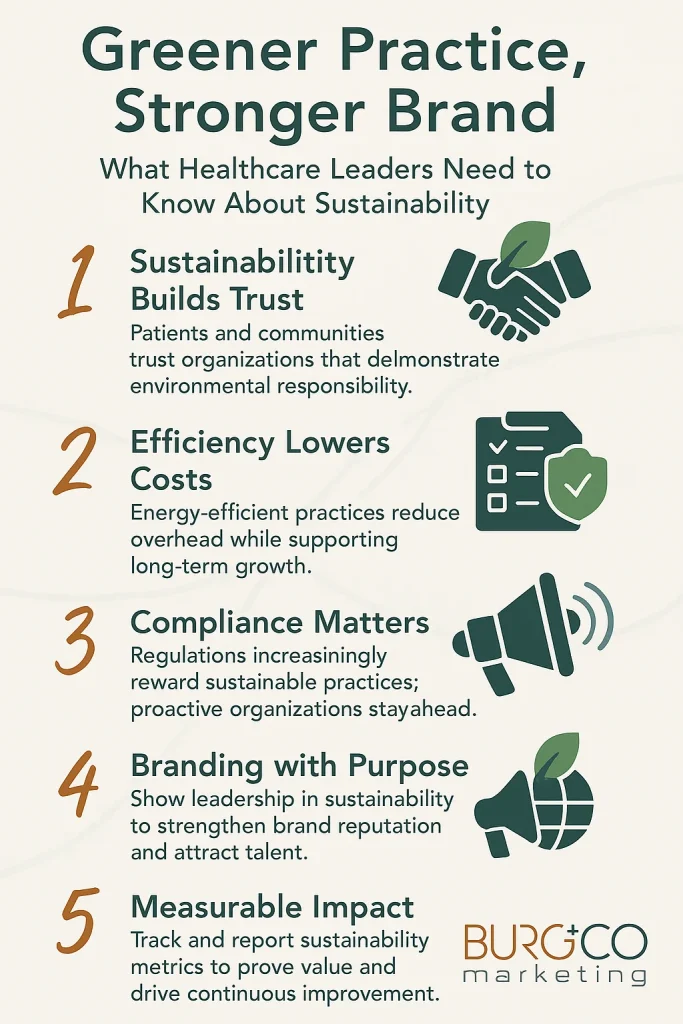
Let’s address the elephant in the waiting room: sustainability isn’t just the right thing to do — it’s a smart business move.
Here’s why:
-
Patient preferences are shifting.
Millennials and Gen Z are more likely to support businesses (yes, including healthcare providers) that take sustainability seriously.
-
Public perception matters.
One study found that 94% of patients consider a hospital’s sustainability program to be important.
-
Cost savings are real.
From energy-efficient lighting to digital intake forms, reducing waste can mean reducing overhead.
-
It sets you apart.
In a saturated healthcare market, showcasing your sustainability efforts gives your brand a compelling point of differentiation.
Reports from organizations like Energy Star show that eco-conscious operations correlate with increased patient trust and long-term savings. For instance, Energy Star reports that a typical hospital could reduce their energy usage by 30% by following best energy efficiency practices and upgrading to more energy-efficient equipment.
And let’s not forget risk management. Climate change is already affecting healthcare facilities — think wildfires, floods or heat waves disrupting power supplies. Investing in sustainability is also investing in resilience.
Let’s break it down. Imagine your clinic spends $20,000 annually on electricity. Switching to LED lighting and solar panels could reduce that by 30% over three years. That’s $6,000 saved — money that can be reinvested in staff, technology or patient services.
Bottom line: going green can lead to stronger patient loyalty, reduced costs and more visibility on search engine results pages (SERPs).
Real examples of sustainable healthcare practices
There are certain challenges that sustainable healthcare practices are trying to address. Not sure where to start addressing these challenges? Here are some proven, real-world strategies your practice can adopt:
- Ditch the paper: Switch to digital forms, patient portals and e-prescriptions. Not only is it greener — it’s more efficient.
- Retrofit your space: Invest in energy-efficient HVAC systems, LED lighting or low-flow plumbing.
- Choose green suppliers: Look for vendors that use biodegradable packaging or have carbon-neutral certifications.
- Leverage telehealth: Virtual visits mean fewer commutes, lower emissions and more convenience for everyone.
Look at Kaiser Permanente: they became the first U.S. healthcare system to achieve carbon neutrality, investing in renewable energy and redesigning supply chains. Their efforts show that scale doesn’t have to be a barrier — it can be a driver.
Green building certifications and facility design
Another area of sustainability is the built environment. Practices can pursue certifications like LEED (Leadership in Energy and Environmental Design) or follow WELL building standards, which prioritize indoor air quality, natural lighting and energy efficiency.
Even smaller design changes, like using low-VOC paints or energy-efficient appliances, can enhance both environmental impact and patient comfort. Sustainable design isn’t just for new builds. Retrofits and renovations can qualify too.
Sustainability and your brand’s story
Patients want to feel good about who they’re trusting with their health — and that includes trusting your values. Sustainability, when authentically embraced, becomes a powerful part of your brand narrative.
You’re not just a healthcare provider. You’re an organization that cares about the health of your community and the planet.
Here’s how to weave that into your story:
- Feature your sustainability efforts in your mission statement and About page
- Create content that highlights real changes (e.g., “How we reduced our paper waste by 40%”)
- Train your team to communicate your eco-friendly initiatives to patients confidently and consistently
Showcasing this commitment helps build emotional trust. And emotional trust is often what turns one-time patients into lifelong advocates.
Marketing strategies that highlight your commitment
Now let’s talk strategy. Sustainability is a great value — but it’s also a powerful marketing lever.
Here’s how to market your green side without going overboard:
-
Build SEUO content.
Create blogs, landing pages and service descriptions that are search engine and user optimized around topics like “sustainable healthcare near me” or “eco-friendly dental offices.”
-
Optimize your Google Business Profile.
Highlight sustainability certifications or efforts in your business description and posts.
-
Use social media for storytelling.
Behind-the-scenes reels, before-and-after photos and stats about your environmental impact create engagement and trust.
-
Be transparent.
Authenticity matters. Avoid greenwashing (exaggerating your sustainability efforts), and instead focus on tangible changes, no matter how small.
-
Repurpose content.
Turn your green initiatives into email campaigns, waiting room posters or videos on your homepage.
Need content ideas? You can use topics like these as a starting point:
- Top 5 ways we’re reducing waste in our practice
- Why we made the switch to digital intake forms
- Meet our eco-conscious partners and vendors
How to talk about sustainability with stakeholders
Implementing sustainability often requires buy-in from leadership, staff and even patients. Here’s how to engage each group:
-
Executives and board members:
Frame sustainability as both a brand and financial investment. Share projections, case studies and patient trend data to demonstrate long-term ROI.
-
Staff:
Provide training on your green goals and how they impact day-to-day work. Create champions within your team who can lead by example.
-
Patients:
Use newsletters and appointment reminders to highlight your sustainability wins. Let them know their choice of provider is making a difference.
Clear, value-based communication turns sustainability from an internal initiative into a shared mission.
Metrics that matter: Measuring success
Sustainability isn’t fluff — it can be tracked and tied to real results.
Here are some KPIs to consider:
- Engagement: Are your sustainability posts getting more traction?
- Conversions: Are users landing on your green-related content and taking action (e.g., booking an appointment)?
- Patient sentiment: Track reviews and feedback that mention your environmental efforts.
- Operational metrics: Are your utilities, supply costs or waste removal expenses going down?
Want to go deeper? Use tools like Energy Star Portfolio Manager or Practice Greenhealth’s Greenhouse Gas Reduction tool kit to assess environmental performance. Set quarterly goals and monitor how changes affect cost savings and brand engagement.
A great benchmark: practices that implement energy-saving technologies often see a reduction in annual utility bills. For example the Cleveland Clinic’s 2021 Sustainability Report estimated that the organization’s sustainability initiatives resulted in more than $537,000 in annual utility cost savings.
Sustainability also contributes to long-term brand equity. Practices that consistently highlight eco-friendly initiatives tend to see higher Net Promoter Scores (NPS) and better community trust.
If you’re tracking brand performance, consider adding press mentions, backlinks from sustainability features or local awards to your list of KPIs. These serve both your public relations and your SEO strategy.
Getting started: Steps your practice or organization can take now
Feeling motivated? Good. Here’s how to move forward:
- Audit your current operations. Where are you wasting the most resources?
- Engage your team. Host a meeting to brainstorm green initiatives and get staff buy-in.
- Start small. Choose 1-2 impactful changes to implement this quarter.
- Tell the story. Let your patients know what you’re doing and why it matters.
Other quick-start ideas:
- Partner with a local recycling service for medical plastics
- Add a sustainability pledge page to your website
- Set up a “green suggestion box” for staff input
Remember: Progress over perfection. Even small steps make a difference.
Frequently asked questions about sustainability in healthcare
Isn’t going green expensive?
Not always. Many initiatives, like switching to digital paperwork or installing LED lights, have up-front costs but result in long-term savings. Grants and tax credits can also offset investment.
Do patients really care about this?
Yes. Surveys consistently show that younger generations and urban patients prefer eco-conscious providers. It signals modernity, empathy and community alignment.
What if we’re not ready for big changes?
That’s OK. Sustainability is a journey, not a flip of a switch. Even small steps, like switching from disposable to reusable exam gowns, contribute to a bigger impact.
Why sustainability in healthcare matters more than ever
Healthcare doesn’t exist in a vacuum. As climate change accelerates and regulations tighten, sustainability is quickly becoming an industry standard — not an optional add-on.
Practices that adapt early won’t just survive — they’ll lead.
Quote to consider: “The most effective sustainability strategies are those that permeate all parts of an organisation and feel relevant to everyone, albeit in different ways,” she says. “Sustainability isn’t a tick-box exercise. True sustainability is about deep transformation; it is often about culture change.” — Dr. Sally Uren, CEO Forum for the Future
With pending incentives from CMS and state governments for green upgrades, now is the perfect time to act. Building codes, reimbursement policies and patient expectations are evolving fast.
Position your brand as a trusted, forward-thinking healthcare provider. Show your community and the people in your organization that you’re not only invested in their health, but in the health of the planet they live on.
Ready to make sustainability part of your healthcare brand’s search engine optimization (SEO) and content marketing strategy?
Discover the difference a strategic digital marketing partner can make. Schedule your complimentary consultation with BURG+CO. now.