
For a growing healthcare organization, search engine optimization gets harder when a brand spans multiple locations, service lines, teams or digital properties. At that point, the SEO program has to work as a coordinated system — not a collection of one-off tasks. That is where enterprise SEO becomes relevant.
Enterprise SEO uses the same core principles as traditional SEO. The difference is scale. Enterprise programs must also account for governance, cross-functional workflows, complex site architecture and the risk that one decision can affect many pages at once.
A multi-location practice, health system or growing behavioral health organization may outgrow a traditional SEO process before the team calls it “enterprise.” Understanding the differences can help leaders choose the right operating model.
What is enterprise SEO?
Enterprise SEO is search engine optimization built for complex websites, large content ecosystems and multiple stakeholders. It is less about company size than the operational complexity behind search performance.
Enterprise SEO is an approach built for the scale, complexity and operational needs of large organizations. In practice, recommendations may move through marketing, content, web development, compliance or leadership before they go live.
That coordination is especially important in healthcare, where accuracy, brand consistency and patient trust matter as much as publishing speed.
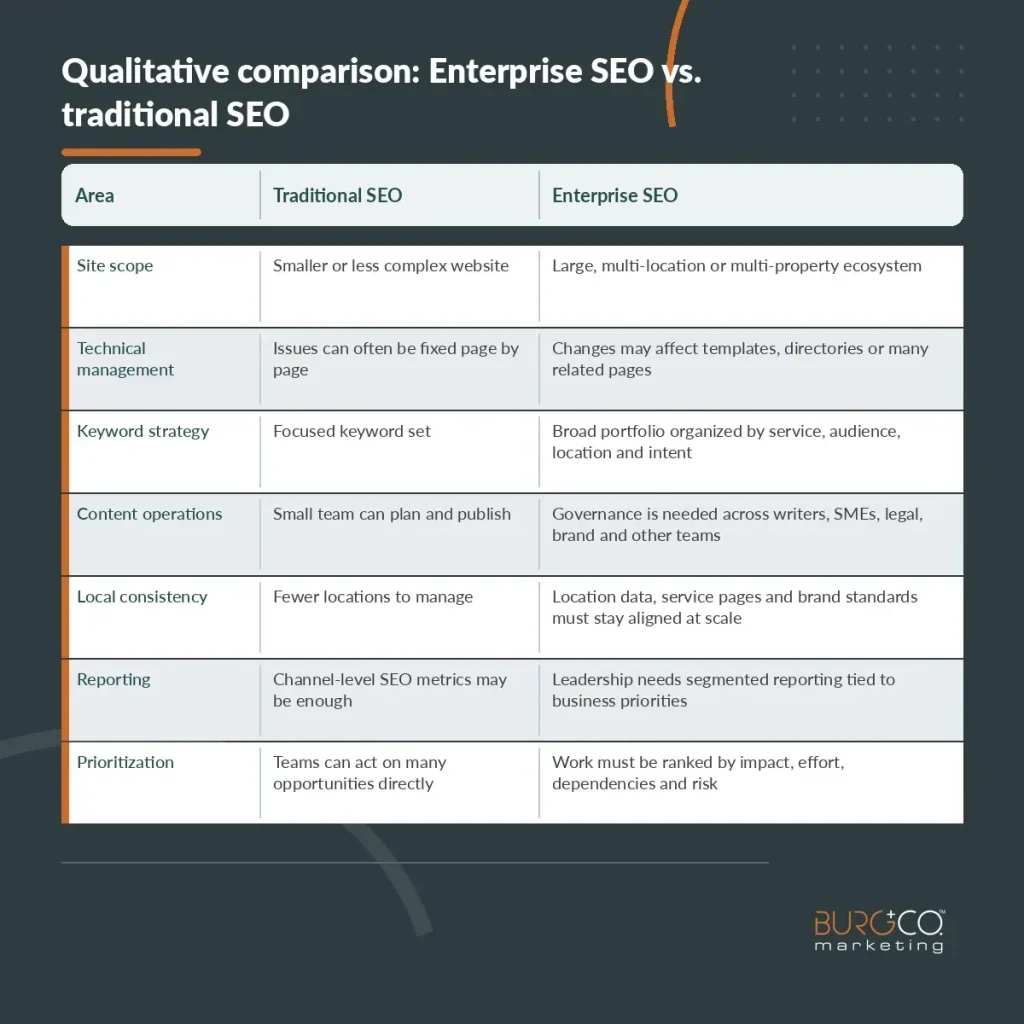
Qualitative comparison: Enterprise SEO vs. traditional SEO
Enterprise SEO is not a different search algorithm. It is a different way to organize the people, technology and decisions behind search visibility.
Here are seven differences between the two SEO approaches:
1. Enterprise SEO manages a more complex site architecture
Traditional SEO may involve a relatively simple hierarchy. Enterprise SEO has to manage relationships among service pages, location pages, provider profiles, resources and other content types.
For healthcare brands, those relationships must be clear to people and search engines. A patient should move naturally from a condition page to a relevant service and nearby location. Search engines also need crawlable links and a logical structure.
As organizations grow, site architecture becomes an SEO concern, not just a web-development concern.
2. Technical SEO carries more systemic risk
On a smaller site, one broken canonical tag or redirect may affect a few pages. In an enterprise environment, a template-level problem can spread across an entire section.
Technical SEO therefore depends on repeatable controls. Teams may need standards for redirects, canonical tags, XML sitemaps, robots directives, structured data and page templates, plus monitoring that spots patterns early.
Google’s large-site crawl guidance shows why crawl efficiency, URL inventory and duplicate-content controls matter more as websites grow.
Scalable content systems can help when automation is paired with human quality control.
3. Keyword strategy becomes portfolio management
Traditional SEO often starts with a manageable group of priority keywords. Enterprise SEO needs a broader view because audiences, services, locations and stages of the patient journey may each require distinct search targets.
Without governance, teams can compete against themselves. Departments may publish similar pages for the same intent, while locations or acquired brands introduce overlapping topics without a clear hierarchy.
Enterprise teams need keyword ownership, topic mapping and rules for when to create, consolidate or update content. Keyword research becomes portfolio management rather than a hunt for isolated opportunities.
4. Content requires stronger governance
Enterprise SEO cannot rely on teams publishing independently and hoping the pieces align later. Healthcare organizations need content standards that support consistent decisions.
Standards may cover brand voice, service naming, page structure, SME review, metadata, internal linking and claims. The goal is not identical pages. It is accurate, useful content aligned with the larger search strategy.
Good governance helps teams scale without turning healthcare information into repetitive template copy.
5. Collaboration becomes part of the SEO process
Traditional SEO can often move through a small team. Enterprise SEO usually depends on stakeholders with different priorities.
A technical recommendation may require engineering, while a service-page update may need clinical review. The SEO team must translate recommendations into clear business priorities and workflows other teams can follow.
One BURG+CO. client described that collaborative working relationship this way:
“Working with Burg & Co. Marketing has been a pleasure. [The team] has been very forthcoming with advice on how to improve our web presence and has been helping us get a better grasp on building our brand awareness in our local area. They view themselves as an extension of our own office and will help out our existing employees to take over certain aspects of our online marketing when the time is right. I would definitely recommend their services.”
— Amit Gaglani, Owner, Arrow Physical Therapy
That individual experience does not promise the same outcome for every organization. It illustrates why enterprise SEO depends on cross-functional collaboration.
6. Measurement has to connect search to business priorities
Traditional SEO reporting may focus on rankings, traffic and conversions. Enterprise leaders usually need more context.
Healthcare leaders may need performance segmented by service line, location, market, audience or patient-journey stage. They also need to distinguish visibility gains from meaningful business movement.
A useful enterprise dashboard should show where search creates demand, where users get stuck and which opportunities deserve resources next — without burying leaders in every available metric.
Search performance has more value when teams understand what happens after someone reaches the site.
7. Prioritization matters more than the size of the task list
Enterprise SEO teams usually have plenty of ideas. The challenge is deciding what gets done first.
A large audit can surface technical fixes, content gaps, internal-link opportunities and new keyword targets at once. Pursuing everything creates bottlenecks. A stronger approach ranks work by likely impact, effort, dependencies, risk and business alignment.
A small change to a high-value template may deserve attention before a major rewrite. Teams also need to revisit priorities as search behavior, goals and site conditions change. This is one reason enterprise SEO works best as an operating system, not a quarterly checklist.
This qualitative comparison shows the operating differences at a glance.
| Area | Traditional SEO | Enterprise SEO |
|---|---|---|
| Site scope | Smaller or less complex website | Large, multi-location or multi-property ecosystem |
| Technical management | Issues can often be fixed page by page | Changes may affect templates, directories or many related pages |
| Keyword strategy | Focused keyword set | Broad portfolio organized by service, audience, location and intent |
| Content operations | Small team can plan and publish | Governance is needed across writers, SMEs, legal, brand and other teams |
| Local consistency | Fewer locations to manage | Location data, service pages and brand standards must stay aligned at scale |
| Reporting | Channel-level SEO metrics may be enough | Leadership needs segmented reporting tied to business priorities |
| Prioritization | Teams can act on many opportunities directly | Work must be ranked by impact, effort, dependencies and risk |
When should a healthcare organization consider enterprise SEO services?
You may need enterprise SEO services when organizational complexity starts slowing down sound SEO work. Common signals include:
- Multiple locations, brands or service lines competing for the same search visibility
- Large content libraries with inconsistent standards or duplicate topics
- SEO recommendations that regularly depend on engineering, legal, compliance or clinical review
- Difficulty connecting search performance to location-level or service-line priorities
- Frequent site changes that create technical risk across many pages
- A growing backlog of SEO opportunities with no shared prioritization process
The goal is not an “enterprise” label. It is a process that matches your complexity.
Search is also expanding beyond traditional rankings. Healthcare organizations need content that is clear for patients and structured for search and AI-driven discovery.
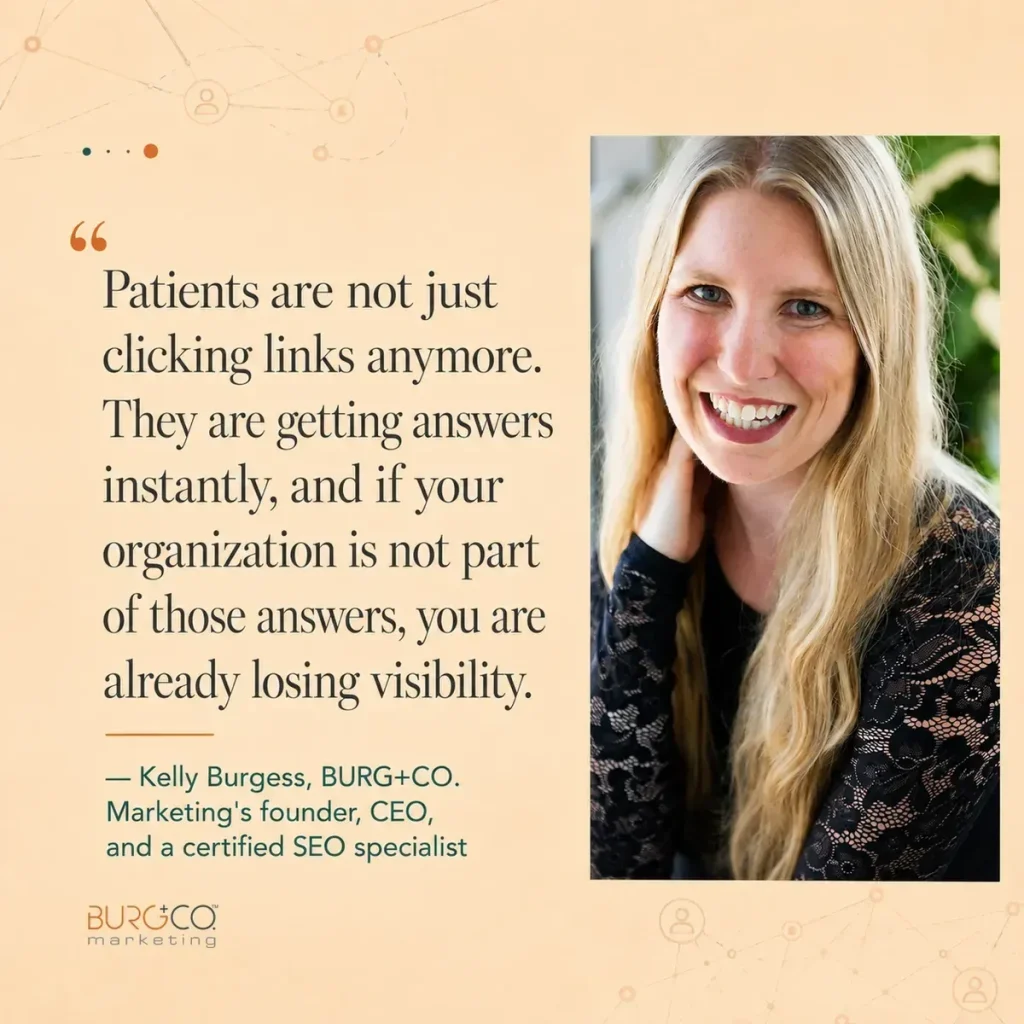
A relevant BURG+CO. perspective captures that shift:
“Patients are not just clicking links anymore. They are getting answers instantly, and if your organization is not part of those answers, you are already losing visibility.”
— Kelly Burgess, BURG+CO. Marketing’s founder, CEO and a certified SEO specialist
For marketing leaders, the takeaway is practical: enterprise SEO should make your search program easier to govern, easier to measure and easier to scale without losing quality.
BURG+CO. Marketing helps healthcare organizations connect SEO strategy, content and site experience to broader business goals. If your SEO process is getting harder to manage as you grow, it may be time for a more scalable system.
Discover the difference a strategic digital marketing partner can make. Schedule your complimentary consultation with BURG+CO. now.
FAQs about enterprise SEO
What is the biggest difference between enterprise SEO and traditional SEO?
The biggest difference is operational complexity. Enterprise SEO must coordinate technical, content and reporting decisions across larger websites, more stakeholders and more dependencies.
Does enterprise SEO use different ranking factors?
No. Enterprise SEO follows the same search fundamentals. The difference is how teams organize, implement and monitor those fundamentals across a more complex digital ecosystem.
Why is technical SEO more important for enterprise websites?
Technical issues can spread across templates, directories or large groups of pages. Strong controls and monitoring help teams catch systemic problems before they affect more of the site.
How does content governance support enterprise SEO?
Content governance creates shared standards for quality, brand voice, page structure, claims, reviews and internal linking. It helps different teams publish consistently without creating unnecessary duplication.
How should enterprise SEO teams prioritize work?
Teams should weigh likely impact, effort, dependencies, risk and business alignment. The highest-value opportunity is not always the biggest project.
Is enterprise SEO only for very large companies?
No. A growing healthcare organization may need an enterprise approach whenever site complexity, multiple locations or cross-functional workflows make traditional SEO processes difficult to manage.
Can enterprise SEO support multi-location healthcare marketing?
Yes. It can help teams create consistent location structures, keyword ownership, internal-linking rules and reporting while still allowing useful local differences.
What should enterprise SEO services include?
They may include technical strategy, keyword research, content governance, site architecture guidance, reporting, workflow design and ongoing prioritization. The mix should reflect the organization’s actual needs.
How long does enterprise SEO take to work?
There is no universal timeline. Results depend on site health, competition, implementation speed, content quality and how quickly teams can act on recommendations.
How do you choose an enterprise SEO partner for healthcare?
Look for a partner that understands healthcare, explains recommendations clearly, works well across internal teams and connects search work to meaningful business goals without promising guaranteed rankings.