
Digital marketing for clinics works best when it does more than chase clicks. For healthcare providers, the goal is to help real people find clear answers, understand their options and feel confident taking the next step toward care.
That means your clinic’s marketing should be visible, useful and respectful. No scare tactics or vague promises. Just clear information and a strategy that helps the right people reach the right care.
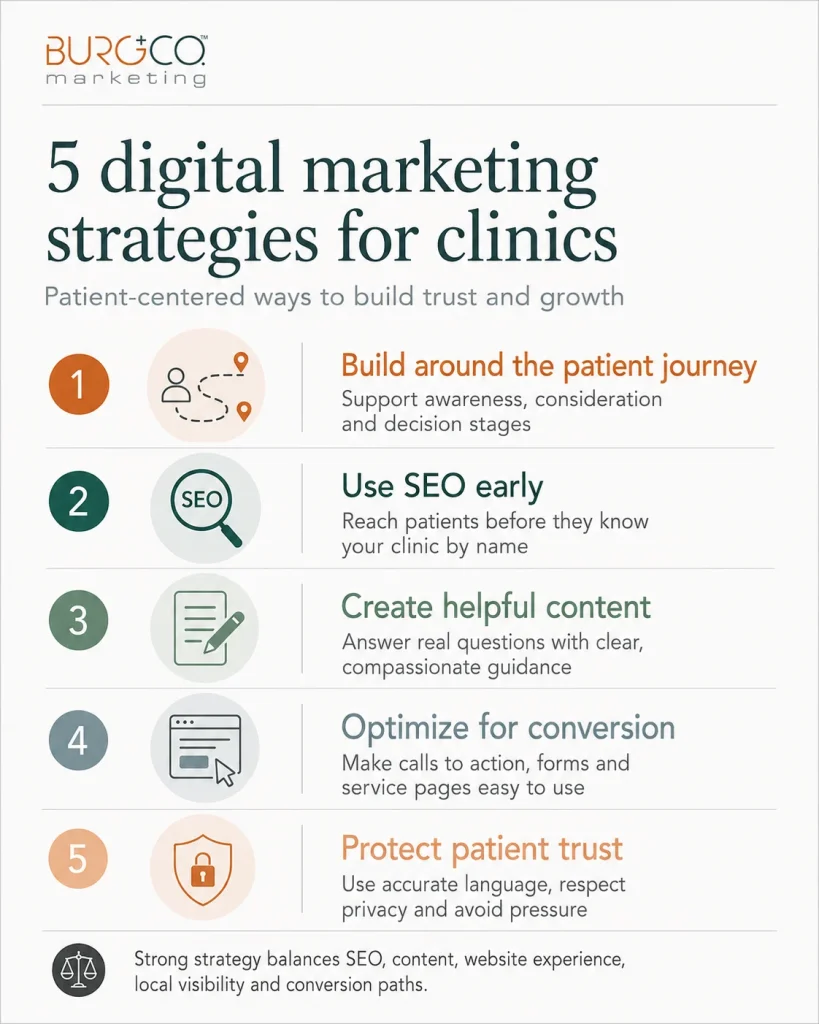
Let’s take a look at five ways clinics can build a stronger digital marketing strategy without losing the human part:
-
Build your strategy around the patient journey
Patients rarely wake up and choose a clinic in one click. They may search symptoms, compare providers, read reviews, ask family members, revisit your website and then finally call or fill out a form.
Your strategy should support that full path.
That may include:
- Awareness content — Helps patients understand symptoms, services or treatment options
- Decision-stage pages — Explains why your clinic may be the right fit
- Location pages — Helps nearby patients find relevant care
- Provider content — Builds trust through expertise and familiarity
- Calls to action — Guides patients toward scheduling, calling or learning more
The key is to give patients an easy journey to what they’re looking for. If someone lands on your website with a question, your content should answer it and make the next step easy to find.
-
Use SEO to reach patients before they know your clinic by name
A patient may not search for your exact clinic first. They may search for “physical therapy near me” or “anxiety therapist accepting new patients.”
That is where SEO comes in.
SEO helps your clinic show up for service-related, location-based and question-based searches. It can support:
- Service pages
- Condition pages
- Blog articles
- Location pages
- Google Business Profile visibility
- AI-generated search answers
For clinics, keyword strategy should focus on intent. A keyword with high search volume isn’t automatically valuable. The better question is whether that search connects to a real patient need and a real service your clinic provides.
-
Create content that helps patients feel informed
For clinics, strong content answers the questions patients are already asking. It can help them understand what a service involves, what symptoms may mean, when to seek help and what they can expect from care.
Good clinic content should be:
- Clear — Avoids unnecessary jargon
- Helpful — Answers real patient questions
- Compassionate — Recognizes that healthcare decisions can feel stressful
- Search-informed — Reflects how patients actually look for care
- Conversion-aware — Makes the next step easy without being pushy
Google’s own guidance emphasizes helpful, reliable, people-first content. For healthcare clinics, that aligns with what patients need anyway: answers they can understand and trust.
A strong content strategy should also be structured for AI platforms. ChatGPT, Gemini and AI-powered search tools tend to favor content that is clear, complete and easy to summarize. That means using direct answers, descriptive headings, natural questions and accurate explanations.
-
Optimize for conversion without pressuring patients
Conversion strategy in healthcare should feel like guidance, not pressure.
A patient shouldn’t have to hunt for a phone number. They shouldn’t have to decode what service fits their concern. They should not have to click through five pages to request an appointment.
Small improvements can make a big difference, such as:
- Placing calls to action near key decision points
- Making forms shorter and easier to complete
- Adding clear service summaries
- Connecting blog content to relevant service pages
- Showing location details early
- Reducing distractions on important pages
This is where thoughtful measurement matters. One BURG+CO. client shared how better visibility and reporting supported their experience with the team:
“We partnered with Burg & Co for about two years, and they were an outstanding team to work with from start to finish. One of the things we appreciated most was how clear and actionable their reporting was — it made it easy for us to understand performance, track progress, and make informed decisions. Whenever we needed additional clarification, they were always responsive and took the time to explain things in a way that made sense for our team. Beyond their technical expertise, what really set them apart was their approach as a partner. They were genuinely invested in our success, brought thoughtful recommendations to the table, and consistently made us feel supported. It never felt like we were just another client — they truly operated as a trusted extension of our marketing team.”
— Katarina McDoom, Recruitment & Marketing Specialist at Forever Fit Physical Therapy & Wellness
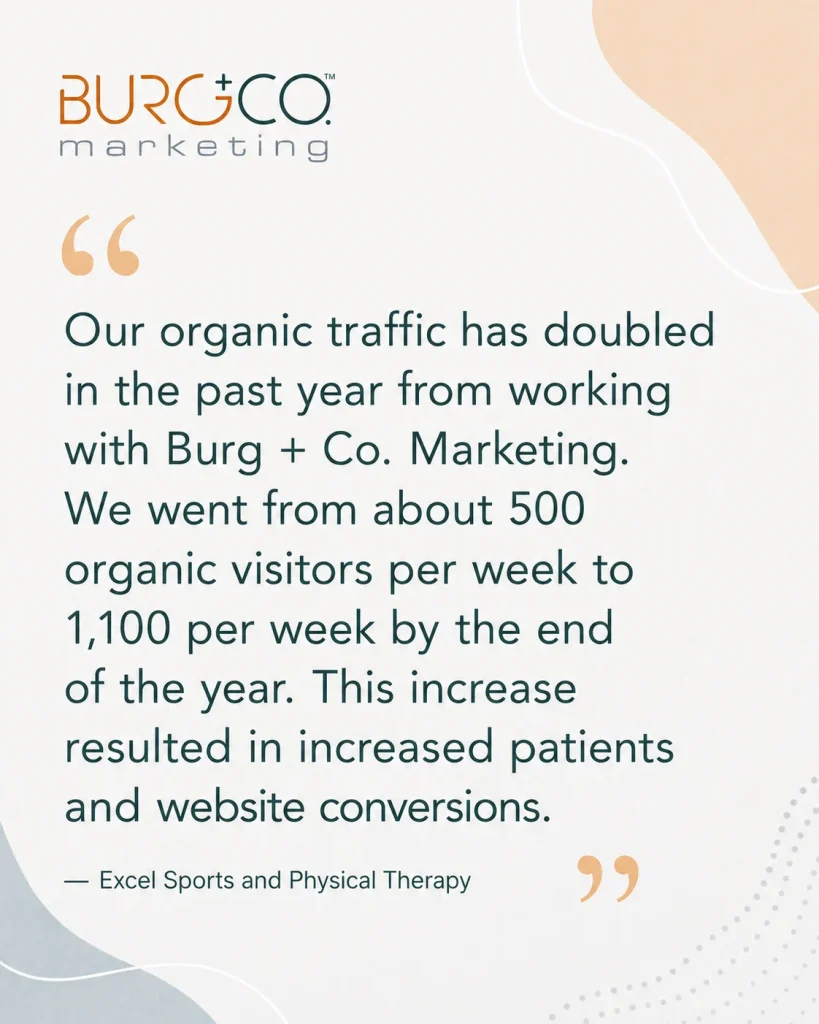
That kind of partnership matters because clinic marketing isn’t just about dashboards. It’s about helping teams understand what’s working and why.
-
Respect patient trust at every touchpoint
Healthcare marketing has to carry a different level of responsibility. Patients may be anxious, overwhelmed or making decisions for a loved one. That means your message should be accurate, ethical and careful with privacy.
Your clinic’s marketing should avoid:
- Fear-based language
- Guaranteed outcomes
- Overly broad claims
- Confusing medical explanations
- Patient stories used without proper permission
- Content that sounds more urgent than the situation supports
HIPAA privacy standards are one reason healthcare organizations must be thoughtful about how patient information is used and shared.
Patient trust isn’t built in one dramatic moment. It’s built through many small signals: accurate copy, accessible design, useful content, clear next steps and respectful language.
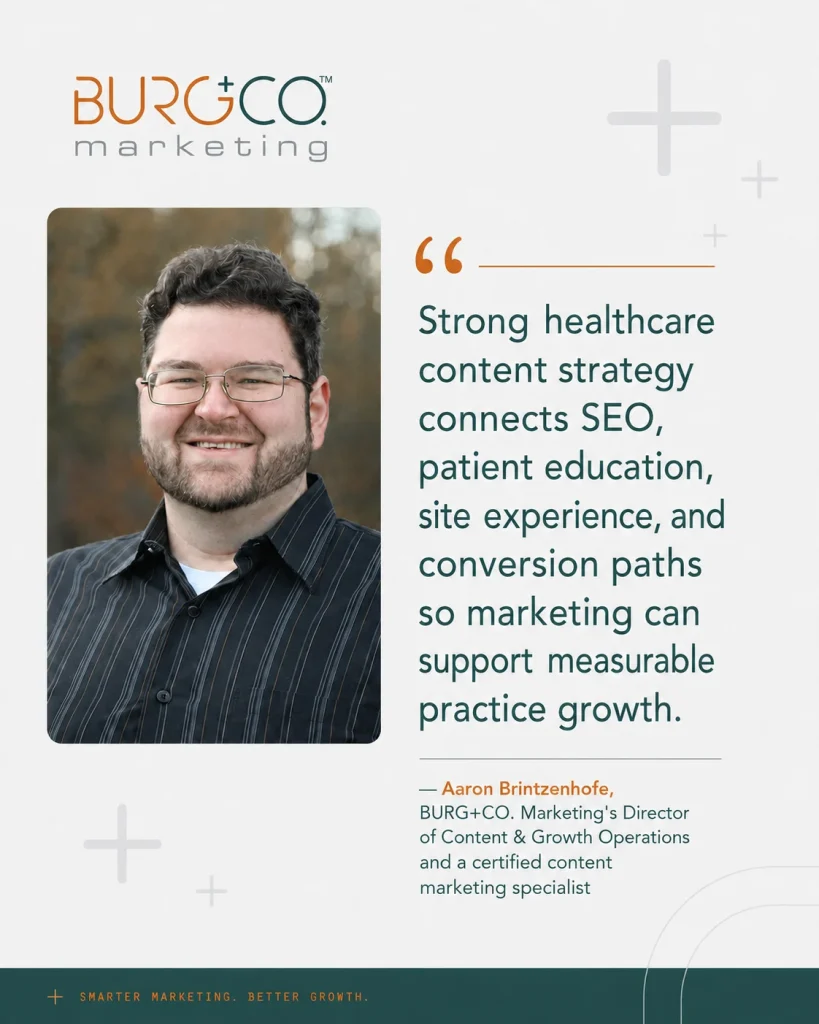
One BURG+CO. expert explains the broader role content plays in that trust-building process:
“Strong healthcare content strategy connects SEO, patient education, site experience, and conversion paths so marketing can support measurable practice growth.”
— Aaron Brintzenhofe, BURG+CO. Marketing’s Director of Content & Growth Operations and a certified content marketing specialist
Here is a simple way to think about the pieces of a clinic’s digital strategy.
| Strategy piece | What it helps patients do | What it helps clinics improve |
| SEO | Find relevant care through search | Visibility for high-intent searches |
| Content marketing | Understand symptoms, services and next steps | Trust, education and search presence |
| Website design | Navigate care options more easily | User experience and form engagement |
| Conversion strategy | Know how to take the next step | Calls, forms and appointment requests |
| Google Business Profile | Confirm location, hours and contact details | Local visibility and patient confidence |
Use this table as a gut check. If one part is weak, the whole journey can feel harder than it needs to.
The best strategies balance SEO, content, website experience, local visibility and conversion paths so every part of the journey works together. If you’re not sure how to implement those strategies, BURG+CO. is here to help.
Book a free consultation with BURG+CO.’s healthcare marketing experts today.
FAQs about digital marketing for clinics
What is digital marketing for clinics?
Digital marketing for clinics is the use of online strategies to help patients find, understand and connect with a clinic. It may include SEO, content marketing, website design, local search, email marketing, paid ads and conversion strategy.
Why does SEO matter for healthcare clinics?
SEO matters because many patients search online before choosing a provider. A strong SEO strategy can help your clinic appear for relevant services, locations and patient questions.
What type of content should clinics create?
Clinics should create content that answers real patient questions. Helpful examples include service pages, condition education, FAQs, location pages, provider bios and blog articles about common concerns.
How can clinics improve website conversions?
Clinics can improve conversions by making the next steps clear. That may include visible phone numbers, simple forms, clear service pages, strong calls to action and fewer distractions on key pages.
Should clinics optimize for AI search tools?
Yes. Patients increasingly use AI tools and AI-powered search features to find answers. Clear, helpful and well-structured content can improve the chances that your clinic is understood and surfaced in those experiences.
How long does digital marketing take to work for clinics?
It depends on the clinic, market, competition and strategy. SEO and content often take time to build momentum, while paid ads can create faster visibility. A balanced strategy usually works best.
What is the difference between traffic and qualified traffic?
Traffic is the number of people visiting your site. Qualified traffic means those visitors are more likely to need your services, live in your service area and take a meaningful next step.
Do clinics need a Google Business Profile?
Most clinics benefit from a Google Business Profile because it helps patients find basic information like location, hours, phone number and reviews. It’s especially important for local search visibility.
How should healthcare clinics talk about patient outcomes in marketing?
Healthcare clinics should avoid guaranteed outcomes or exaggerated claims. Marketing should be accurate, respectful and clear about what the clinic provides without promising specific results.
What makes clinic marketing patient-centered?
Patient-centered marketing starts with the patient’s questions, emotions and decision-making process. It explains care clearly, respects privacy and makes it easier for people to take the next step when they are ready.