

Content personalization helps healthcare and behavioral health brands share more relevant information. It uses signals like what people need, where they are in the decision journey and which next step may actually help. For marketing teams, that can mean building smarter pathways across site content, email and conversion points — without making the experience feel creepy, overengineered or disconnected from real patient needs.
Let’s start with the big question: What is content personalization?
Content personalization is the process of tailoring content based on audience segment, user need, search intent, location, service interest or decision stage. In healthcare marketing, it is not about pushing harder. It is about helping better.
For a behavioral health organization, that might mean showing different content to:
- A parent researching teen treatment options
- An adult comparing therapy providers
- A referring professional looking for program details
- A current patient who needs follow-up resources
- A family member trying to understand insurance or admissions
Same website. Different needs. Different emotional states. Different next steps.
And that is where personalization gets powerful.
Why content personalization matters in healthcare marketing
Healthcare decisions are rarely casual. People may be scared, overwhelmed, privacy-conscious, skeptical, hopeful or all of the above before they ever complete a form.
That is especially true in behavioral health. A person searching for anxiety therapy, addiction treatment, eating disorder support or teen mental health care may need more than a polished landing page. They need clarity. They need trust. They need to feel that your organization understands the human side of the search.
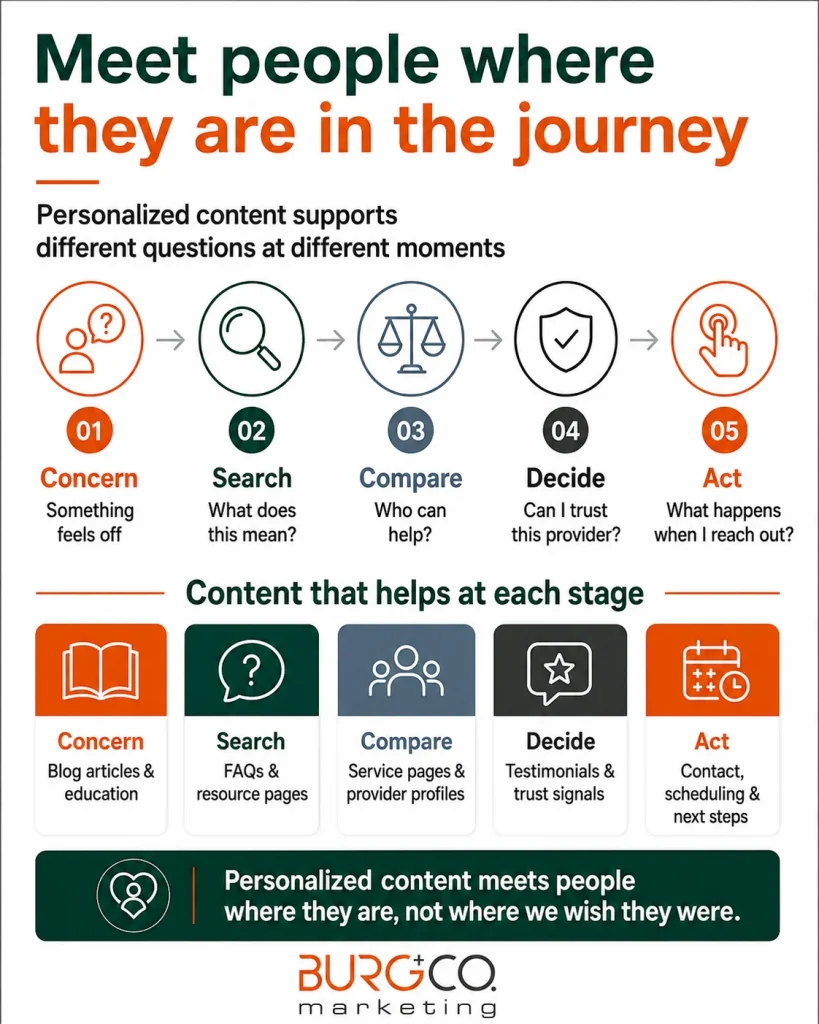
Personalized content can help your team:
- Improve relevance — Match content to what the reader is actually trying to solve
- Reduce friction — Make the next step easier to understand
- Build trust — Answer sensitive questions before someone has to ask
- Support conversions — Guide people toward voluntary next steps, such as forms, calls, assessments or admissions, when appropriate and helpful
- Strengthen SEO, answer engine optimization (AEO) and generative engine optimization (GEO) — Create clearer, more complete answers for search engines, answer engines and generative AI platforms
One important note: Content personalization in healthcare should never mean casually using protected health information, sensitive behavioral data or private patient details to target people without proper HIPAA, legal, compliance and platform-policy review. Your strategy should be useful, respectful and privacy-aware from the start.
The real goal: Better guidance, not just better targeting
Personalization gets a little weird when marketers treat people like data points instead of people. Healthcare audiences can feel that quickly.
The better goal is to ask: What would help this person feel more informed, more respected and more ready to take the next right step?
That might look like:
- Location-specific service pages for multi-location groups
- Condition or concern-specific blog content
- Program comparison guides
- FAQ sections tied to real intake questions
- Calls to action based on readiness level
- Email sequences segmented by audience type
- Contact, scheduling or admissions pages that reflect urgency, privacy concerns and family involvement
For example, a “schedule an appointment” call to action may work well for someone comparing physical therapy locations. But a parent researching residential treatment for a teenager may need a softer next step, such as “Talk with an admissions specialist” or “Learn what to expect before you call.”
The message, timing and emotional temperature all matter.
A simple framework for healthcare content personalization
Before choosing tools, start with strategy. Personalization works best when your team understands five things: audience, intent, context, content type and next step.
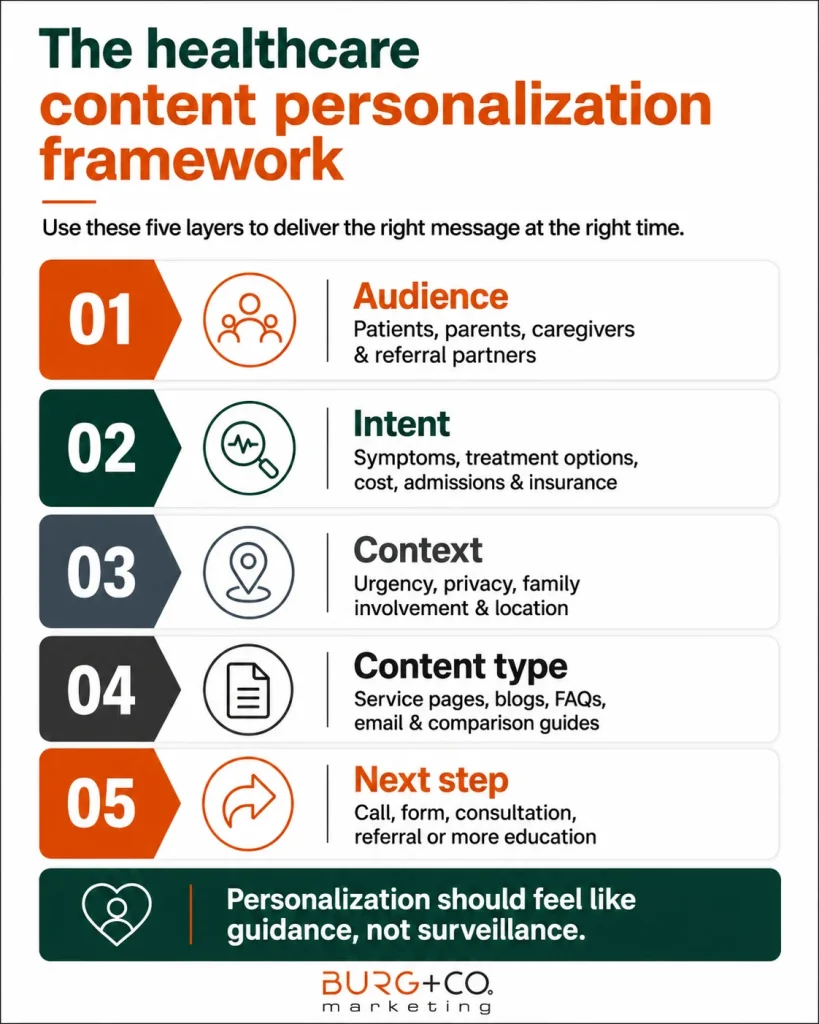
Use this framework before you add technology. If the strategy is unclear, a personalization engine will only help you scale confusion. And nobody needs more automated chaos in their life.
How to personalize content without crossing the line
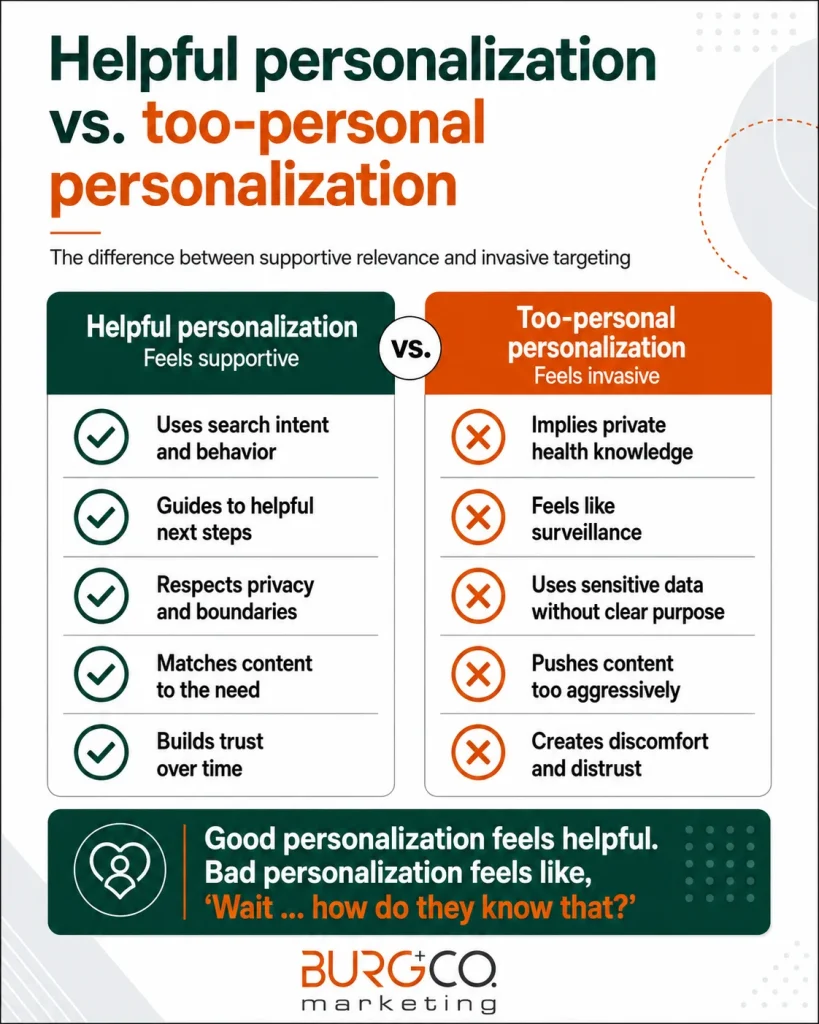
Healthcare personalization should be intentional, not invasive. That means your team should define three things: what data is appropriate, what requires legal or compliance review and what should stay off limits.
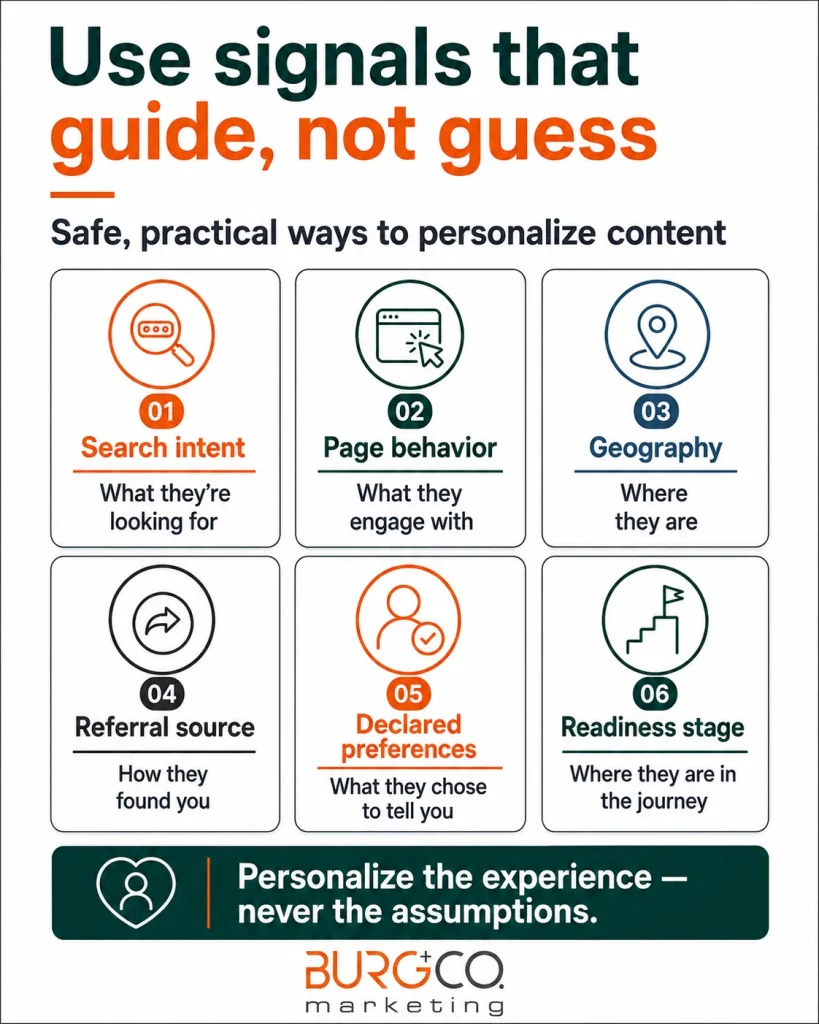
A responsible strategy may use:
- Search intent — What keyword or query brought the person to the content
- Page behavior — Which content categories people engage with
- Geography — Which location or service area is most relevant
- Referral source — Whether someone came from search, email, social or another campaign
- Declared preferences — Information the person chooses to share through forms or subscriptions
A riskier strategy may involve sensitive health data, condition-based remarketing or messages that imply knowledge of a person’s private situation. Those tactics may be restricted or inappropriate depending on the data source, consent, platform rules and legal review.
A good rule of thumb: If the message would make someone think, “How do they know that about me?” pause before launching it.
Where content personalization fits into SEO, AEO and GEO
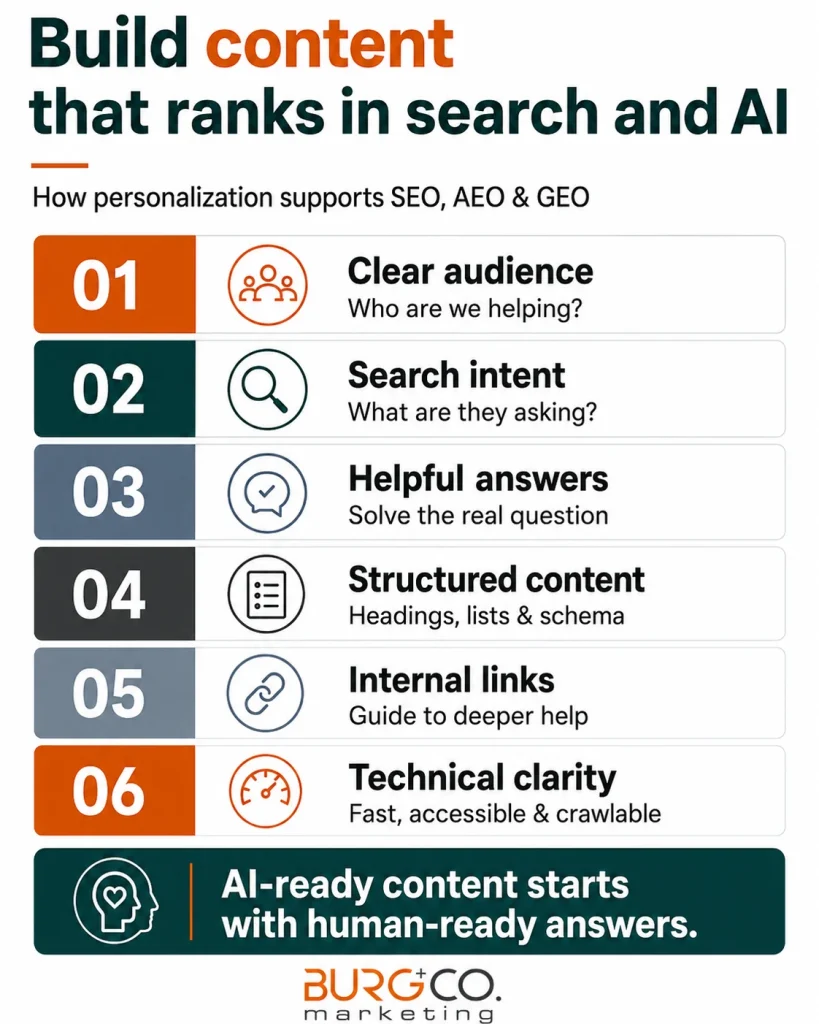
Content personalization is not separate from organic growth or SEO, AEO and GEO. It can support the way your brand appears in traditional search results, AI-generated answers and answer engines.
That is because clear, complete, structured and useful content is easier for search engines and AI platforms to crawl, interpret and surface in helpful answers. Personalized content strategies often push teams to build those qualities into the site.
For example, a strong healthcare content ecosystem may include:
- Service pages that clearly explain who the service is for
- Location pages that answer local access questions
- Blog articles that address patient concerns in plain language
- FAQs that mirror real search questions
- Internal links that guide readers to the next helpful resource
- Schema markup that helps search engines understand the content
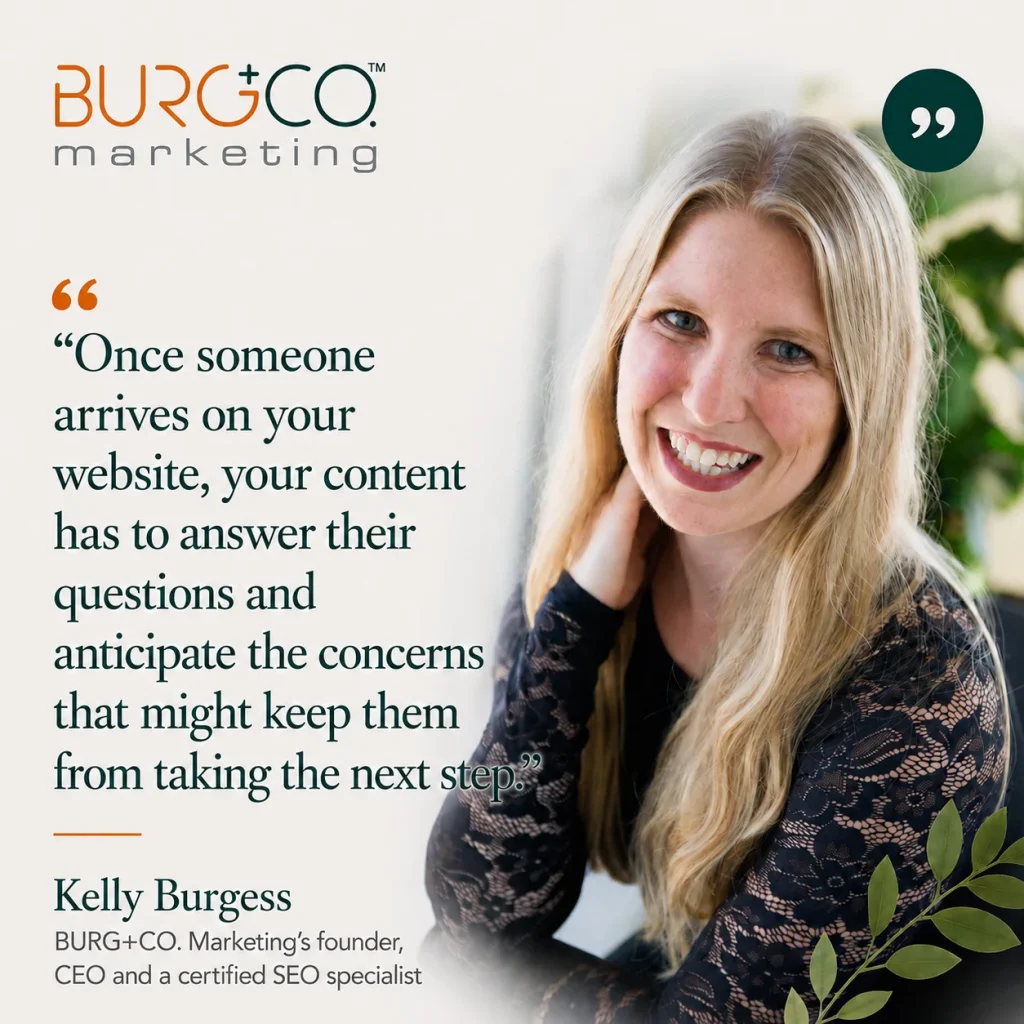
“Once someone arrives on your website, your content has to answer their questions and anticipate the concerns that might keep them from taking the next step.”
— Kelly Burgess, BURG+CO. Marketing’s founder, CEO and a certified SEO specialist
That idea is the heart of ethical, useful personalization. You are not simply trying to get more clicks. You are trying to build a better bridge between a person’s concern and your organization’s information, access points or services.
How to choose a personalization engine for content strategy
When you need to choose a personalization engine for content strategy, start with your actual needs. The flashiest platform is not always the best fit.
Look for a tool that supports your marketing strategy, compliance needs and internal bandwidth.
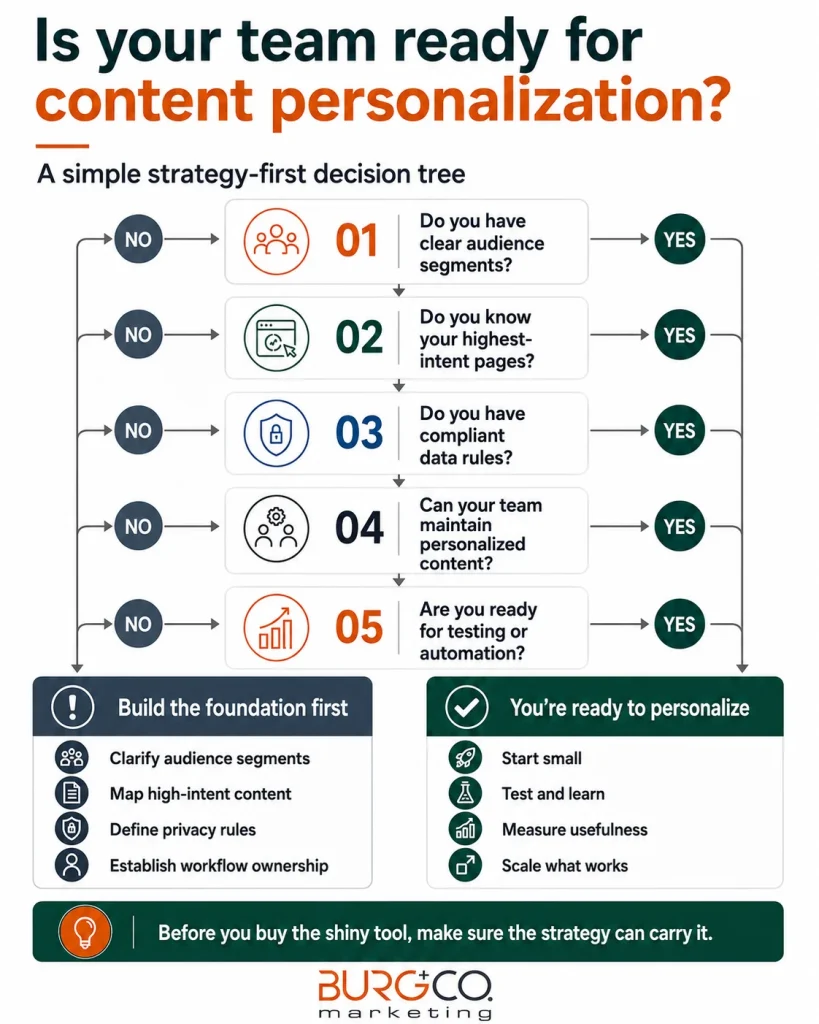
Important questions to ask include:
- Data controls — Can your team define what data is collected, stored and used?
- Segmentation — Can you build useful audience groups without overcomplicating workflows?
- Content management — Does it integrate with your content management system (CMS), customer relationship management platform (CRM), email platform or analytics tools?
- Reporting — Can you see which personalized experiences are helping engagement or conversions?
- Testing — Can you run A/B tests or compare content paths?
- Privacy and compliance — Can your legal, compliance and IT teams review how data flows?
- Ease of use — Can your marketing team actually manage it without getting buried in dashboard busywork?
For healthcare and behavioral health organizations, the right tool should support trust. It should help your team deliver clearer content, not create a maze of automated messages that nobody has time to maintain.
Personalization ideas for healthcare and behavioral health brands
You do not need to start with advanced AI. In many cases, your best first step is improving content alignment.
Here are practical ways to begin:
- Segment service content — Create pathways for different audiences, such as patients, parents, caregivers, family members and referral partners
- Build intent-based blog clusters — Group articles around symptoms, treatment questions, insurance concerns and next-step questions
- Personalize by location — Help users find the closest clinic, program or provider without digging
- Match CTAs to readiness — Use softer CTAs for education-stage content and stronger CTAs for high-intent pages
- Create service-line FAQ blocks — Answer common questions tied to specific services, concerns or care paths
- Use internal links intentionally — Guide readers from education to service pages, location pages or contact options
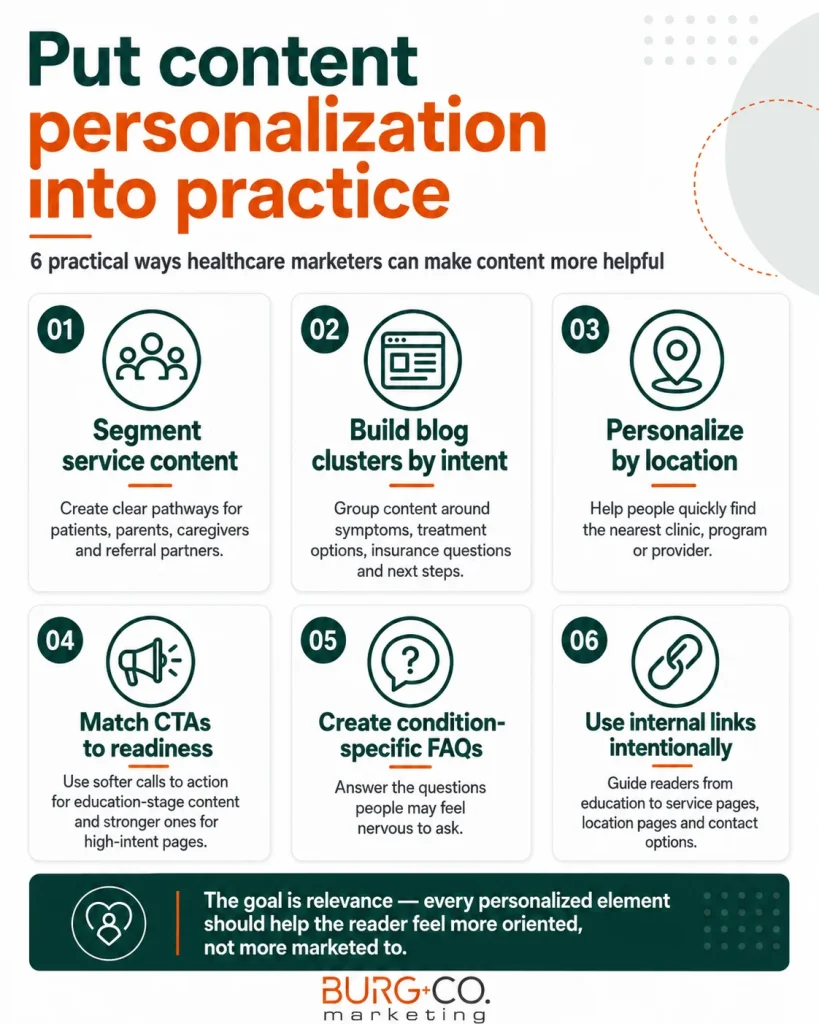
The common thread is relevance. Every personalized element should help the user feel more oriented, not more marketed to.
What healthcare marketing teams should measure
Personalization should be tied to useful performance indicators. Otherwise, it becomes another shiny thing on the strategy shelf.
Track metrics such as:
- Visibility — Organic traffic by content cluster
- Engagement — Engagement on personalized pages
- Internal link clicks
- Conversion — Form starts and completions
- Phone call clicks
- Location page engagement
- FAQ interactions
- Assisted conversions
- Lead quality — Qualified lead quality
- Qualitative feedback — De-identified patient experience themes, intake team feedback or admissions team observations
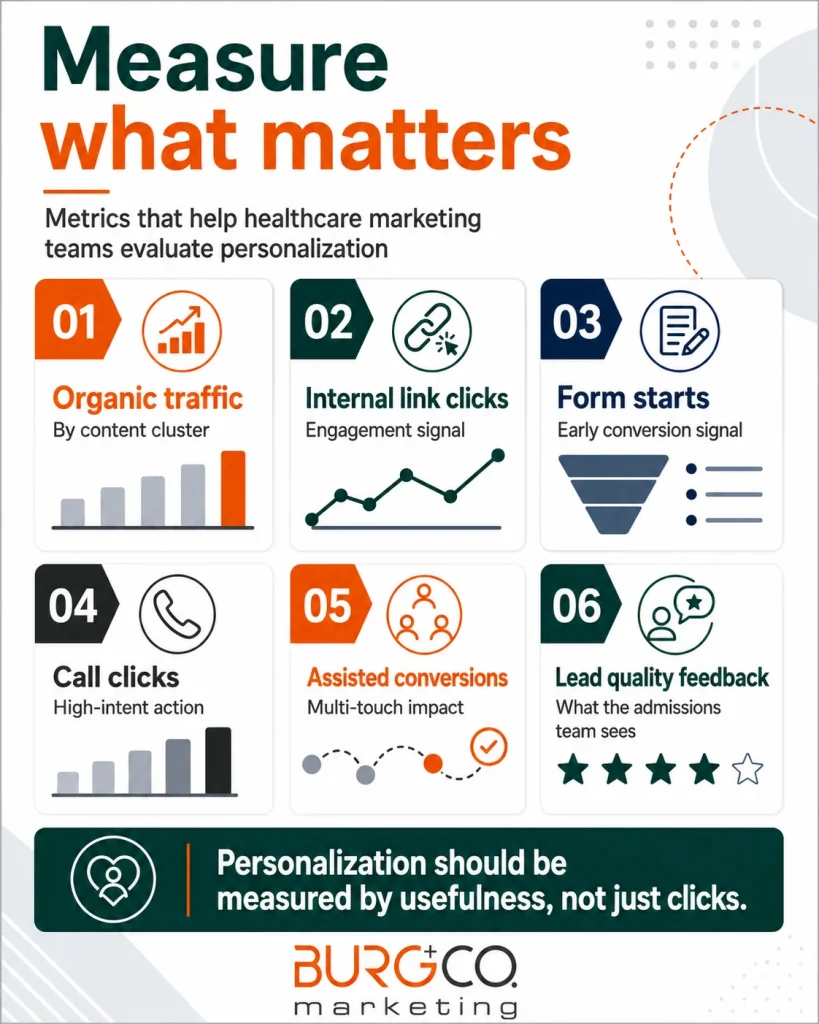
The best measurement combines data and human context. A page may have lower traffic but higher-quality conversions. A blog may not drive immediate forms but may support trust before a later branded search. A personalized email may not create a new patient by itself, but it may help someone feel ready to call.
Client feedback can also help show how strategic support feels from the other side of the partnership.
Kateigh Axness Williams — “As a healthcare marketing executive, I’m most interested in partnering with external service providers and vendors who just ‘get it’. And that’s BURG+CO.! Our company has partnered with BURG+CO. for nearly a year, and in that time they’ve helped my company and me strategize and execute marketing initiatives that have not only increased return on marketing investment (ROMI), but they’re an absolute delight to work with. Each member of their team thinks and works on behalf of their client, and I’ve come to rely on their collective domain expertise regarding digital marketing best practices. Cannot recommend BURG+CO. enough. KB and her team are an impressive outfit, and I’m thrilled to continue working with them. 5 stars, all around!”
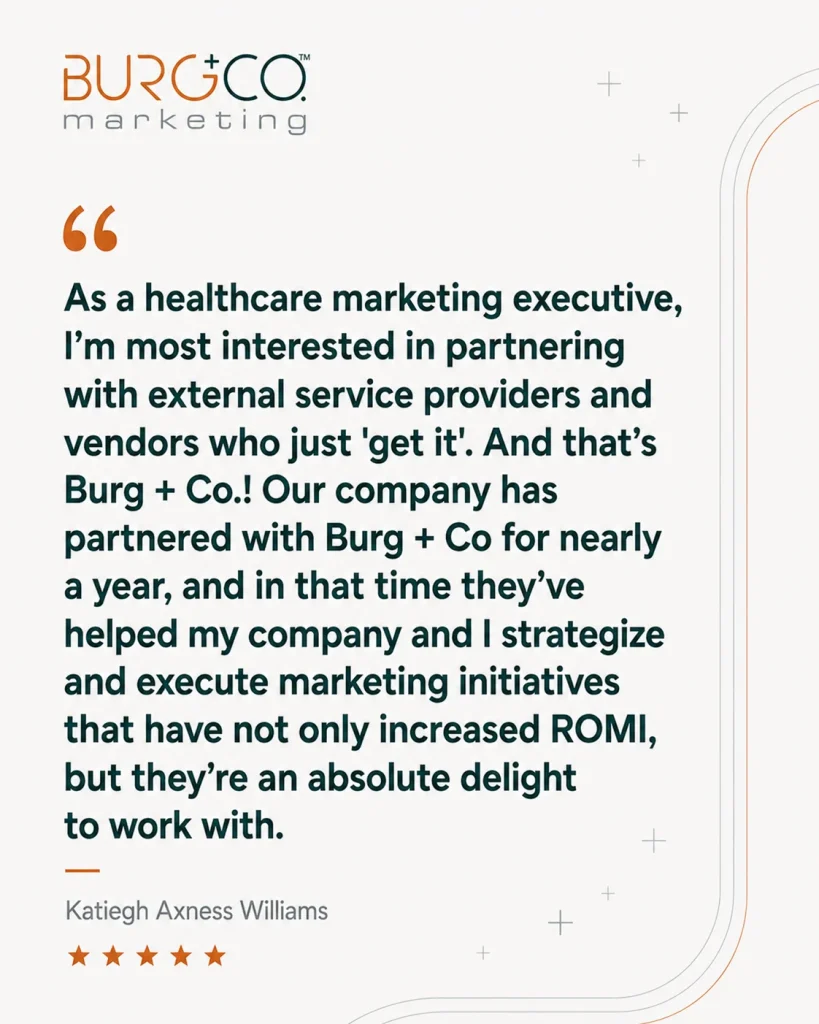
That kind of partnership matters because personalization is not just a tool setup. It requires strategy, testing, empathy and the ability to connect marketing activity to the real decisions patients and families are making.
Make content personalization feel human
Content personalization in healthcare should feel like guidance, not surveillance. The strongest strategies use data to understand people better while still honoring privacy, consent and context.
For CGOs, CMOs, marketing directors and healthcare marketing teams, the opportunity is not just to deliver more content. It is to deliver the right content at the right moment, in the right tone, with the right next step.
Done well, personalization can help your organization become easier to find, easier to understand and easier to contact when someone is ready.
Looking to elevate your healthcare marketing strategy? Contact BURG+CO. for personalized insights and next steps.
FAQs
What is content personalization in healthcare marketing?
Content personalization in healthcare marketing means tailoring content to a user’s needs, intent, location, service interest or stage in the decision journey using appropriate, privacy-aware signals. The goal is to make information more helpful and easier to act on.
Why is content personalization important for behavioral health organizations?
Behavioral health decisions often involve urgency, privacy concerns, fear and family input. Personalized content can help people find relevant answers faster and feel more supported before they reach out.
Is content personalization the same as using patient data for marketing?
No. Personalization can use non-sensitive signals like search intent, content category or location. Any use of patient data or protected health information should be reviewed for privacy and compliance requirements.
What content should healthcare brands personalize first?
Start with high-impact areas like service pages, location pages, calls to action, FAQs, blog clusters and email pathways. These are often close to the actions and content paths people use before contacting the organization.
How does personalization support SEO and AI search visibility?
Personalized content strategies often create clearer, more complete answers for specific audiences. That can support traditional SEO, answer engine optimization and generative engine optimization when the content is structured well.
How do you choose a personalization engine for content strategy?
Choose a platform that fits your content goals, compliance needs, data policies, CMS, CRM and team capacity. The best tool is one your team can manage responsibly and measure clearly.
Can small healthcare practices use content personalization?
Yes. Smaller practices can start with simple steps, such as location-specific content, condition-specific FAQs, segmented blog topics and calls to action that match the reader’s readiness.
What is an example of personalized healthcare content?
An example is a therapy website that offers separate content paths for adults seeking care, parents looking for teen support and referral partners who need program details.
What should healthcare marketers avoid when personalizing content?
Avoid tactics that feel invasive, imply knowledge of a private condition or use sensitive health information without proper review. Personalization should feel helpful, respectful and transparent.
How often should personalized content be reviewed?
Review personalized content on a set schedule and whenever services, locations, intake processes, compliance requirements or audience behavior change. Quarterly reviews are a useful starting point for many teams.