
AI search is creating another place where prospective clients can encounter your healthcare brand. The challenge is that traditional rankings and website traffic do not tell you whether ChatGPT, Gemini, Google AI results or other AI tools are mentioning your organization. Tracking AI search visibility requires a broader approach that looks at prompts, mentions, citations, competitors and referral traffic.
For healthcare providers exploring the best ways to track brand mentions in AI search, the goal is not simply to count appearances. You also need to understand where your brand appears, how it is described and which sources AI platforms use when discussing it.
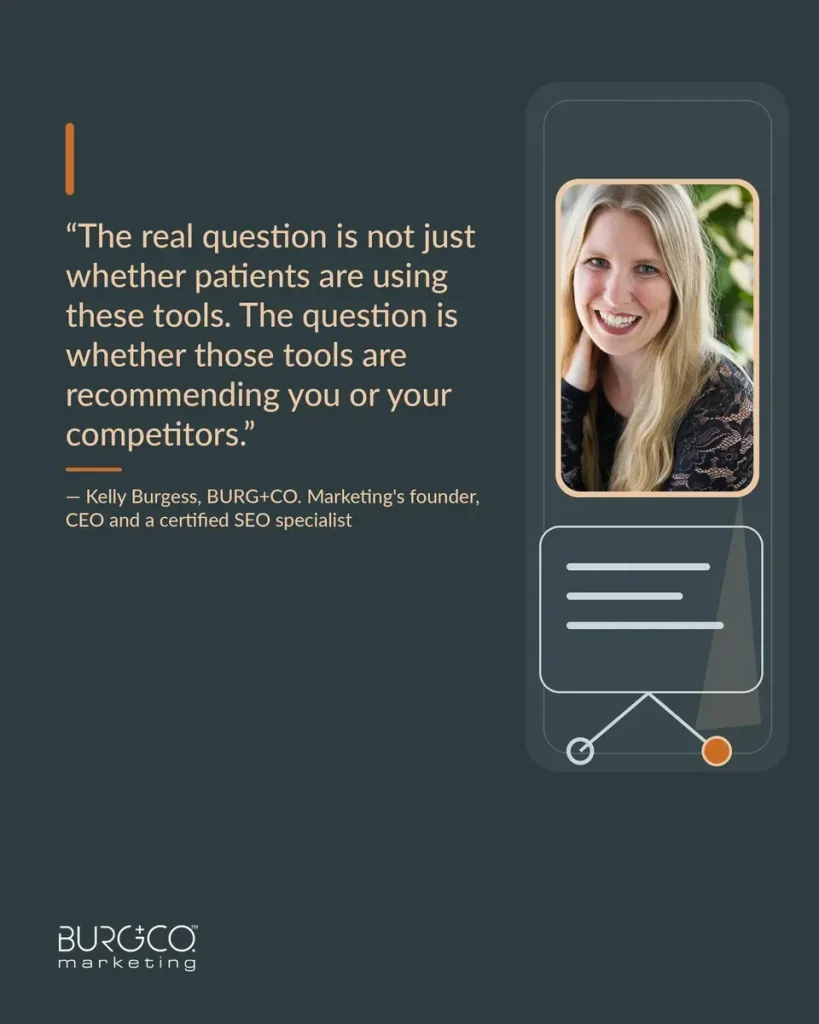
A useful question to keep in mind comes from BURG+CO. leadership:
“The real question is not just whether patients are using these tools. The question is whether those tools are recommending you or your competitors.”
— Kelly Burgess, BURG+CO. Marketing’s founder, CEO and a certified SEO specialist
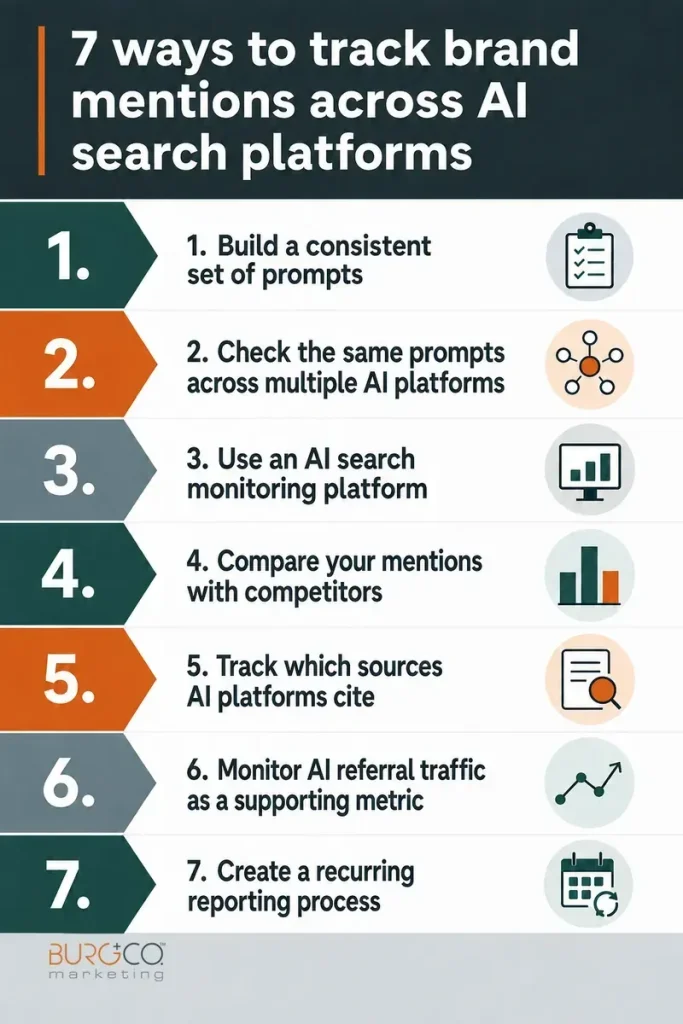
Here are a few ways to track your brand mentions throughout AI platforms:
1. Build a consistent set of prompts
Start with questions that reflect how prospective clients may search for your services. Include your specialty, location, services and common decision-making questions.
For example, a provider might track prompts around “behavioral health providers in Tampa” or “what to look for in a physical therapy provider.” Keep the core prompts consistent so you can compare results over time.
This prompt library also gives your answer engine optimization efforts a repeatable measurement framework.
2. Check the same prompts across multiple AI platforms
Do not assume one AI platform represents the entire search landscape. Run priority prompts across platforms such as ChatGPT, Gemini, Perplexity and Google’s AI-powered search experiences.
Record whether your brand appears and note:
- Brand name accuracy
- Services mentioned
- Location information
- Competitors included
- Links or sources cited
- Overall context of the recommendation
Manual checks work especially well when you are establishing a baseline or monitoring a smaller group of high-value prompts.
3. Use an AI search monitoring platform
As your prompt list grows, manual tracking can become difficult to maintain. An AI search monitoring platform can automate parts of the process.
For example, Semrush’s AI visibility tool reports brand mentions, platform-level visibility, prompts and pages receiving AI citations. Ahrefs Brand Radar can monitor brand visibility, competitors and cited sources while allowing users to track custom prompts on recurring schedules.
4. Compare your mentions with competitors
A mention means more when you understand the competitive context. Track whether competing healthcare brands appear for the same questions and how often your organization appears alongside them.
Look for patterns rather than reacting to one answer. If competitors repeatedly surface for an important service or location, review the topics and sources associated with those responses. This can reveal areas where your content marketing strategy needs deeper coverage.
5. Track which sources AI platforms cite
A brand can appear because an AI platform found information on your website, a directory, an article or another third-party source.
Record cited pages whenever they are visible. Then ask:
- Is your own website being cited?
- Which service or educational pages appear?
- Are third-party sources accurately representing the brand?
- Which competitors’ pages receive citations?
This helps distinguish a simple mention from evidence that your owned content is influencing the answer.
6. Monitor AI referral traffic as a supporting metric
Brand mentions do not always lead to a website visit, so traffic should not be your only measurement. However, referral traffic can show when an AI platform does send people to your website.
Google Analytics 4 identifies traffic arriving through third-party domains and reports the referring domains as traffic sources.
Use this metric alongside mention and citation data rather than treating traffic as a complete measure of AI visibility.
7. Create a recurring reporting process
AI results can change, so one audit is only a snapshot. Establish a regular review cadence and record meaningful website, content and campaign updates alongside your tracking data.
A simple qualitative framework can help:
| Tracking method | What it helps reveal | Main limitation |
|---|---|---|
| Manual prompt checks | Wording, accuracy and context | Difficult to scale |
| AI visibility tools | Mentions, citations and competitor patterns | Coverage varies by tool |
| Citation review | Sources influencing answers | Requires manual interpretation |
| Referral analysis | AI-driven website visits | Misses exposure without clicks |
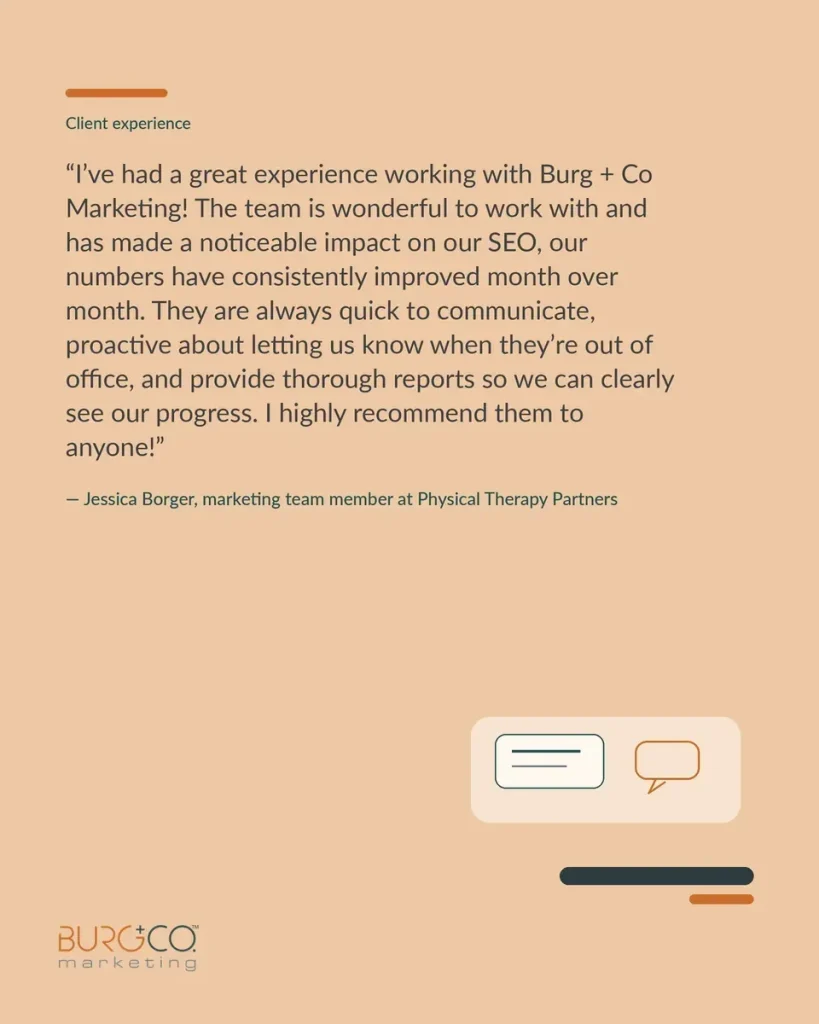
Clear reporting matters because the data is only useful when your team can act on it. One BURG+CO. client described that value this way:
“I’ve had a great experience working with Burg + Co Marketing! The team is wonderful to work with and has made a noticeable impact on our SEO, our numbers have consistently improved month over month. They are always quick to communicate, proactive about letting us know when they’re out of office, and provide thorough reports so we can clearly see our progress. I highly recommend them to anyone!”
— Jessica Borger, marketing team member at Physical Therapy Partners
Tracking brand mentions gives healthcare providers a clearer picture of where they appear in a changing search environment. The strongest measurement system combines consistent prompts, cross-platform monitoring, competitor comparisons, citation reviews and traditional analytics.
BURG+CO. Marketing helps healthcare brands connect search data with a broader SEO strategy so visibility insights can inform practical marketing decisions.
Discover the difference a strategic digital marketing partner can make. Schedule your complimentary consultation with BURG+CO. now.
FAQs about brand mentions in AI search
What is a brand mention in AI search?
A brand mention occurs when an AI-generated answer names or discusses your organization. It may appear with or without a link to your website.
How often should healthcare providers track AI brand mentions?
Use a consistent schedule that fits your resources and business priorities. The most important factor is tracking often enough to identify meaningful trends rather than relying on isolated checks.
Which AI search platforms should healthcare providers monitor?
Start with the platforms most relevant to your audience, such as ChatGPT, Gemini, Google AI search experiences and Perplexity. Platform coverage can expand as your tracking process matures.
What is the difference between an AI mention and an AI citation?
A mention names or discusses your brand. A citation points to a website or other source the AI platform used or referenced in its answer.
Why should healthcare brands track competitor mentions?
Competitor tracking adds context. It can show which brands repeatedly appear for important topics and where your organization may have content or visibility gaps.
Can Google Analytics track every AI brand mention?
No. Analytics can help identify website visits from referring sources, but an AI answer can mention your organization without sending a visitor to your site.
Will AI search results always give the same answer?
No. Responses can vary by platform, prompt wording, location, available sources and other factors. That is why repeated tracking is more useful than a single test.
Can AI search monitoring replace traditional SEO tracking?
No. AI visibility adds another measurement layer. Organic rankings, traffic, conversions and other established metrics still provide important information about overall search performance.
What should a healthcare provider do if an AI tool describes its brand inaccurately?
Document the issue first. Then review your website and other authoritative public sources for inconsistent, outdated or unclear information that may be contributing to the response.
Is it possible to improve how a healthcare brand appears in AI search?
A strong foundation of clear, useful, accurate and well-structured online information can support discoverability. Monitoring helps your team identify where additional work may be needed.