
Healthcare marketing gets harder when every channel has its own plan, owner and set of priorities. A full-service digital marketing agency can help connect strategy, content, search, website experience and conversion work so your team is not constantly stitching the pieces together on its own.
That does not mean outsourcing everything. A full-service marketing agency can fill skill gaps and work beside your internal team. If several of the signs below feel familiar, your current structure may need more integrated support.
What is a full-service digital marketing agency?
A full-service digital marketing agency brings several disciplines under one strategic framework. Services may include SEO, content, website strategy, UX/UI, conversion optimization, digital PR and video.
The real value is coordination: specialists work from shared goals and audience insights instead of separate plans. For healthcare organizations, that can reduce handoffs between vendors and make it easier to keep patient needs, brand standards and growth priorities aligned.
7 signs that you should seek a full-service digital marketing agency
We understand that outsourcing isn’t an easy decision to make, but here are a few signs that hiring a digital marketing agency is the right option for your healthcare practice:
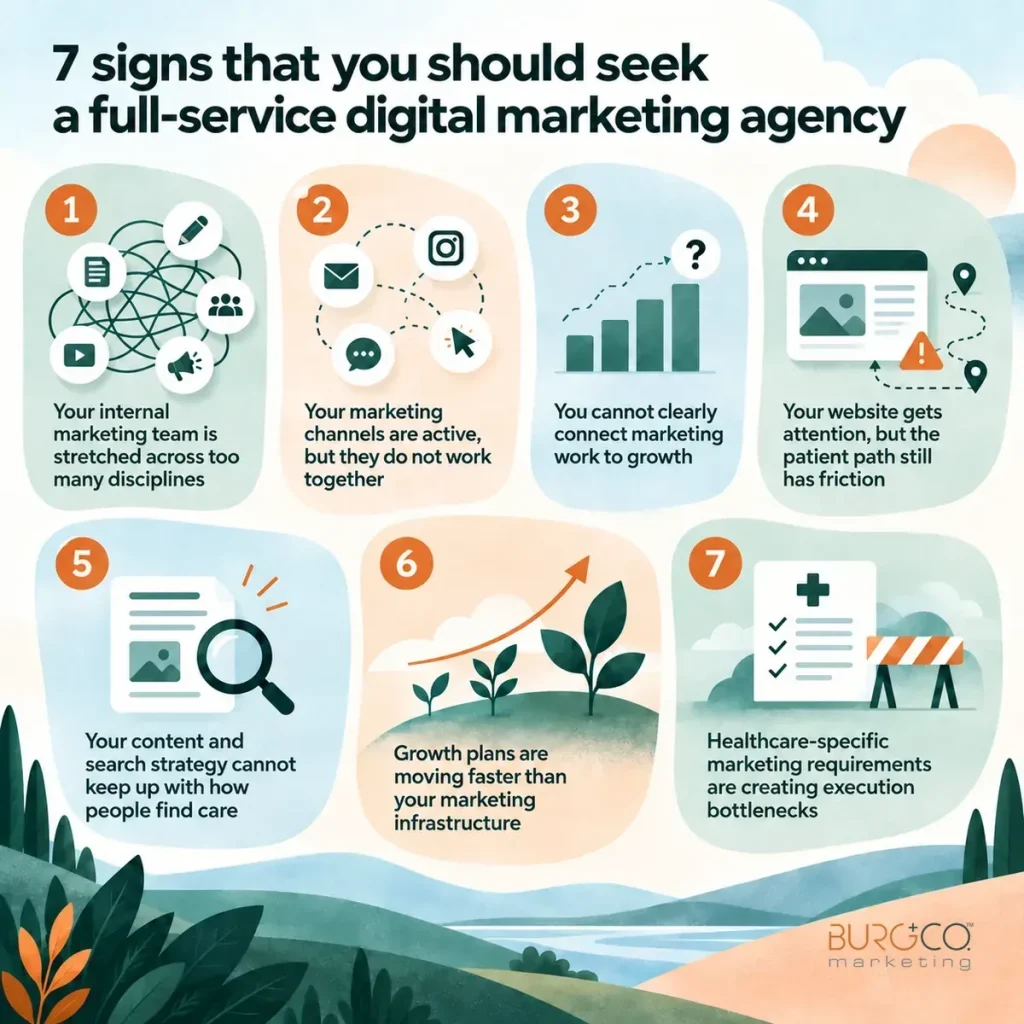
1. Your internal marketing team is stretched across too many disciplines
A small healthcare marketing team may be responsible for strategy, content, search, website updates, reporting and brand consistency at once. The issue is often capacity, not talent.
A full-service digital marketing agency can add specialized expertise without requiring a separate hire for every discipline. Clear ownership also helps internal employees know what stays in-house and what the agency will lead. That matters when a small team is spending more time coordinating work than improving strategy, learning from performance or supporting organizational priorities.
2. Your marketing channels are active, but they do not work together
A healthcare organization can publish useful content, invest in search and maintain a strong website while still having a fragmented strategy. That happens when each activity is planned independently rather than around one patient journey and shared goals. A relevant expert perspective captures the problem with one-channel thinking.
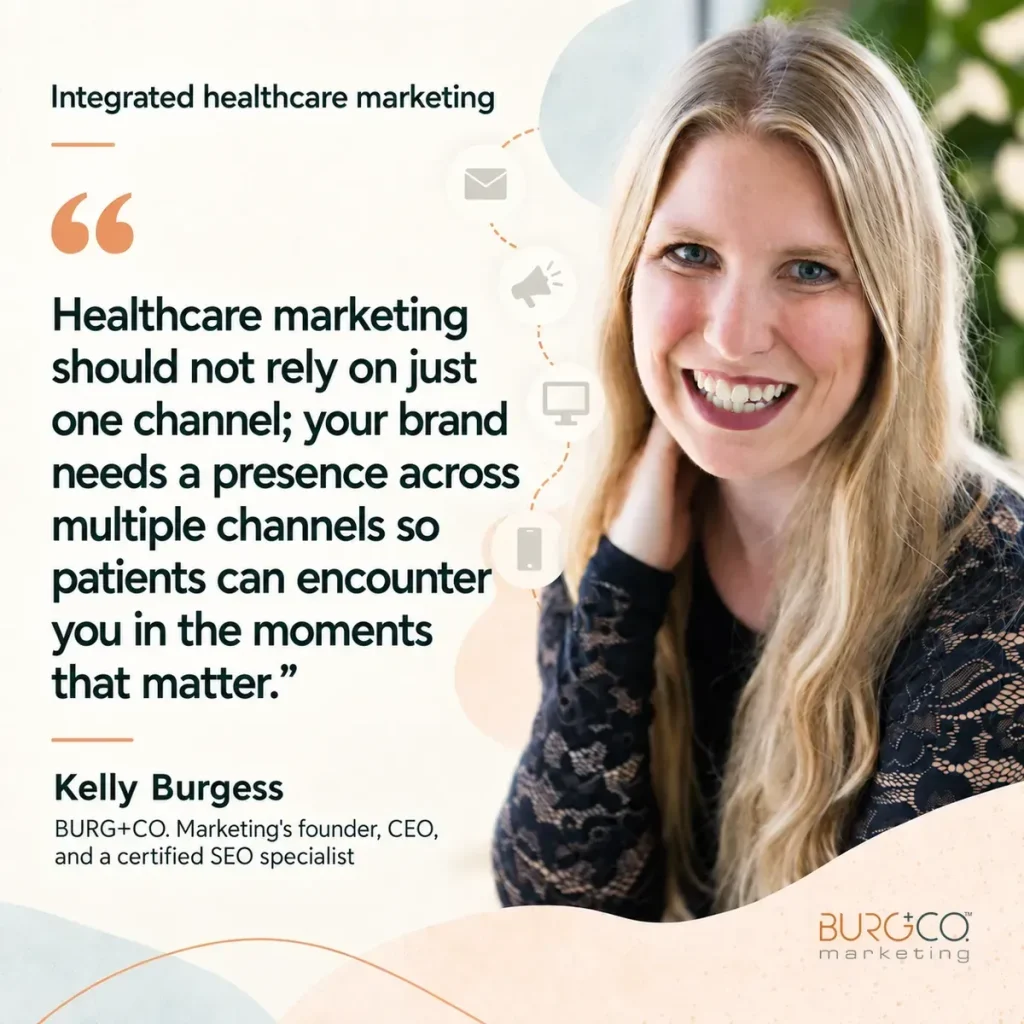
“Healthcare marketing should not rely on just one channel; your brand needs a presence across multiple channels so patients can encounter you in the moments that matter.”
— Kelly Burgess, BURG+CO. Marketing’s founder, CEO, and a certified SEO specialist
The goal is not to be everywhere. It is to make the right channels support what comes next.
3. You cannot clearly connect marketing work to growth
If leadership sees impressions, clicks, rankings and traffic but still asks, “What did this actually do for us?” your measurement system may be fragmented. A full-service agency can help connect channel activity to outcomes your organization actually cares about, such as qualified inquiries and appointment requests.
Marketing attribution can also help teams understand how different touchpoints contribute to conversion instead of giving all credit to the final click.
One healthcare client described how an integrated partnership made reporting and decision-making easier:
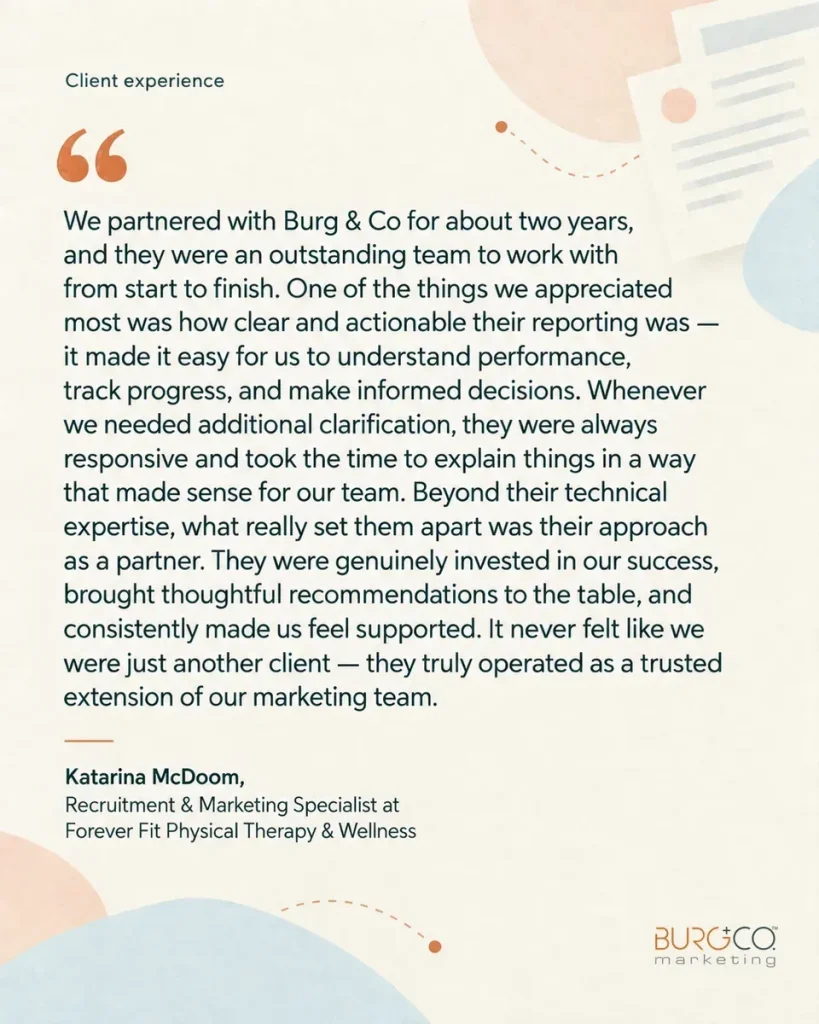
“We partnered with Burg & Co for about two years, and they were an outstanding team to work with from start to finish. One of the things we appreciated most was how clear and actionable their reporting was — it made it easy for us to understand performance, track progress, and make informed decisions. Whenever we needed additional clarification, they were always responsive and took the time to explain things in a way that made sense for our team. Beyond their technical expertise, what really set them apart was their approach as a partner. They were genuinely invested in our success, brought thoughtful recommendations to the table, and consistently made us feel supported. It never felt like we were just another client — they truly operated as a trusted extension of our marketing team.”
— Katarina McDoom, Recruitment & Marketing Specialist at Forever Fit Physical Therapy & Wellness
That is one client’s perspective, not a guarantee of results. It does show the value of reporting that supports clearer decisions.
4. Your website gets attention, but the patient path still has friction
Traffic alone does not show whether people can take the next appropriate step. Visitors may still leave because information is unclear, navigation is difficult or the conversion path does not match their intent.
These problems cross specialties. SEO can bring the right audience in, content can answer questions and UX/UI can reduce friction. Website and conversion specialists can then help make calls to action, forms and next steps easier to use.
A consumer journey map can show where search, content, website experience and action points connect — or break apart.
5. Your content and search strategy cannot keep up with how people find care
Search requires more than publishing pages around keywords. Teams must consider technical SEO, useful content, internal linking, intent and website quality. Google’s Search Essentials recommends helpful, reliable, people-first content. That guidance reinforces the value of coordinating search, content and website teams instead of optimizing each area in isolation.
When content planning and technical SEO happen in separate silos, teams can solve one problem while creating another.
A coordinated agency can also connect content research, creation, publishing and performance review instead of treating each deliverable in isolation.
6. Growth plans are moving faster than your marketing infrastructure
Opening locations, entering new markets or launching services creates a coordination challenge. Location pages, content, search research, website changes, conversion paths and reporting may need to move together.
A full-service digital marketing agency can help build a repeatable process and assign specialist ownership while the internal team stays focused on brand, leadership and cross-functional priorities. A repeatable system also gives your team a clearer starting point for each launch instead of rebuilding timelines, responsibilities and measurement plans from scratch.
7. Healthcare-specific marketing requirements are creating execution bottlenecks
Healthcare marketing can involve privacy obligations, platform rules and sensitive audience considerations. An agency does not replace legal or compliance counsel, but it should know when work needs additional review and plan for it.
HHS guidance explains how the HIPAA Privacy Rule limits certain uses and disclosures of protected health information for marketing. Teams should understand those boundaries before using patient information in marketing workflows.
Platforms add their own requirements. Google maintains healthcare and medicines advertising policies that restrict some content and require certification for certain categories.
The goal is a process where strategy, execution and review work together before launch.
How a full-service agency can address these gaps
The table below is qualitative, not measured performance data. It connects common organizational signals with the support an integrated agency may provide.
| Organizational signal | What may be happening | Coordinated support to consider |
|---|---|---|
| Internal team is overloaded | Too many specialties compete for limited time | Clear division of ownership and specialist support |
| Channels feel disconnected | Tactics are planned separately | Shared strategy, audience journey and goals |
| Reporting feels unclear | Metrics do not tell one performance story | Cross-channel measurement and decision-ready reporting |
| Website traffic does not become action | Search, content and UX gaps are not addressed together | SEO, content, UX/UI and conversion coordination |
| Growth creates repeated fire drills | Launch processes are rebuilt each time | Repeatable workflows that can scale with expansion |
Use this as a diagnostic, not a scorecard. Several issues at once can signal that your marketing structure needs more integrated support.
What should healthcare organizations look for in a full-service marketing agency?
A bigger service list does not automatically make a better partner. As you evaluate full-service digital marketing agencies, focus on qualities that make the relationship easier to manage and measure:
- Strategic coordination — Individual tactics should connect to clear organizational goals.
- Healthcare context — The team should understand patient decision-making, privacy sensitivity and channel requirements.
- Transparent reporting — You should understand what is happening, why it matters and what comes next.
- Collaborative ownership — The agency should strengthen your internal team, not create another silo.
- Flexible expertise — Support should adapt as priorities change.
The model works best when it reduces complexity rather than adding another layer.
Need a more connected digital marketing strategy? BURG+CO. can help
If these signs feel familiar, the answer may not be “do more marketing.” It may be to connect the work around a clearer strategy.
BURG+CO. Marketing helps healthcare organizations connect SEO, content, website experience and conversion strategy around meaningful growth goals. We work to complement internal teams rather than create another silo. If your team needs specialized support without another disconnected vendor relationship, contact BURG+CO. to discuss where an integrated strategy may help.
Let’s turn your digital goals into real growth. Contact BURG+CO. today to learn how we support healthcare practices like yours.
FAQs about digital marketing agencies
How do I know if my healthcare organization needs a full-service digital marketing agency?
You may need one if your internal team is overloaded, channels are disconnected, reporting is unclear or growth plans require more specialized marketing support than your team can provide alone.
Does hiring a full-service agency mean replacing an internal marketing team?
No. A full-service agency can work alongside an internal team by filling skill gaps, adding capacity and taking ownership of selected areas while internal leaders retain brand and strategic responsibilities.
Why does channel coordination matter in healthcare marketing?
Potential patients often interact with several digital touchpoints before taking action. Coordinating search, content, website experience and conversion paths can make those interactions clearer and more consistent.
Can a full-service agency help improve marketing reporting?
Yes, depending on the engagement. An integrated agency can help align channel metrics around shared goals and build reporting that is easier for marketing teams and leadership to use in decision-making.
What should I do if my website gets traffic but few qualified inquiries?
Review the full journey, not traffic alone. Search intent, page content, UX/UI, calls to action and conversion paths may all influence whether the right visitors understand and take the next step.
What does a full-service digital marketing agency typically do?
Services vary by agency but may include strategy, SEO, content, website work, UX/UI, conversion optimization, digital PR, video and other digital marketing disciplines.
Is a full-service marketing agency better than several specialized agencies?
Not automatically. A full-service model can reduce coordination work, while specialists may be useful for narrow needs. The right choice depends on your goals, internal expertise and how much integration you need.
How should healthcare organizations evaluate digital marketing agencies?
Look at relevant experience, strategic approach, reporting transparency, collaboration style, service capabilities and how clearly the agency explains the connection between marketing activity and business goals.
How much should a healthcare organization outsource to an agency?
There is no single right amount. Some organizations outsource specific specialties, while others use an agency for broader execution. Define what your internal team does best and where outside expertise or capacity would add value.
What is the difference between a full-service agency and a marketing consultant?
A consultant often focuses on advice, planning or a specific specialty. A full-service agency typically combines strategy with execution across several marketing disciplines, though the exact scope varies by provider.