

Healthcare marketing gets personal quickly. One person may be comparing providers for themself. Another may be researching care for a child, parent or partner. Audience segmentation helps your team respect those differences and deliver useful information without treating every visitor like the same person.
So, what is audience segmentation? It is the practice of dividing a broad audience into smaller groups with shared characteristics, needs or behaviors. The goal is not to squeeze people into tidy boxes. It is to make your message more relevant to the person receiving it.
For healthcare providers, thoughtful segments may reflect location, service interest, decision stage, preferred content format or relationship to the person seeking care.
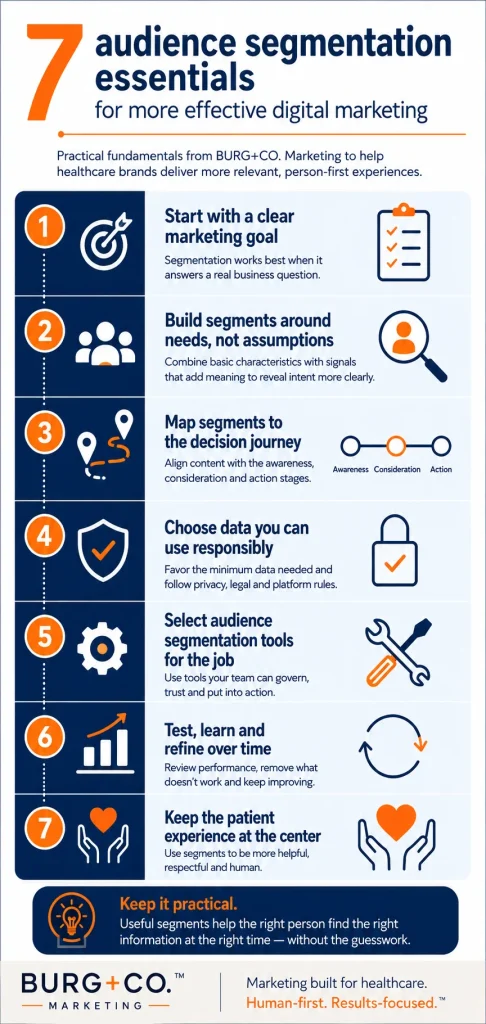
The seven essentials below can help you build a practical approach that supports patients and your marketing goals.
-
Start with a clear marketing goal
Segmentation works best when it answers a real business question. “We need better segments” is not a goal. “We need to help parents find our pediatric therapy locations” is specific enough to guide action.
Before choosing data or audience segmentation tools, identify the outcome you want to support. You might want to:
- Increase awareness of a new location — Focus on relevant geographic audiences
- Improve engagement with service pages — Group people by topic or service interest
- Support appointment decisions — Align content with each stage of the patient journey
- Strengthen referral outreach — Separate professional audiences from patient and caregiver audiences
One campaign may need several segments, but each segment should earn its place. If you cannot explain how a segment changes your message, channel or next step, it may only add complexity.
-
Build segments around needs, not assumptions
Demographics can provide context, but age or ZIP code alone rarely explains what someone needs. Two people who look similar in a dashboard may have different concerns, levels of urgency and roles in the decision.
Combine basic characteristics with signals that add meaning. Search language, content viewed, referral source and stated preferences can reveal intent more clearly. Interviews, call-center themes and patient-facing team feedback can add the human context that dashboards miss.
This is where person-first marketing matters. Use segments to understand patterns, not to label individuals or assume a diagnosis. Describe the need you can support, such as “caregivers comparing program options,” instead of defining people by a condition.
-
Map segments to the decision journey
The same person may need different information over time. Early in the journey, they may want plain-language education. Later, they may compare insurance, locations, provider experience or appointment options.
Map each segment to the questions people ask at the awareness, consideration and action stages. Then look for missing information and confusing handoffs. A search ad, article and service page should feel like connected steps, not three campaigns that have never met.
This audience-centered view is especially important in healthcare content strategy.
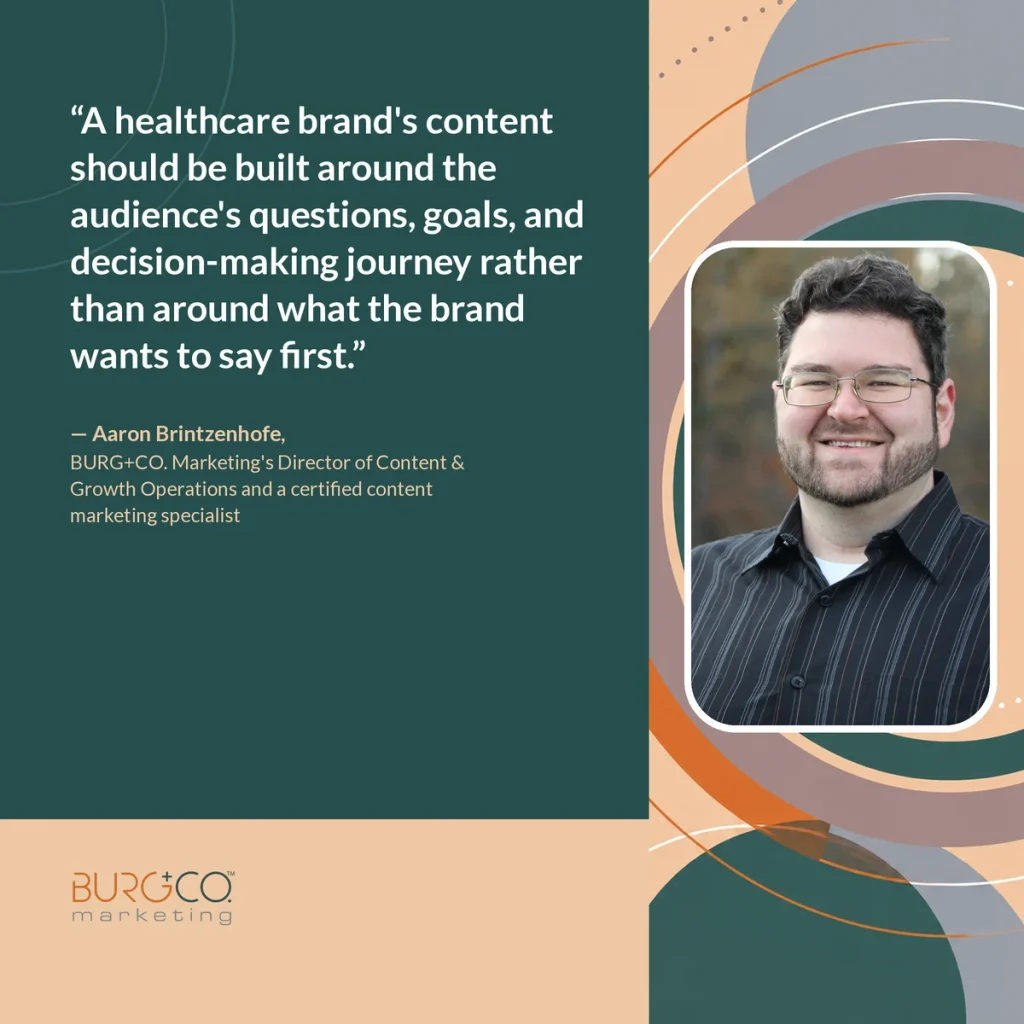
“A healthcare brand’s content should be built around the audience’s questions, goals and decision-making journey rather than around what the brand wants to say first.”
— Aaron Brintzenhofe, BURG+CO. Marketing’s Director of Content & Growth Operations and a certified content marketing specialist
That principle keeps segmentation useful. The segment helps your team decide which question to answer next, while the journey keeps the experience coherent.
-
Choose data you can use responsibly
Healthcare audience data deserves extra care. A useful data point is not automatically an appropriate targeting signal. Your legal, privacy, compliance and marketing teams should review how information is collected, combined, stored and activated.
Favor the minimum data needed for the stated purpose. First-party information that people knowingly provide, such as content preferences or a selected location, may support helpful personalization. Avoid sending protected health information or other sensitive data to tools that are not approved for that use.
Platform rules matter, too. Google treats health content as a sensitive interest category and restricts certain personalized advertising practices. Policies and legal obligations can change, so involve qualified compliance counsel before activating health-related segments.
-
Select audience segmentation tools for the job
The best tool is the one your team can govern and use. A complex platform will not rescue an unclear strategy or unreliable data.
Common audience segmentation tools include:
- Customer relationship management systems — Organize consented contact data and relationship history
- Email platforms — Group subscribers by stated interests, engagement or lifecycle stage
- Web analytics platforms — Show aggregate behavior patterns across pages and traffic sources
- Survey and feedback tools — Capture needs, preferences and language directly from people
- Advertising platforms — Reach allowed audiences within current platform policies
Before adding a tool, define access controls, retention rules, approved data sources and a review process. Confirm whether a vendor will sign any required agreements. Technology should support your governance model, not quietly become the model.
-
Match the message, channel and next step
A segment becomes valuable when it changes the experience in a helpful way. That could mean showing location-specific information, answering a caregiver’s questions or presenting a short video when a topic is difficult to scan.
Use this qualitative guide to connect each segment signal with a practical response:
| Segment signal | Helpful marketing response | Check before launch |
| Location interest | Show relevant locations and service availability | Confirm details are current |
| Service-page behavior | Offer related education and a clear next step | Avoid inferring a diagnosis |
| Decision stage | Match introductory or comparison content to the question | Keep claims accurate and balanced |
| Content preference | Use email, video or long-form content appropriately | Honor consent and opt-out choices |
The takeaway is simple: personalization should reduce friction or answer a question. If it only proves that your technology knows something about the visitor, pull it back.
-
Measure, learn and refine
Segmentation is a working hypothesis. Test whether each group responds differently enough to justify a distinct experience. Use metrics that fit the goal, such as qualified service-page engagement, appointment-path progression or engagement with location content.
Compare results carefully. A small segment may look impressive because of limited volume. A larger segment may appear weaker while contributing more meaningful actions. Review qualitative feedback alongside performance data and check for unintended gaps in access or representation.
Set a regular cleanup rhythm. Merge segments that behave similarly, retire stale definitions and update rules when services, locations or patient needs change. Clear reporting also helps internal teams understand why the strategy is changing.
A client described the value of that transparent, collaborative approach this way:
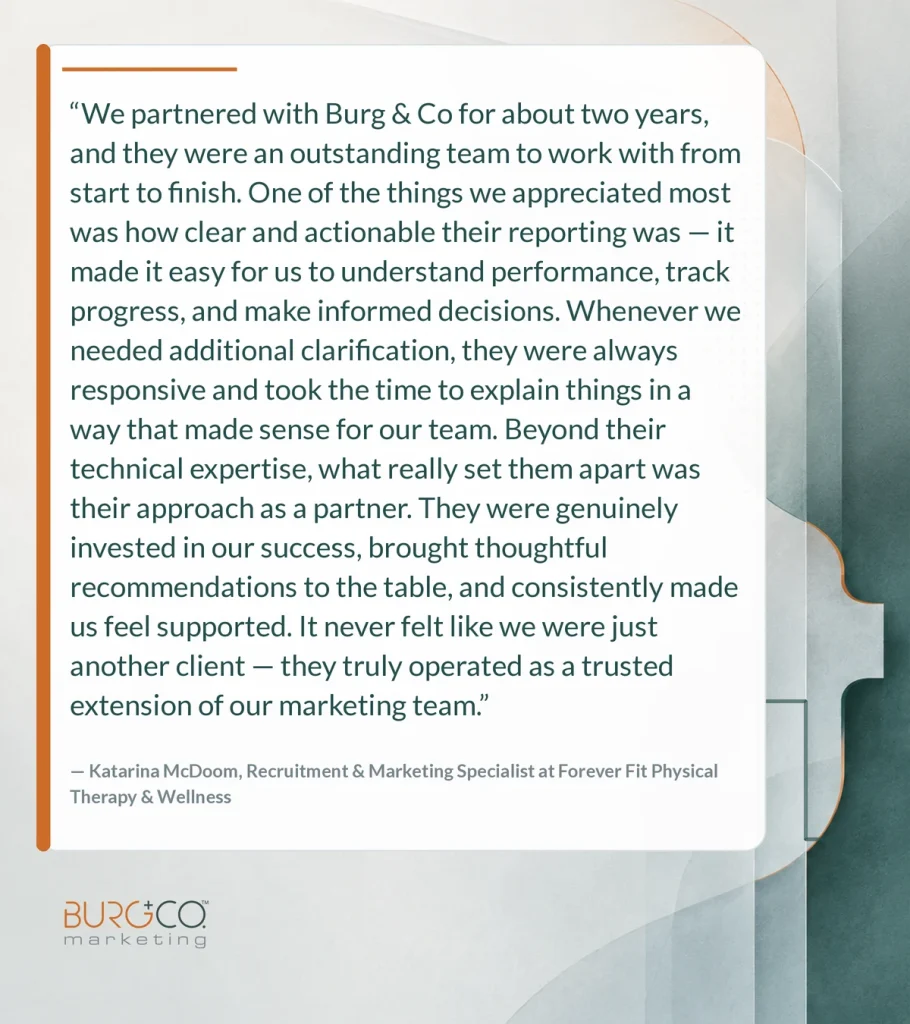
“We partnered with Burg & Co for about two years, and they were an outstanding team to work with from start to finish. One of the things we appreciated most was how clear and actionable their reporting was — it made it easy for us to understand performance, track progress, and make informed decisions. Whenever we needed additional clarification, they were always responsive and took the time to explain things in a way that made sense for our team. Beyond their technical expertise, what really set them apart was their approach as a partner. They were genuinely invested in our success, brought thoughtful recommendations to the table, and consistently made us feel supported. It never felt like we were just another client — they truly operated as a trusted extension of our marketing team.”
— Katarina McDoom, Recruitment & Marketing Specialist at Forever Fit Physical Therapy & Wellness
That experience is one client’s perspective, not a promise of universal results. It does show why usable reporting and shared decision-making matter when a segmentation strategy evolves.
Effective audience segmentation gives your healthcare marketing team focus. It helps you decide who needs what information, where that information belongs and how you will know whether it helped.
The work is part strategy, part data discipline and part empathy. Start with a clear goal. Use only the data you need. Respect privacy, test your assumptions and keep the patient journey connected from search to the next appropriate step.
BURG+CO. Marketing helps healthcare brands connect audience insight, SEO, content and website experience into a strategy that feels human. Want expert support with your digital marketing? Schedule your complimentary consultation with BURG+CO.
FAQs about audience segmentation
What is audience segmentation in healthcare marketing?
Audience segmentation divides a broad audience into useful groups based on shared needs, behaviors or characteristics. It helps healthcare marketers make information more relevant while keeping people at the center.
Which segments should a healthcare provider start with?
Start with groups tied to a clear goal. Location, service interest, decision stage and role in the care decision are often practical starting points.
Can audience segmentation improve SEO content?
Yes. Segment insights can reveal distinct questions and search intent. Your team can then create accurate content that answers those needs without producing thin, repetitive pages.
How often should audience segments be reviewed?
Review them on a regular schedule and when services, locations, campaigns or data practices change. Retire segments that no longer guide a meaningful decision.
What makes a segment useful?
A useful segment changes the message, channel, content or next step in a clear way. It should also be measurable, manageable and appropriate to use.
What is the difference between audience segmentation and a persona?
A segment is a group defined by shared criteria. A persona is a research-based profile used to humanize a common pattern within one or more segments.
Is audience segmentation the same as personalization?
No. Segmentation organizes people into groups. Personalization adjusts an experience using information about a group or individual, subject to consent, privacy and platform rules.
Does audience segmentation require personal health information?
No. Many useful segments rely on nonclinical signals, such as location interest, content preference or decision stage. Use the minimum necessary data and consult qualified compliance professionals.
What data can healthcare marketers use for segmentation?
That depends on the organization, purpose, consent, applicable law, contracts and platform policies. Marketing, privacy, legal and compliance teams should approve data sources and uses.
How do you measure audience segmentation performance?
Use metrics connected to the campaign goal. Review quantitative results, qualitative feedback, segment size and potential access gaps before deciding what to change.