
Keyword research and search engine optimization aren’t separate marketing chores that live in different tabs of the same spreadsheet. They work together to help healthcare providers understand what patients are searching for, create content that answers those questions and build a website that can earn more qualified organic visibility over time.
Here’s the very human part: Patients don’t search like marketers write strategy decks. They search from a place of need, urgency, curiosity, confusion, privacy concerns or all of the above. A parent looking for “teen anxiety treatment near me” isn’t in the same mindset as a clinic owner searching “how to improve healthcare SEO.” Keyword research helps you see those differences before your content team starts writing.
SEO then turns that research into action. It helps you organize pages, improve search visibility, build topic depth and make your content easier for both people and search engines to understand.
So, how do keyword research and SEO work together? Let’s get into the specifics:
-
Keyword research reveals what patients actually want to know
Good keyword research starts with search behavior. It helps healthcare marketers understand the language patients, families and referral partners use when they are trying to solve a problem.
That language isn’t always clinical. A patient may not search for “lumbar radiculopathy.” They may search for “shooting pain down leg.” Someone looking for mental health support may search with questions, symptoms, insurance concerns or location needs before they ever search for a specific provider.
Keyword research can help uncover:
- Service-based searches — Terms tied to care options, programs, specialties or provider types
- Question-based searches — Concerns patients ask before they’re ready to contact someone
- Location-based searches — Local intent that may connect to clinic pages or service area content
- Comparison searches — Queries that show someone is weighing options
- Barrier-based searches — Concerns about cost, insurance, privacy, access or what happens next
For healthcare providers, this matters because content should meet people where they are. Not where your internal team wishes they were. Search intent is the difference between content that answers a real question and content that just politely waves from the sidelines.
-
SEO turns keyword insights into a clear content structure
Once your team understands what people are searching for, SEO helps decide where that information belongs. Not every keyword should become a blog. Not every search term deserves a service page. And not every FAQ needs its own corner of the internet.
A smart SEO strategy sorts keyword opportunities into the right content types, such as:
- Core service pages
- Location pages
- Blog articles
- FAQ sections
- Comparison guides
- Resource hubs
- Video scripts
- Patient education content
That structure helps search engines understand how your website is organized. It also helps patients move through your site without feeling like they have entered a hallway with dozens of unlabeled doors.
This is especially important for AI search visibility. Platforms such as ChatGPT, Gemini and Google AI features look for content that’s clear, well organized and easy to summarize. If your website answers related questions in a connected way, you make it easier for search and answer engines to understand your expertise.
-
Keyword research helps match content to the patient journey
Patients rarely go from “I have a question” to “I am ready to schedule” in one perfect click. Healthcare decisions are usually more layered than that.
Keyword research can help identify what patients need at different stages:
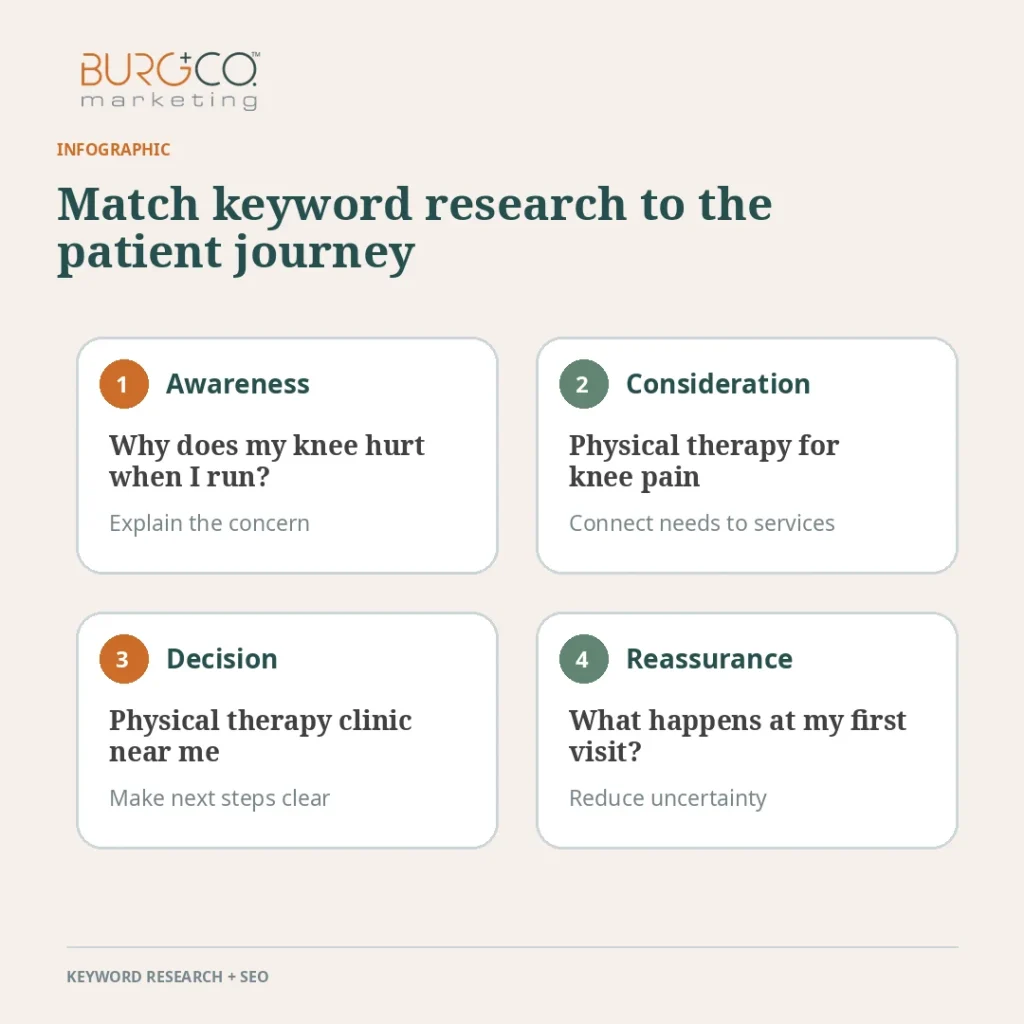
| Patient journey stage | What the person may be searching | What your content should do |
| Awareness | “Why does my knee hurt when I run?” | Explain the concern in plain language |
| Consideration | “Physical therapy for knee pain” | Connect symptoms or needs to possible services |
| Decision | “Physical therapy clinic near me” | Make location, access and next steps clear |
| Reassurance | “What happens at first PT appointment?” | Reduce uncertainty and build trust |
-
SEO helps prioritize the keywords that can support growth
Not all keywords are equally useful. Some have high search volume but weak intent. Others may have lower volume but signal a much stronger chance that someone is looking for care, a provider or a next step.
For healthcare providers, the goal isn’t to rank for every possible keyword. The goal is to rank for the right keywords. That means looking at factors like:
- Relevance — Does this keyword connect to your services?
- Intent — Is the searcher learning, comparing or ready to act?
- Location — Does the query connect to your market?
- Competition — Can your site realistically compete?
- Content fit — Do you have a strong page for this topic?
- Conversion path — Is there a clear next step after someone lands on the page?
A relevant SME insight helps explain why this foundation matters.
“Thorough keyword research matters because business owners need to understand exactly how patients are searching before they build an organic marketing strategy.”
— Kelly Burgess, BURG+CO. Marketing’s founder, CEO, and a certified SEO specialist
That is the real job of keyword research. It’s not just finding popular phrases. It’s understanding how demand, patient intent and business goals intersect.
-
Keyword research guides content depth and topic authority
One blog article can answer one question. A strong content strategy answers a whole cluster of connected questions.
For example, a healthcare provider may want to rank for a broad topic like “physical therapy for back pain.” Keyword research may reveal related searches about causes, treatment options, exercises, appointment timing, insurance, location and what to expect during the first visit.
SEO helps your team turn those related searches into a deeper content ecosystem. That may include a main service page, supporting blogs, FAQs, internal links and structured content that clearly signals your topical expertise.
This is where SEO and keyword research start to feel less like a checklist and more like a growth system. The more clearly your content covers a topic, the easier it can be for search engines and AI tools to understand what your brand knows.
Google also emphasizes helpful, reliable, people-first content. That matters in healthcare because accuracy, clarity and trust are not optional extras. They are the whole point.
-
Keyword research and SEO make organic growth more measurable
Organic growth shouldn’t be measured by rankings alone. Rankings matter, of course. But the better question is whether those rankings are bringing in the right traffic and supporting meaningful action.
A strong strategy may track:
- Organic impressions
- Keyword movement
- Click-through rate
- Service page traffic
- Blog-to-service-page movement
- Calls, forms or appointment requests
- Qualified leads
- Patient acquisition trends
- AI search visibility
- Conversion path performance
This is also where conversion strategy comes into play. If keyword research helps attract the right visitor and SEO helps them find the page, your website still needs to make the next step clear.
Client feedback can show how valuable a strategic SEO partner can be, without implying every organization will see the same experience.
“Kelly and her team are one of the best in the business! We’ve partnered with Burg&Co for the past 3+ years and look forward to furthering our work together. Would strongly recommend for any prospect looking for SEO expertise regardless of industry vertical but particularly in health / digital health.”
— Tim Ming, Co-Founder of Growth Vanguard
The takeaway is simple: Keyword research and SEO are stronger when they are tied to real business goals, not vanity metrics. More visibility is nice. Better visibility, connected to the right patient journey, is the real win.
Keyword research helps healthcare providers understand what patients are searching for. SEO turns those insights into content, structure and visibility that can support organic growth over time. Together, they help your website become more than a digital brochure. BURG+CO. brings keyword research and SEO expertise that can help your site become a trusted resource, a clearer patient pathway and a stronger growth asset.
Want expert support with your digital marketing? Connect with BURG+CO. today to explore how we can help your healthcare brand grow.
FAQs about keyword research and SEO
What is keyword research in SEO?
Keyword research is the process of finding the words and phrases people use when they search online. In SEO, those insights help guide page topics, content structure and optimization.
Why does keyword research matter for healthcare providers?
Healthcare searches often reflect real questions, concerns and barriers. Keyword research helps providers create content that answers those needs in a clear and trustworthy way.
How do keyword research and SEO work together?
Keyword research identifies what people are searching for. SEO uses that information to improve website content, structure, technical visibility and the path from search to next step.
Should every keyword become a blog article?
No. Some keywords are better for service pages, location pages, FAQs, videos or resource hubs. The right format depends on search intent and the role of the page.
How often should healthcare providers update keyword research?
Keyword research should be revisited regularly. Search behavior, competition, services, locations and AI search features can change over time.
What is search intent?
Search intent is the reason behind a search. A person may want to learn, compare options, find a local provider or take action.
What are long-tail keywords?
Long-tail keywords are longer, more specific search phrases. They often have lower search volume but can reveal clearer intent.
Can SEO help with AI platforms like ChatGPT and Gemini?
Yes, strong SEO fundamentals can support AI visibility. Clear structure, helpful answers, topic depth and trustworthy content can make your website easier for AI systems to understand.
What tools can help with keyword research?
Teams may use tools such as Google Search Console, Google Trends, Semrush, Ahrefs or other SEO platforms. The best tool depends on your goals, budget and workflow.
Is keyword research a one-time task?
No. Keyword research works best as an ongoing strategy. Your team should update it as services change, competitors shift and patient search behavior evolves.