
Getting more traffic is great. We love traffic. But if your healthcare website brings in the right people and they still do not call, request an appointment or take the next step, your growth problem may not be visibility. It may be conversion.
Conversion rate optimization tools help healthcare marketers understand what people do after they land on a webpage. These tools can show where users click, how far they scroll, where forms get abandoned and which page elements may be helping or hurting the next step. For healthcare providers, that matters because patients and families are often making decisions with urgency, privacy concerns, location needs and trust questions all happening at once.
Read on to learn everything you need to know about conversion rate optimization tools.
What are conversion rate optimization tools?
Conversion rate optimization tools are platforms that help marketers improve the percentage of visitors who take a desired action. In healthcare marketing, that action may be:
- Requesting an appointment
- Calling a clinic
- Filling out a contact form
- Starting an admissions inquiry
- Downloading a guide
- Clicking to a location or service page
The point isn’t to push people into decisions. Healthcare marketing should never feel like a digital shove. The point is to remove unnecessary friction so people can find clear information and choose their next step with more confidence.
A relevant expert perspective from BURG+CO.’s CEO, Kelly Burgess, says it well:
“Conversion optimization is not always about driving more people to the site. It is about capturing more value from the traffic you already have.”
That is the real magic of CRO. It helps your website do a better job with the audience you have already worked hard to reach.
5 conversion rate optimization tools
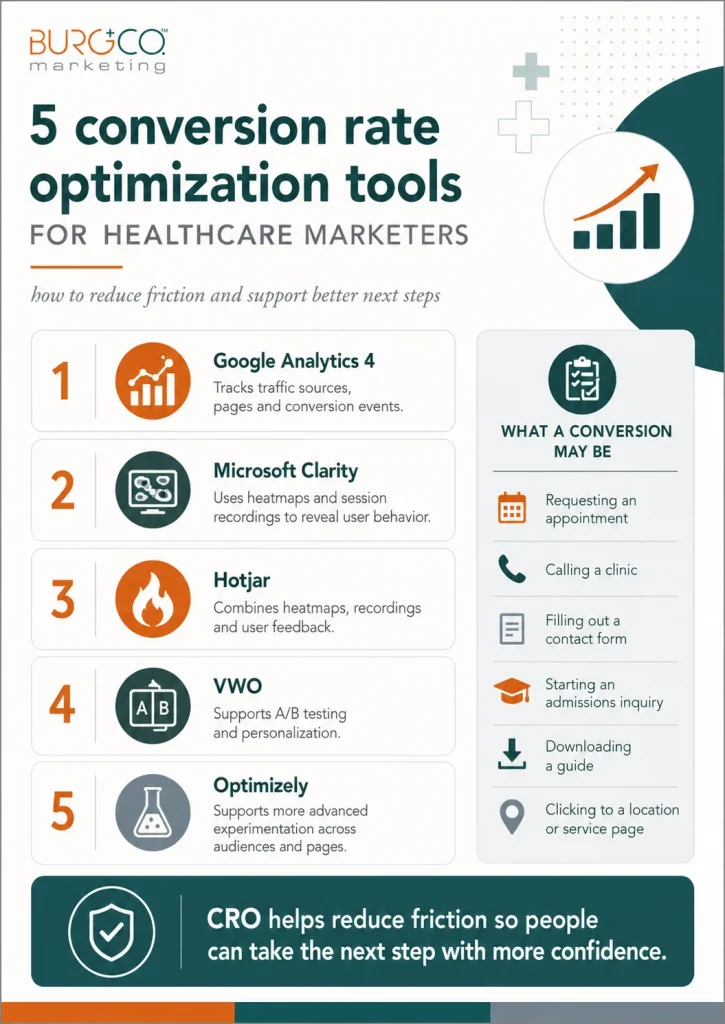
If you’re not sure what tools to incorporate into your digital marketing toolbox, here are 5 conversion rate optimization tools marketers can use to make better website decisions:
-
Google Analytics 4
Google Analytics 4, or GA4, is often the foundation of CRO measurement. It helps marketers see where users come from, which pages they visit and what actions they take.
For healthcare providers, GA4 can help answer questions like:
- Which service pages drive the most appointment clicks?
- Do organic visitors behave differently from paid ad visitors?
- Which blog posts lead users toward core conversion pages?
- Where do users leave the site before contacting the practice?
GA4 will not tell you everything. It is better at showing what happened than why it happened. But when paired with behavior tools, it gives your team the baseline data needed to make smarter CRO decisions.
-
Microsoft Clarity
Microsoft Clarity is a user behavior tool that includes heatmaps and session recordings. Heatmaps show where users click and scroll. Session recordings let marketers review how real users move through a page.
For healthcare websites, this can be especially useful on:
- Appointment request pages
- Admissions pages
- Service pages
- Location pages
- High-traffic blog posts
If users keep missing the “Request an Appointment” button, scrolling past key information or getting stuck on a form, Clarity can help your team see the issue more clearly.
-
Hotjar
Hotjar also offers heatmaps, recordings and feedback tools. It can help healthcare marketers understand user behavior and collect direct feedback from site visitors.
This matters because quantitative data can show that people are dropping off. Feedback tools can help explain why. Maybe the form feels too long. Maybe the insurance information is unclear. Maybe the next step is hidden too far down the page.
-
VWO
VWO is an experimentation platform that supports A/B testing and personalization. A/B testing compares two versions of a page or element to see which performs better.
For a healthcare website, that might mean testing:
- A shorter form against a longer form
- A top-of-page call to action against a lower placement
- A patient-focused headline against a service-focused headline
- A simplified service page layout against a denser version
A/B testing can be helpful, but only when there is enough traffic to create meaningful results. Smaller practices may need to focus first on analytics, heatmaps and qualitative insights before running formal tests.
-
Optimizely
Optimizely is another experimentation platform used for testing digital experiences. For larger healthcare groups, multi-location organizations or health tech companies, it can support more advanced CRO work across multiple audiences and pages.
The key is to test meaningful changes. Button color alone usually isn’t the big strategic lever. Stronger tests often focus on message clarity, page structure, form flow, trust signals and the placement of next-step options.
| Tool category | What it helps you understand | Why it matters for healthcare websites |
| Analytics platforms | Traffic sources, events and conversions | Shows whether users take key actions after arriving |
| Heatmapping tools | Clicks, scrolls and attention patterns | Reveals whether users notice important content |
| Session recording tools | Real user journeys | Helps uncover confusing page experiences |
| A/B testing tools | Which page version performs better | Supports more informed design and copy decisions |
| Form analytics tools | Form starts, errors and drop-offs | Helps reduce friction during high-intent actions |
| Call tracking tools | Calls tied to marketing channels | Connects website activity to offline inquiries |
| Page speed tools | Load time and technical performance | Helps identify slow pages that may frustrate users |
| Accessibility tools | Usability barriers and inclusive design issues | Supports easier access for more people |
| Survey tools | Direct user feedback | Helps explain the “why” behind behavior data |
A quick client perspective on conversion-focused websites
CRO should never be framed as a guarantee. Every organization’s website, audience, market and operations are different. Still, approved client experiences can show how conversion-focused website work has supported real marketing goals.
“We saw a 3x increase in form fill on our website within four weeks of flipping our site over to one of Burg + Co.’s conversion-optimized website templates. We were able to open three new locations from 2019-2021. Our team worked tirelessly to hit these goals, and we appreciate the cohesive help from Burg + Co. on the organic side of our marketing strategy.”
— Armor PT
This example should be read as one client experience, not a promised outcome. However, the broader takeaway is that CRO works best when website structure, SEO strategy, content and user behavior analysis are all moving in the same direction.
BURG+CO. Marketing helps healthcare brands connect SEO, content, analytics and conversion strategy so your website can support a more thoughtful patient journey. Contact our team today for more information about our digital marketing services or to schedule a complimentary consultation.
Want expert support with your digital marketing? Connect with BURG+CO. today to explore how we can help your healthcare brand grow.
FAQs about conversion rate marketing
What are conversion rate optimization tools?
Conversion rate optimization tools help marketers understand and improve how users take action on a website. They may track clicks, forms, calls, page speed, testing results or user feedback.
Why do healthcare providers need CRO tools?
Healthcare providers need CRO tools because website visitors often have specific questions, concerns and next-step needs. CRO tools help identify friction that may make it harder for people to contact the practice.
Are CRO tools the same as SEO tools?
No. SEO tools help improve visibility in search results. CRO tools help improve what happens after someone reaches the website. The strongest strategies often use both.
What is the best CRO tool for healthcare websites?
There is no single best tool for every healthcare website. Many teams start with analytics, heatmaps, recordings and page speed testing, then add A/B testing or call tracking as needed.
Can CRO tools increase patient inquiries?
CRO tools can help teams find and reduce barriers that may affect inquiries. They do not guarantee more patients, but they can support better website decisions.
What does CRO stand for?
CRO stands for conversion rate optimization. It is the process of improving the percentage of users who take a desired action on a website.
What is a conversion in healthcare marketing?
A conversion may be an appointment request, phone call, contact form submission, admissions inquiry, guide download or click to a key service page.
How often should healthcare marketers review CRO data?
Many teams review key CRO data monthly, with deeper reviews each quarter. Higher-traffic websites may benefit from more frequent review.
Do small healthcare practices need CRO tools?
Yes, but they may not need a large tool stack. A smaller practice can often start with basic analytics, heatmaps and page speed checks.
How does CRO support AI search visibility?
CRO can help teams improve page clarity, structure and usefulness. Those improvements can support stronger SEO, AEO and GEO performance over time.