
Healthcare marketing gets expensive fast when every patient sees the same message. Customer segmentation helps healthcare providers group audiences by shared needs, behaviors or decision points so campaigns can feel more useful and less like digital spaghetti tossed at the wall.
For healthcare brands, segmentation is about using the right information to make marketing more respectful, relevant and easier to act on. A first-time patient comparing providers may need education and reassurance. A past patient may need a different reminder, service update or reactivation message. A referring provider may care about access, outcomes and communication.
Done well, customer segmentation can support stronger targeting, clearer content and better use of your budget. Done poorly, it can become messy, over-personalized or privacy-risky.
We’re here to give you the rundown on customer segmentation before diving into strategies that can help boost your return on investment.
What is customer segmentation?
Customer segmentation is the process of dividing a broad audience into smaller groups based on shared traits, behaviors or needs. In healthcare marketing, those groups might include new patients, returning patients, caregivers, referral partners, service-line audiences, location-based audiences or people at different stages of the decision journey.
The goal is to understand enough to answer better questions, such as:
- Who needs this message?
- What information do they need before they act?
- Which service, location or next step fits their situation?
- What would make this message feel helpful instead of pushy?
That last question matters a lot in health care. Patients may be anxious, overwhelmed, busy or unsure what kind of support they need. Segmentation should help your brand meet them with clarity, not pressure.
3 customer segmentation strategies
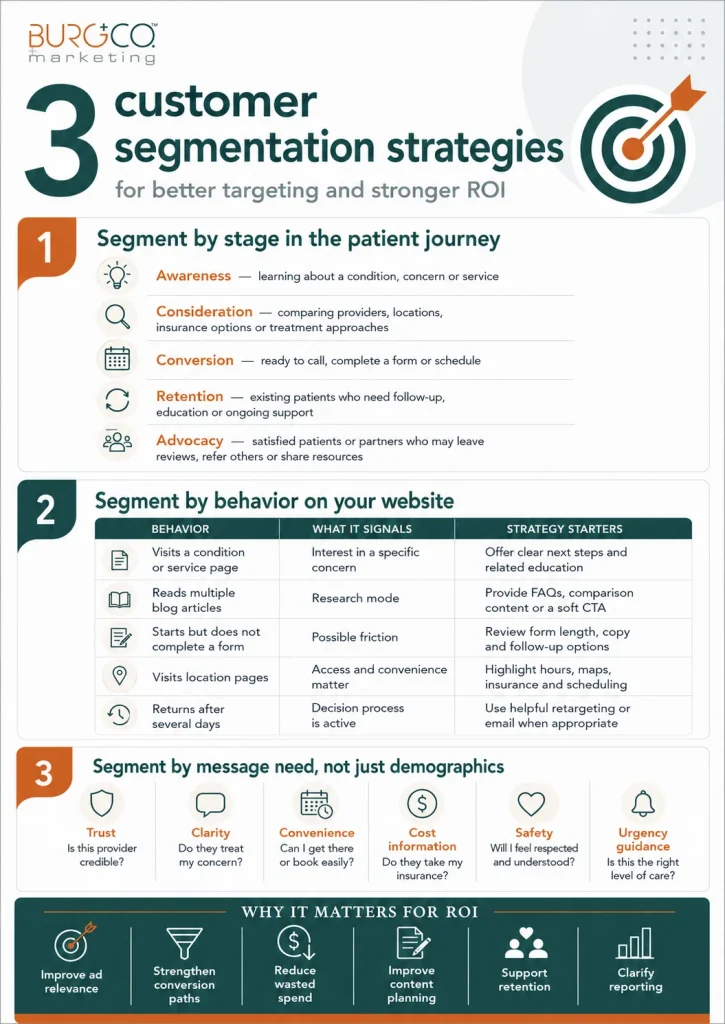
If you’re trying to get the most out of your customer segmentation, and boost your bottom line, here are a few strategies worth testing out:
-
Segment by stage in the patient journey
A person who just started researching symptoms or services isn’t in the same mindset as someone ready to book. Their questions, objections and calls to action shouldn’t be the same either.
Common journey-based segments include:
- Awareness — People who are learning about a condition, concern or service
- Consideration — People comparing providers, locations, insurance options or treatment approaches
- Conversion — People who may be ready to call, complete a form or schedule
- Retention — Existing patients who may need follow-up, education or ongoing support
- Advocacy — Satisfied patients or partners who may leave reviews, refer others or share resources
-
Segment by behavior on your website
Behavioral segmentation uses actions people take, such as pages viewed, forms started, content downloaded, appointment buttons clicked or return visits. This can help your team understand what people are trying to do before they convert.
For example, a visitor who reads three service pages and checks insurance information may need a direct scheduling CTA. A visitor who reads beginner educational content may need a softer next step, such as a guide, FAQ or consultation prompt.
Here is a simple way to think about it:
| Audience behavior | What it may suggest | Helpful marketing response |
| Visits a condition or service page | Interest in a specific concern | Offer clear next steps and related education |
| Reads multiple blog articles | Research mode | Provide FAQs, comparison content or a soft CTA |
| Starts but does not complete a form | Possible friction | Review form length, copy and follow-up options |
| Visits location pages | Access and convenience matter | Highlight hours, maps, insurance and scheduling |
| Returns after several days | Decision process is active | Use helpful retargeting or email when appropriate |
Use this table as a strategy starter, not a diagnosis of intent. Behavior can guide better questions, but it should not lead to creepy assumptions.
-
Segment by message need, not just demographics
Demographics can be useful, but they’re rarely enough. Two people may be the same age and live in the same city, yet need totally different messages.
Message-based segmentation asks what the person needs to understand before taking action. They may need:
- Trust — “Is this provider credible?”
- Clarity — “Do they treat my concern?”
- Convenience — “Can I get there or book easily?”
- Cost information — “Do they take my insurance?”
- Safety — “Will I feel respected and understood?”
- Urgency guidance — “Is this the right level of care?”
This is where healthcare marketing needs empathy and strategy in equal measure.
A helpful segmentation strategy starts with the audience’s real questions, not the brand’s internal preferences.
“A healthcare brand’s content should be built around the audience’s questions, goals and decision-making journey rather than around what the brand wants to say first.”
— Aaron Brintzenhofe, BURG+CO. Marketing’s Director of Content & Growth Operations and a certified content marketing specialist
That mindset keeps segmentation grounded in patient usefulness. The better you understand what people need to know, the easier it is to create content that supports action without forcing it.
How customer segmentation can improve ROI
Customer segmentation can support ROI because it helps reduce waste. Instead of sending every campaign to every person, your team can focus budget, messaging and landing pages around higher-fit audiences.
Segmentation can help you:
- Improve ad relevance — Campaigns can speak to specific needs and service lines
- Strengthen conversion paths — Landing pages can match the audience’s intent
- Reduce wasted spend — Broad audiences can be narrowed with more purpose
- Improve content planning — Blog topics can map to real patient questions
- Support retention — Existing patients can receive more relevant education
- Clarify reporting — Performance can be evaluated by segment, not just by channel
A client perspective can help show how strategic marketing support may feel in practice without treating any one outcome as guaranteed.
“As a healthcare marketing executive, I’m most interested in partnering with external service providers and vendors who just ‘get it’. And that’s Burg + Co.! Our company has partnered with Burg + Co for nearly a year, and in that time they’ve helped my company and I strategize and execute marketing initiatives that have not only increased ROMI, but they’re an absolute delight to work with. Each member of their team thinks and works on behalf of their client, and I’ve come to rely on their collective domain expertise regarding digital marketing best practices. Cannot recommend Burg + Co. enough. KB and her team are an impressive outfit, and I’m thrilled to continue working with them. 5-stars, all around!”
— Kateigh Axness Williams
This testimonial reflects one client’s experience and shouldn’t be read as a guaranteed or typical result. Yet, the practical takeaway is that strategy, execution and audience understanding work best when they stay connected.
BURG+CO. Marketing helps healthcare brands build digital strategies that connect SEO, content, conversion strategy and patient decision-making. If your team wants clearer targeting, better content alignment and a more thoughtful path toward ROI, customer segmentation is a smart place to start.
Want expert support with your digital marketing? Connect with BURG+CO. today to explore how we can help your healthcare brand grow.
FAQs about customer segmentation
What is customer segmentation in healthcare marketing?
Customer segmentation means grouping healthcare audiences by shared needs, behaviors or decision stages so marketing can be more relevant and useful.
Why does customer segmentation matter for healthcare providers?
It helps providers avoid one-size-fits-all messaging. That can make content, ads, emails and landing pages better aligned with patient needs.
What are common healthcare customer segments?
Common segments include new patients, returning patients, caregivers, referral partners, service-line audiences, location-based audiences and people at different journey stages.
Can customer segmentation improve ROI?
It may support better ROI by reducing wasted spend and helping campaigns focus on higher-fit audiences. Results depend on strategy, execution, data quality and follow-through.
Is customer segmentation the same as personalization?
Not exactly. Segmentation groups people by shared traits or behaviors. Personalization adapts specific messages or experiences for those groups or individuals.
What data can healthcare marketers use for segmentation?
Teams may use non-sensitive data such as location, channel, website behavior, service interest and journey stage. Any use of health-related or identifiable data should be reviewed carefully.
How do you start a customer segmentation strategy?
Start with your goals. Then identify key audiences, map their questions, review available data and build simple segments your team can actually use.
What mistakes should healthcare marketers avoid?
Avoid using too many segments, relying only on demographics, making sensitive assumptions or creating messages that feel invasive.
How does segmentation support content marketing?
Segmentation helps teams create content for real audience needs. That may include educational blogs, service pages, FAQs, email content and location-specific resources.
How often should healthcare providers update customer segments?
Review segments at least a few times per year or when services, locations, patient behavior, referral patterns or marketing goals change.