
Healthcare marketers need audience insights, but people expect care-related interactions to feel private and respectful. Zero-party data offers a clearer way forward: People intentionally share information, and your team explains how it will be used. A thoughtful healthcare marketing strategy can turn those preferences into more relevant experiences without treating trust like a line item on a spreadsheet.
In healthcare, even a friendly quiz or email form can create privacy, compliance and governance questions. Let’s unpack how to collect this data with purpose.
What is zero-party data?
Zero-party data is information a person knowingly gives your organization. It may describe preferences, goals, interests or communication choices. Unlike observed behavior, it comes from a direct answer.
Healthcare examples may include:
- Content interests — A visitor chooses topics such as stress management, injury prevention or caregiver support
- Communication preferences — A subscriber selects email or text and chooses how often to hear from you
- Service interests — A prospective patient identifies the type of program or appointment information they want to explore
- Experience feedback — A person voluntarily answers a survey about website navigation or educational resources
Zero-party data is not automatically protected health information or automatically safe to use. Context matters. An ordinary answer can become sensitive when it relates to symptoms, care-seeking or an identifiable person. Privacy and legal teams should review the collection method, use and applicable rules.
How zero-party data differs from other marketing data
The key difference isn’t simply who stores the data. It is how the information is obtained.
| Data type | How it is collected | Healthcare marketing example | Main strategic question |
| Zero-party data | A person intentionally provides it | Selected content topics | Did we clearly explain the value and intended use? |
| First-party data | Your organization observes it through direct interactions | Website engagement or email activity | Are our collection and use practices appropriate? |
| Second-party data | Another organization shares its first-party data | Partner-provided audience insights | Do permissions cover this sharing and use? |
| Third-party data | An outside source aggregates it | Purchased audience segments | Can we verify its origin, consent and fitness for healthcare? |
Labels aren’t a compliance shortcut. Calling information “zero-party” does not override HIPAA, state privacy laws, platform rules or your privacy notice.
Why zero-party data can support better healthcare marketing
When collected thoughtfully, volunteered preferences can help your team reduce guesswork. Instead of inferring that every visitor wants the same next step, you can offer choices.
Zero-party data may help healthcare organizations:
- Create more relevant patient education pathways
- Adjust email topics and frequency based on stated preferences
- Learn which website questions deserve clearer answers
- Segment audiences without relying only on hidden behavioral signals
- Build experiences that give people more control
This approach can strengthen content marketing because it starts with questions your audience has chosen to answer.
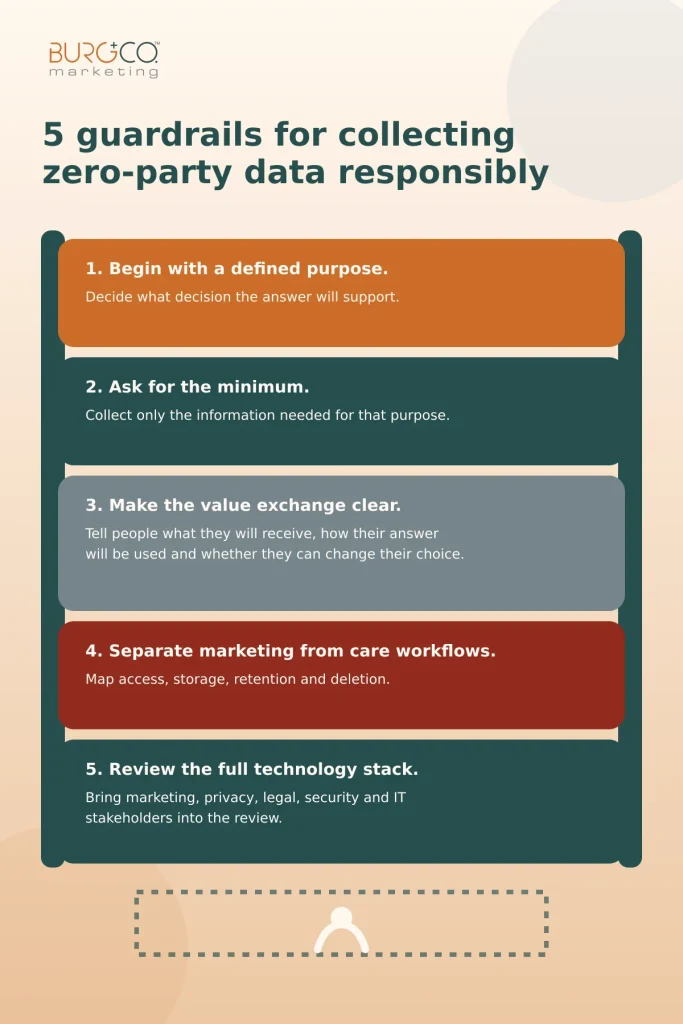
5 guardrails for collecting zero-party data responsibly
A “tell us about yourself” form should not become a vacuum cleaner for every possible detail. Use these guardrails before launching a quiz, survey, preference center or intake-adjacent experience.
- Begin with a defined purpose. Decide what decision the answer will support. If your team cannot explain why a field exists, remove it.
- Ask for the minimum. Collect only the information needed for that purpose. Avoid sensitive health questions when a broader preference will do.
- Make the value exchange clear. Tell people what they will receive, how their answer will be used and whether they can change their choice.
- Separate marketing from care workflows. Do not casually move information between marketing tools, analytics platforms and clinical systems. Map access, storage, retention and deletion.
- Review the full technology stack. Forms, pixels and plug-ins can transmit more information than teams expect. Bring marketing, privacy, legal, security and IT stakeholders into the review.
The FTC has highlighted how tracking pixels on digital health platforms may collect and disclose sensitive information. That makes a full data-flow review more than technical housekeeping.
A UX/UI audit can also uncover places where forms, disclosures or preference controls confuse users.
Turn answers into insight, not assumptions
Zero-party data is useful when your team can act on it carefully. Start with a small question tied to one experience, then measure whether the result is more helpful.
Useful review questions include:
- Are people completing the interaction?
- Are they changing or withdrawing preferences?
- Does the follow-up match what they requested?
- Are teams using the data only for the stated purpose?
- Is the experience improving meaningful actions instead of vanity metrics?
BURG+CO. has gathered data across healthcare marketing campaigns and uses those insights to shape strategy rather than chase disconnected numbers.
A healthcare marketing executive described the value of that partnership this way:
“As a healthcare marketing executive, I’m most interested in partnering with external service providers and vendors who just ‘get it’. And that’s Burg + Co.! Our company has partnered with Burg + Co for nearly a year, and in that time they’ve helped my company and I strategize and execute marketing initiatives that have not only increased ROMI, but they’re an absolute delight to work with. Each member of their team thinks and works on behalf of their client, and I’ve come to rely on their collective domain expertise regarding digital marketing best practices. Cannot recommend Burg + Co. enough. KB and her team are an impressive outfit, and I’m thrilled to continue working with them. 5-stars, all around!”
— Kateigh Axness Williams
That experience is specific to one client, but it illustrates why data strategy works best when the people interpreting it understand healthcare marketing.
BURG+CO. helps healthcare organizations connect audience insight, content, website experience and measurement.
Looking to elevate your healthcare marketing strategy? Reach out to our team for personalized insights and next steps.
FAQs about zero-party data
What is zero-party data in healthcare marketing?
It is information that a person intentionally shares with a healthcare organization, such as content interests or communication preferences.
Is zero-party data the same as first-party data?
No. Zero-party data is deliberately provided. First-party data is a broader category that can include observed interactions such as website activity.
Is zero-party data always HIPAA compliant?
No. A label does not determine compliance. The information, context, systems, entities and intended use all matter.
What are useful ways to collect zero-party data?
Preference centers, short surveys, quizzes and clearly labeled forms can work when each question has a defined purpose.
How can healthcare marketers use zero-party data?
They may use it to tailor educational topics, communication frequency or website pathways, subject to applicable permissions and privacy requirements.
Does zero-party data require consent?
Intentional sharing does not by itself satisfy every consent or authorization requirement; organizations should use clear notices and confirm applicable requirements with counsel. Specific requirements depend on the data and jurisdiction.
What should a zero-party data form explain?
It should explain why information is requested, how it will be used, what the person receives and how choices can be changed.
Can zero-party data replace third-party data?
It can reduce reliance on some third-party sources, but it will not meet every research, measurement or audience-planning need.
Who should oversee zero-party data collection?
Marketing should collaborate with privacy, legal, security, IT and clinical or operational leaders as appropriate.
How should a healthcare organization get started?
Choose one low-risk use case, define its purpose, collect only what is needed and review the full data flow before launch.