

Healthcare has come a long way over the last few decades. You used to have to wait days, if not weeks, to get an appointment with a provider. Then, you would have to take several hours out of your busy schedule to commute there, twiddle your thumbs in the waiting room and hope that you’re the next to be seen.
In this day and age, you can not only quickly access information that can help you decide if your concern requires a doctor’s appointment, but you can receive telehealth services to receive care conveniently in your own home. That’s why, as a healthcare provider, knowing about digital healthcare market trends should be a priority.
In your digital marketing strategy, content and search engine optimization should be two of the pillars. SEO helps your site to rank high on relevant search engine results pages (SERPs) for increased traffic. Content marketing can be used in your SEO strategy by connecting relevant concerns to your treatment as a way to encourage conversions.
We’re here to guide you through a few digital healthcare market trends. We’ll also discuss how you can use them as tips to make the most of the digital health wave that we’re having at the moment.
Top 3 digital health market trends in 2025
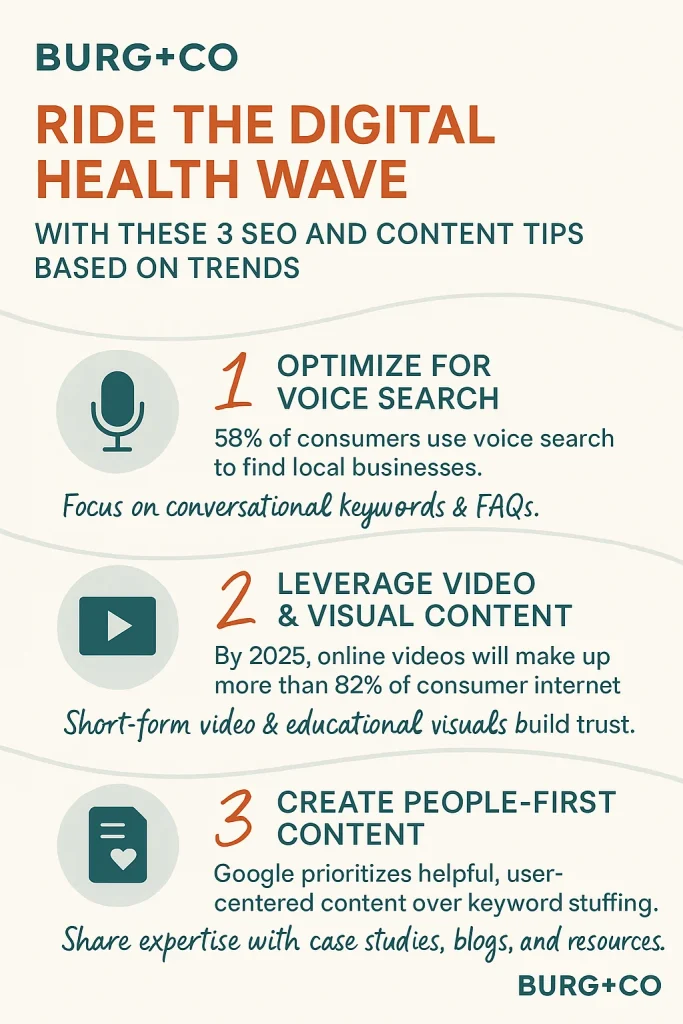
When we’re talking about what SEO and content tips you should incorporate into your marketing strategy, looking at the digital healthcare market trends can help you stay on top of what patients are gravitating toward.
Here are three digital market trends worth paying attention to:
-
Expansion of telehealth and hybrid care models
People do everything online, from paying their bills to ordering groceries. So it makes sense that they would also want their healthcare available online as well.
While telehealth became prevalent during the COVID-19 pandemic, it never really lost steam afterward. In fact, it only continued to evolve, especially with hybrid models being more utilized. Now, we’ve reached the point where more than 80% of patients prefer hybrid care to fully in-person treatment.
There’s also the virtual-first care approach with traditional healthcare, allowing patients to start their patient journey with your practice online before needing to come in for an appointment. This can include talking to AI chatbots about their concern or evaluating their need for an appointment using evaluation tools, such as a quiz.
Telehealth has made a significant positive impact on people wanting to receive mental healthcare, such as therapy. It boosts accessibility and engagement during sessions due to being in their own space.
-
Consumerization and personalized health experiences
Every patient has unique symptoms, needs and goals that impact their health and wellness journey, which is why they want their healthcare experience to be as personalized as possible. One way to provide a personalized health experience is through technological advances that they can purchase such as:
- Wearable tech, like smartwatches
- Mobile health applications to track progress and monitor symptoms
- AI health recommendations for on-demand support
These types of advances have shown a switch toward a “healthcare as a service” mindset, meaning that the goal is to sell your services to patients as a way to provide value. While health is an integral aspect of a person’s life, people may not always consider the ways that external support can make a difference.
-
Focus on preventive and mental healthcare
With the rise of health-centric content creators and open discussions about mental healthcare, research shows that people, especially the younger generations, are prioritizing their overall health more in 2025.
Medical advancements have encouraged early intervention for medical challenges, whether it be a physical or mental health condition. Digital tools, such as wellness tracker apps, allow for preventive and proactive care that improves outcomes by catching the concerns early and getting ahead of the problem.
3 ways you can use SEO and content marketing to capitalize on trends
Now that you know what trends are floating to the top in digital healthcare, it’s time to put them into action by integrating them into your SEO and content strategies.
Here are three SEO and content tips that are based on trends:
-
Create educational, trust-building content
There are many trends in the healthcare space that can work as focal points for your content. Examples include blog posts about the benefits of telehealth or using app-based mental health support.
By creating content that helps to inform patients about potential healthcare challenges and digital solutions, they can learn to advocate for what they need to take an active role in their own wellness journey.
Your content should also showcase the “E-A-T” of your brand:
- Expertise
- Authoritativeness
- Trustworthiness
You can use your content to build trust and showcase your credibility to boost your reputation and strengthen your provider-patient relationships. This can involve using specific statistics, reliable sources and reviews from past patients.
-
Optimize for local and voice search
There are two things that are known to be true about patients in the digital age:
- They want to get their medical information with as little effort as possible.
- They don’t want to go far for their medical treatment.
That’s why local and voice search have both become more and more prevalent. Local SEO helps your site appear in SERPs and Maps results in the surrounding areas. You can use geo-targeted SEO for telehealth and hybrid services, meaning that you’re aiming your efforts toward a specific area.
In this case, it would be for areas that you’re licensed to provide telehealth and hybrid services for. Try to use locally-relevant keywords in your content and keep your Google Business Profile updated.
When it comes to voice search, you want to be the answer when a person verbally asks their virtual assistant a healthcare question or for a provider recommendation. Optimizing for this type of search involves taking a more conversational approach to your content while still using location-based keywords. You’ll also want to prioritize the mobile-friendliness of your site.
-
Building conversion-focused digital funnels
The digital funnel is the journey that a patient goes through with your practice once they learn about your practice online. While it can look different based on who you’re asking, the funnel phases are:
- Awareness — Finding out about your practice through marketing
- Consideration — Engaging with your site and comparing you to competitors
- Conversion — Taking action to further their connection with you, such as booking an appointment
- Loyalty — Becoming a recurring patient who refers you to others
With conversions being the key to acquiring a new patient, they should always be the main goal of your marketing efforts. A few ways that you can create conversion-focused digital funnels include:
- Creating lead magnets tailored for each trend, such as free telehealth consultations
- Building landing pages on your site that are optimized for trendy keywords
- Utilizing schema markup to increase visibility in SERPs
Want to attract new patients to your website by following digital healthcare market trends? BURG+CO. can help
The healthcare digital space is quickly evolving and marketers must meet patients where they are. By keeping up with the market trends, and using content strategies based in SEO, you’re taking the steps needed to boost your site’s online visibility, relevance and growth. At BURG+CO., we’ll help you navigate the trends and figure out how to use them to your advantage.
Our team has years of experience in helping healthcare brands improve their digital presence to attract new patients and retain existing ones. If you’re looking to perform better in search engine results and attract more potential patients to your site, we’re ready to talk to you to see how we can help.
Contact our team today for more information about our digital marketing services or to schedule a complimentary consultation.