
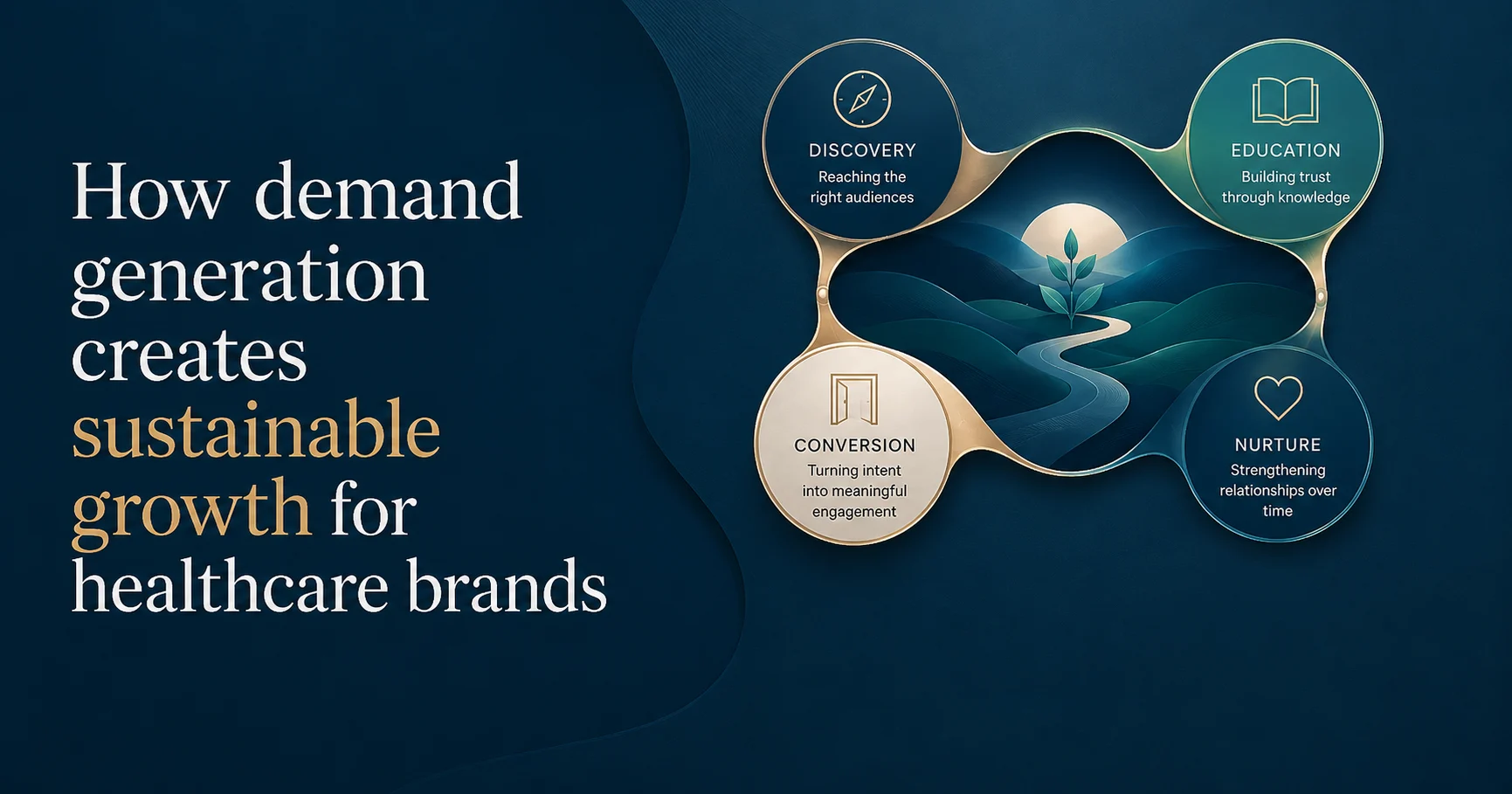
Healthcare organizations rarely have a shortage of marketing tactics. The harder problem is getting those tactics to work together long enough to create steady demand. A strong demand generation strategy connects content marketing, search visibility, reputation, conversion paths and follow-up around what prospective patients actually need to know before they choose care.
For healthcare brands, that distinction matters. Patient decisions can involve research, uncertainty, comparison and multiple touchpoints. Demand generation gives those touchpoints a shared job: help the right people discover your organization, understand its value and feel confident taking the next step.
What is a demand generation strategy?
A demand generation strategy is a coordinated approach to building awareness, interest and trust before someone is ready to become a lead. Lead generation focuses more narrowly on capturing an action, such as a form fill or appointment request. Demand generation creates the conditions that make that action more likely later.
That usually means connecting several disciplines instead of treating them as separate campaigns:
- SEO and AEO — Help people find clear answers when they search on Google or use AI-powered discovery tools.
- Content marketing — Answer questions, explain services and build familiarity before a prospective patient is ready to contact you.
- Conversion strategy — Give people logical next steps without forcing every visit into an immediate sales action.
- Email and nurture content — Stay useful after initial interest, especially for longer consideration cycles.
- Reputation and authority building — Reinforce credibility through expert input, third-party mentions and consistent brand signals.
- Measurement — Track whether visibility and engagement are contributing to qualified inquiries, appointments and sustainable growth.
Google recommends creating “helpful, reliable, people-first content,” which is especially relevant in health-related search where trust matters.
Why campaign-by-campaign marketing can stall healthcare growth
A paid campaign can create visibility quickly. A high-performing landing page can improve conversion. A strong blog article can attract organic traffic. None of those is a problem on its own.
The problem appears when each tactic has to start from zero.
If your organization stops generating demand every time a media budget pauses, an email sequence ends or a campaign expires, growth becomes harder to forecast. That can push marketing teams into a cycle of constantly replacing yesterday’s traffic rather than building assets that compound.
The long-term opportunity is to create a system in which one channel strengthens another. Search content can support email nurture. Digital PR can strengthen authority. A better website can convert traffic from both paid and organic channels. Educational content can answer questions before a prospective patient ever reaches an intake team.
That is where predictable growth becomes more realistic: not because demand is guaranteed, but because the organization owns more of the infrastructure that creates it.
This principle is especially clear in organic marketing.
“When organizations invest in organic strategies like SEO and AEO, they are not just buying temporary visibility. They are building demand assets that can keep working over time.”
— Kelly Burgess, BURG+CO. Marketing’s founder, CEO and a certified SEO specialist
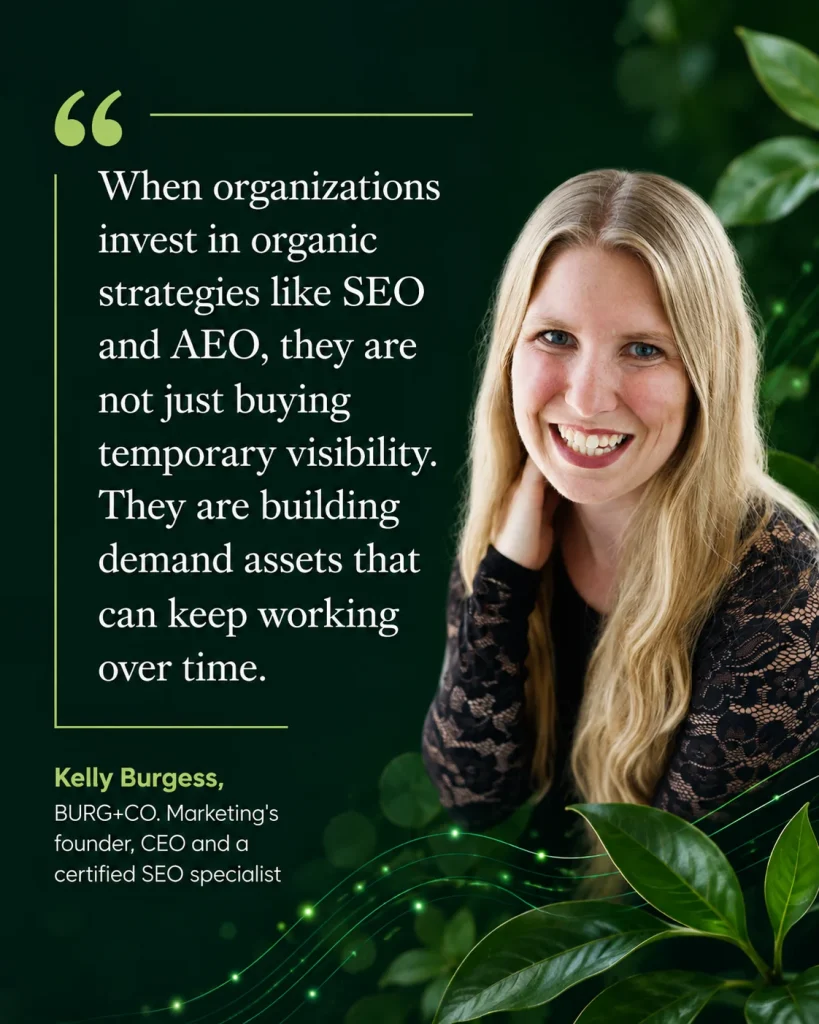
The takeaway is not “organic good, paid bad.” Paid media can be valuable. The point is that sustainable demand generation strategies balance short-term reach with owned assets that can continue supporting discovery and decision-making.
What sustainable healthcare demand generation looks like
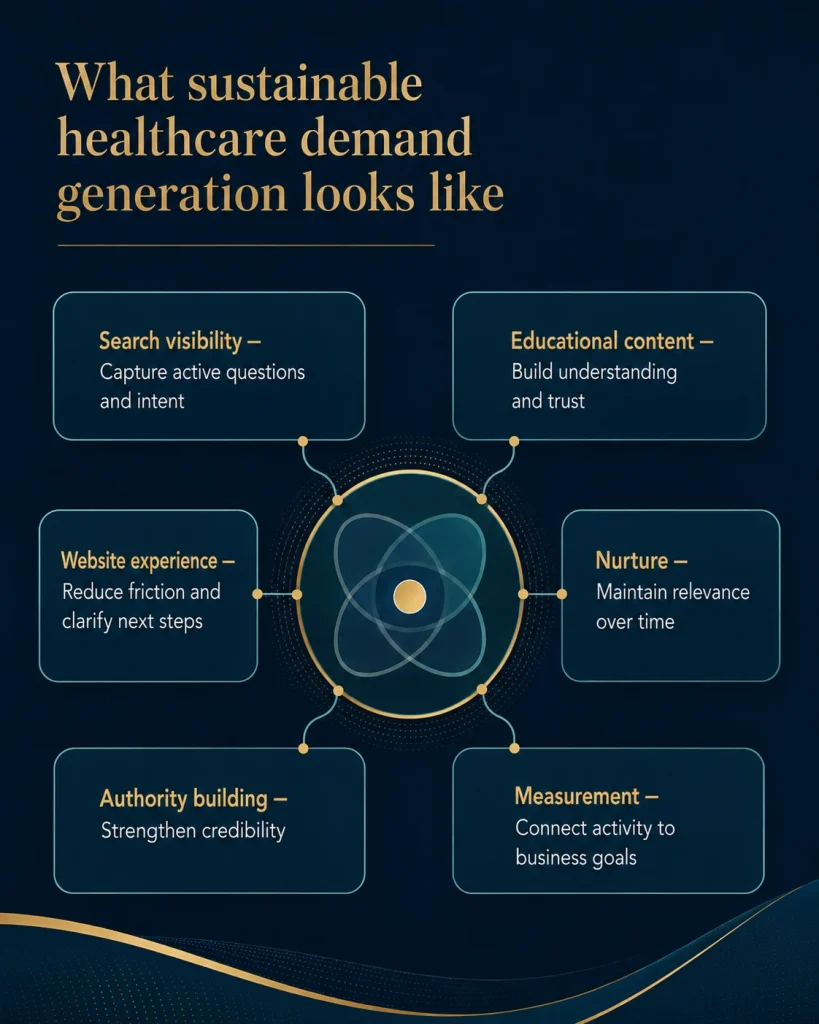
A sustainable strategy does not mean doing everything everywhere. It means choosing channels based on the patient journey and making sure each one contributes to a larger system.
| Strategy area | What it should do | Sustainable-growth question |
| Search visibility | Capture active questions and intent | Are we discoverable when people research this need? |
| Educational content | Build understanding and trust | Are we answering the questions that delay decisions? |
| Website experience | Reduce friction and clarify next steps | Can a visitor quickly understand what to do next? |
| Nurture | Maintain relevance over time | Do we stay useful when someone is not ready today? |
| Authority building | Strengthen credibility | Are trusted signals reinforcing what we say about ourselves? |
| Measurement | Connect activity to business goals | Are we learning which touchpoints contribute to qualified demand? |
The most useful demand generation strategy is one your team can actually operate, measure and improve. A six-channel plan with no ownership is usually less sustainable than a focused three-channel system with clear goals and reporting.
Your website is central to that system because many channels ultimately send people there to learn, compare or act. A site that is difficult to navigate can waste demand that other channels worked hard to create.
Build demand around patient questions, not just service keywords
Keyword targeting still matters, but a mature strategy goes beyond a list of service terms. Prospective patients often ask questions about symptoms, options, logistics, insurance, cost, provider fit and what happens next.
That creates opportunities to build content around distinct stages of consideration:
- Problem awareness — Help people understand the issue they are trying to solve.
- Option exploration — Explain treatment, service or provider options in plain language.
- Comparison — Clarify differences that matter to the decision.
- Trust building — Show expertise, credentials, process and real-world context.
- Action — Make scheduling, contacting or asking a question easy.
This approach also supports AI discovery. Google says the same foundational SEO practices apply to AI Overviews and AI Mode, including useful content, crawlability, internal links and a strong page experience.
For healthcare marketers, that means the best GEO or AEO work is not a separate layer of magic. It starts with content that is specific, trustworthy, well structured and genuinely useful.
Make conversion part of demand generation, not an afterthought
Demand is not valuable if people hit a wall when they are ready to act. Conversion strategy should be built into the journey from the beginning.
That can mean:
- Clear calls to action that match the page’s intent.
- Service pages that explain who a service is for and what happens next.
- Fast, mobile-friendly experiences.
- Contact and scheduling paths that are easy to find.
- Follow-up that reflects what the person has already shown interest in.
- Reporting that connects marketing activity with meaningful outcomes.
Healthcare teams also need to be thoughtful about how they measure digital behavior. HHS guidance addresses how HIPAA obligations can apply when regulated entities use online tracking technologies, depending on the information collected and disclosed.
The marketing lesson is simple: measurement matters, but healthcare measurement needs governance. Your analytics plan should be built with appropriate privacy, legal and compliance review rather than copied from a generic e-commerce playbook.
Sustainable growth comes from an integrated operating system
Demand generation becomes more powerful when teams stop asking, “Which channel gets credit?” and start asking, “How do these channels help the same person move forward?”
A prospective patient might first discover a useful article, later see the brand in search, return through a branded query, read a service page and finally schedule. Trying to force one touchpoint to claim the entire journey can lead to poor budget decisions.
Instead, define a small set of shared outcomes. Depending on the organization, those may include:
- Qualified organic visibility.
- Engagement with high-intent service content.
- Growth in branded demand.
- Conversion rates on priority pages.
- Qualified inquiries or appointment requests.
- Contribution to patient acquisition and retention goals.
This is also why channel silos can be expensive. Telehealth brands, for example, may need SEO, content and conversion experiences to work together when the market is crowded and trust barriers are high.
A healthcare marketing leader described the value of that kind of partnership this way:
“As a healthcare marketing executive, I’m most interested in partnering with external service providers and vendors who just ‘get it’. And that’s Burg + Co.! Our company has partnered with Burg + Co for nearly a year, and in that time they’ve helped my company and I strategize and execute marketing initiatives that have not only increased ROMI, but they’re an absolute delight to work with. Each member of their team thinks and works on behalf of their client, and I’ve come to rely on their collective domain expertise regarding digital marketing best practices. Cannot recommend Burg + Co. enough. KB and her team are an impressive outfit, and I’m thrilled to continue working with them. 5-stars, all around!”
— Kateigh Axness Williams
That experience is one example, not a guarantee of results. The broader takeaway is that demand generation works best when strategy, execution and measurement stay connected.
BURG+CO. Marketing helps healthcare organizations connect content, search visibility and conversion strategy around real growth goals. Our team works to become a true extension of your team, so the strategy can keep evolving instead of becoming another marketing plan that sits in a folder.
Want expert support with your digital marketing? Connect with BURG+CO. today to explore how we can help your healthcare brand grow.
FAQs about demand generation strategy
What is the difference between demand generation and lead generation?
Demand generation builds awareness, interest and trust across the decision journey. Lead generation focuses more directly on capturing contact information or another measurable action.
Why is demand generation important for healthcare brands?
Healthcare decisions often require research and trust before someone takes action. Demand generation helps organizations provide useful information throughout that process rather than relying only on immediate-conversion campaigns.
Which channels belong in a healthcare demand generation strategy?
The right mix varies, but it may include SEO, AEO, content marketing, digital PR, email nurture, conversion optimization and selected paid channels. The key is making those channels support shared growth goals.
How does SEO support sustainable demand generation?
SEO can help useful content remain discoverable after it is published. That gives healthcare organizations an owned demand asset that can continue reaching relevant searchers without buying every visit.
How can healthcare brands measure demand generation?
Start with metrics tied to the journey, such as qualified visibility, engagement with priority content, branded demand, conversion rates and qualified inquiries. Measurement practices should also receive appropriate privacy and compliance review.
How long does a demand generation strategy take to work?
There is no universal timeline. Paid channels can create reach quickly while SEO, content authority and organic visibility often require sustained execution and improvement.
Can a B2B demand generation strategy work in healthcare?
Yes. A B2B demand generation strategy can support organizations marketing to health systems, provider groups, referral partners, employers or other professional audiences. The content and conversion journey should reflect how those buyers research and make decisions.
Does demand generation replace paid advertising?
No. Paid media can be one useful part of the system. Sustainable strategies often combine paid reach with owned assets such as content, search visibility, website experiences and nurture programs.
How can demand generation support visibility in AI search?
Create clear, useful content that answers specific questions, demonstrates expertise and is technically accessible to search engines. Strong SEO fundamentals also remain relevant to AI-powered search experiences.
What should a healthcare organization do before building a demand generation strategy?
Start by defining the audience, growth goals, patient or buyer journey and existing channel performance. Then identify the biggest visibility, trust and conversion gaps before choosing tactics.