
Healthcare providers do meaningful work, but patients and referral partners still need a clear reason to choose one organization over another. A strong brand positioning strategy gives your digital marketing strategy that clarity. It defines who you serve, what you do especially well and why it matters.
Positioning is not a clever tagline dressed up for a strategy meeting. It is the center that keeps your website, content, search presence and patient experience moving in the same direction.
For healthcare brands, the work carries extra weight. People may compare providers while worried or unsure what to ask. Your positioning should clarify the choice without overselling care or flattening complex needs.
What is a brand positioning strategy?
A brand positioning strategy is a plan for shaping the distinct place your organization holds in an audience’s mind. It connects a defined audience, relevant need, credible difference and consistent promise. In plain English, it answers: Who are we for? Why should they consider us? What should they expect?
Brand strategy and positioning are related but not identical. Brand strategy covers purpose, personality, visual identity and experience. Positioning focuses that system around the difference you want people to remember.
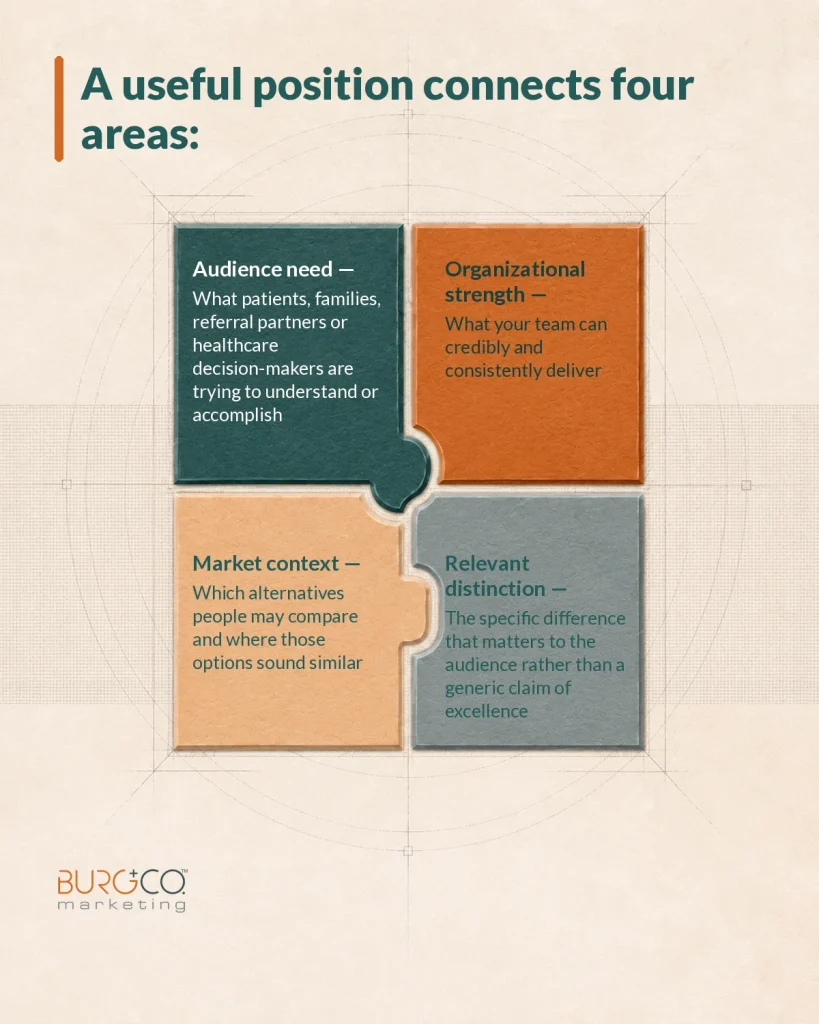
A useful position connects four areas:
- Audience need — What patients, families, referral partners or healthcare decision-makers are trying to understand or accomplish
- Organizational strength — What your team can credibly and consistently deliver
- Market context — Which alternatives people may compare and where those options sound similar
- Relevant distinction — The specific difference that matters to the audience rather than a generic claim of excellence
7 ways a strong brand positioning strategy helps you down the road
If you’re looking for long-term growth, here are a few reasons your brand positioning strategy should be a priority:
-
It gives the right audience a reason to pay attention
Strong positioning starts with focus. “Everyone who needs care” is technically an audience, but it is not a useful marketing target. Different provider types face different decision paths and trust questions.
Define the people whose needs best match your services. Then identify the problem your organization can address and the context surrounding the decision. This gives your brand a lane without dismissing others.
A focused position can also improve your healthcare marketing strategy. Teams can prioritize channels, topics and calls to action based on the audience they want to reach rather than trying to say everything at once.
-
It turns real differentiators into a credible promise
Many healthcare organizations describe themselves as compassionate, experienced and patient-centered. Those qualities matter, but they are often the price of entry. Useful positioning translates a genuine strength into an audience-relevant promise.
Your differentiator might involve a specialty, integrated model, access approach, geographic footprint or experience designed for a particular population. The claim should guide a choice and withstand scrutiny.
Ask whether your team can point to processes, expertise, service design or experience standards that make the promise believable. If not, it may be wishful thinking in a nice blazer.
Use the table below to pressure-test the position before turning it into campaign copy.
| Positioning element | Question to answer | Healthcare application | Growth connection |
| Audience | Who is the best fit? | Define patients, families, referral partners or decision-makers | Concentrates resources on relevant demand |
| Need | What are they trying to solve? | Identify practical, emotional and access questions | Makes messaging more useful |
| Difference | Why consider this organization? | Name a specific, supportable strength | Reduces look-alike marketing |
| Proof | Why should people believe it? | Use accurate expertise, process and experience evidence | Builds confidence without hype |
| Experience | What should every touchpoint feel like? | Align language, design and next steps | Supports consistency as the brand grows |
The takeaway: Each element should support the next. A bold promise with weak proof cannot carry the weight of a clear, demonstrable one.
-
It makes a consistent brand feel human, not robotic
Consistency does not mean repeating one slogan until everyone needs a nap. It means expressing the same core idea through language, design and behavior. Different formats can adapt without making the brand feel like three organizations.
This is where brand voice earns its keep. A defined voice helps writers, clinicians, leaders and agency partners sound connected. It also shows patients what engaging with the organization may feel like.
That human connection is worth protecting as a healthcare brand expands.
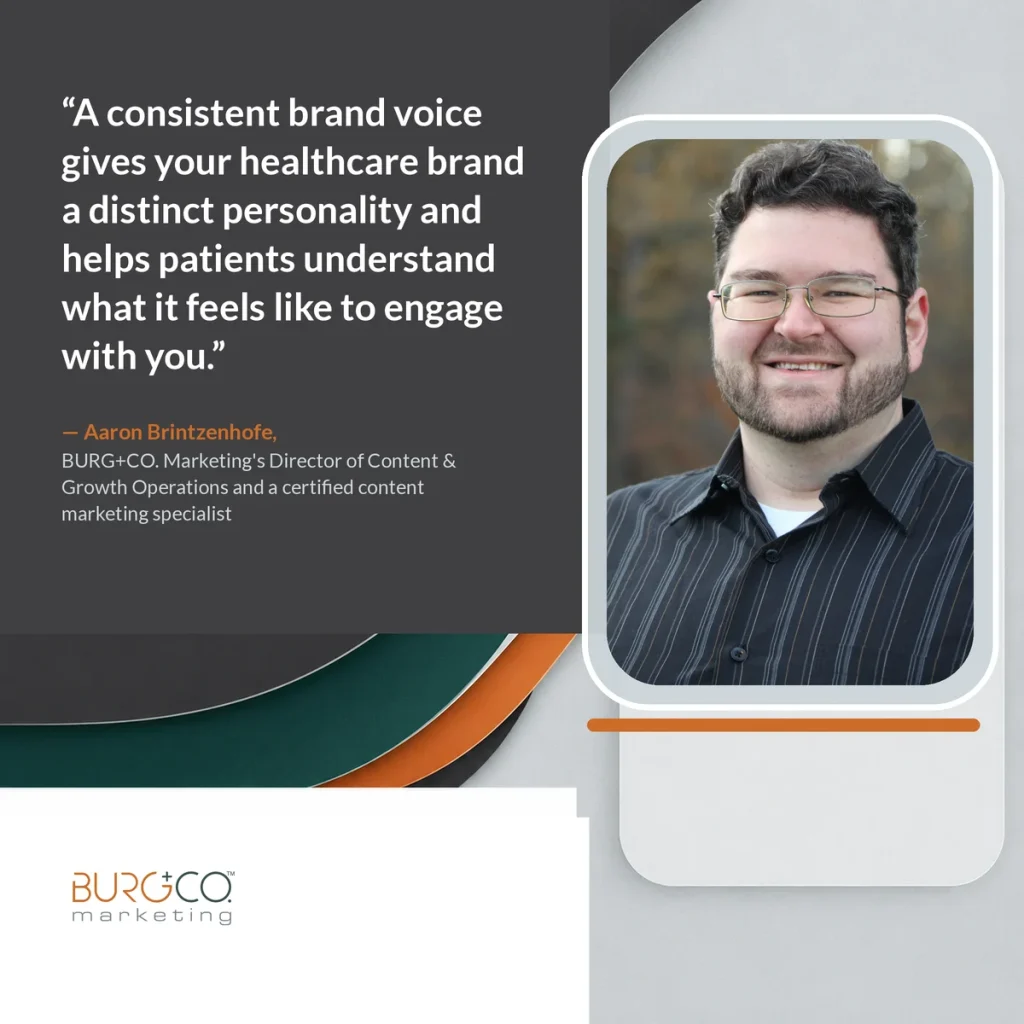
“A consistent brand voice gives your healthcare brand a distinct personality and helps patients understand what it feels like to engage with you.”
— Aaron Brintzenhofe, BURG+CO. Marketing’s Director of Content & Growth Operations and a certified content marketing specialist
Document the position, key messages, voice principles and examples. A short, usable guide will do more good than a beautiful deck nobody opens after launch day.
-
It sharpens content, SEO, AEO and GEO
Positioning gives content teams a useful filter: Does this topic help the audience understand a need, evaluate an option or recognize distinct value? That question can reduce disconnected content.
It also supports search engine optimization, answer engine optimization and generative engine optimization. Clear, well-structured information about services and audience questions can help search and AI systems interpret your content. Positioning cannot replace technical SEO, but it can keep your content strategy focused.
People-first content remains the goal. Answer real questions, structure information clearly and use keywords naturally. This helps people use the content and search or AI platforms interpret it.
-
It aligns the experience from search result to next step
A position only works if people can feel it across the patient journey. A brand that promises clarity but offers vague service pages creates friction. A brand positioned around access should not hide contact options.
Audit the full website experience against the position. Review language, navigation, provider information, forms and calls to action. Find where the experience reinforces the promise and where it argues with it.
Healthcare content should be easy to find, understand and act on across reading levels. That means organizing accurate information for use, not removing nuance.
-
It protects trust by setting boundaries around claims
Healthcare positioning must be compelling and careful. It does not need guaranteed outcomes, fear-based language or claims that outrun the evidence. Those shortcuts can weaken trust.
Create message guardrails alongside the position. Document approved claims, supporting evidence and required reviewers. Privacy and marketing rules should also stay in the room when campaigns use patient information or target specific audiences.
Health-related advertising claims should be truthful, not misleading and appropriately supported. Credible positioning can be memorable without borrowing certainty it has not earned.
-
It creates a clearer system for long-term growth
Positioning supports growth by improving decisions across channels. Teams can judge new services, markets, campaigns and partnerships against it. The strategy becomes a compass, not another PDF collecting digital dust.
Track whether the position appears in outcomes that matter. Indicators may include qualified inquiries, conversion paths, priority-topic visibility, referral feedback and message recall. Select measures that fit your goals and data.
A broader growth marketing strategy can build on what you learn. Review the position after meaningful changes in markets, services, audiences or competitive context.
Outside expertise can help an internal team turn strategy into consistent execution. One client described that experience this way:
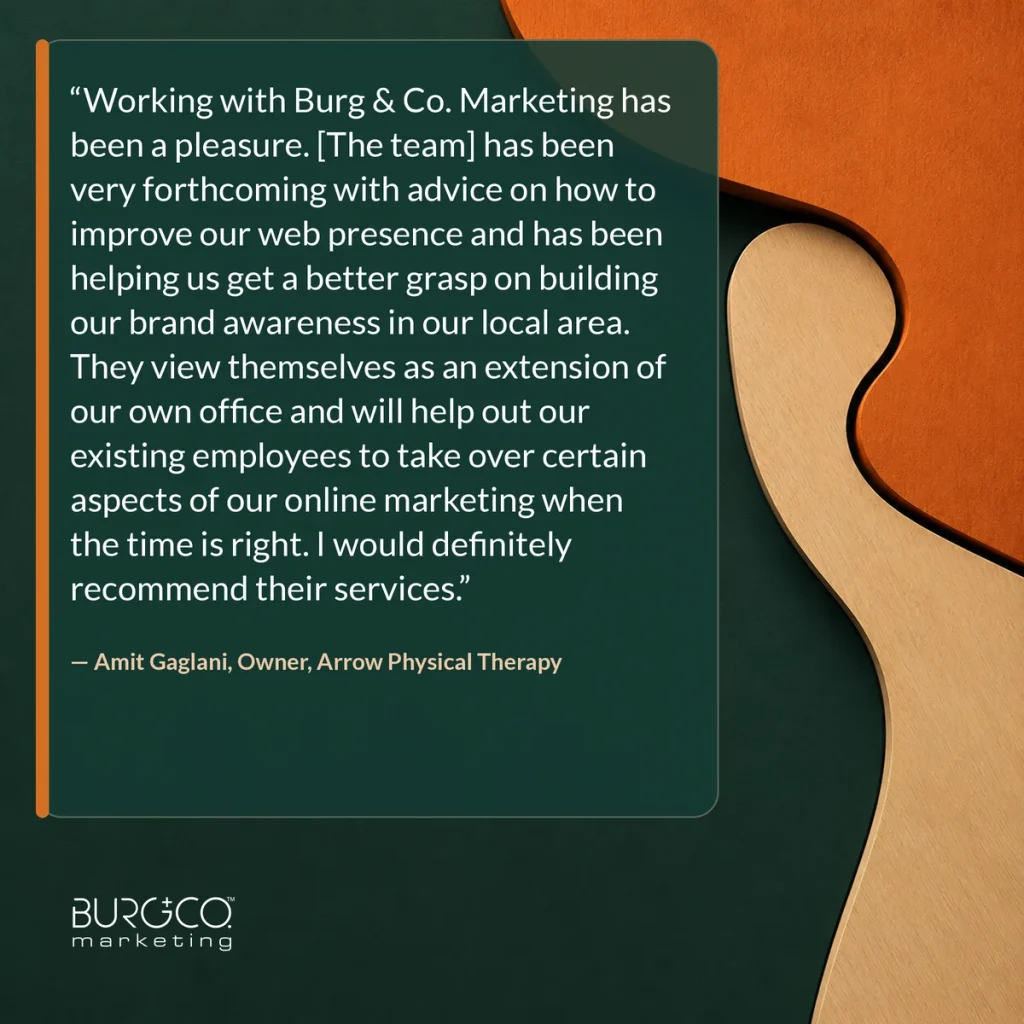
“Working with Burg & Co. Marketing has been a pleasure. [The team] has been very forthcoming with advice on how to improve our web presence and has been helping us get a better grasp on building our brand awareness in our local area. They view themselves as an extension of our own office and will help out our existing employees to take over certain aspects of our online marketing when the time is right. I would definitely recommend their services.”
— Amit Gaglani, Owner, Arrow Physical Therapy
That perspective is not a promise of identical results. It highlights how partnership can support the team while building clarity.
BURG+CO. Marketing helps healthcare organizations connect patient needs with purposeful content, search visibility and digital experiences.
Looking to elevate your healthcare marketing strategy? Reach out to our team for personalized insights and next steps.
FAQs about brand positioning strategy
What is a brand positioning strategy?
A brand positioning strategy defines the distinct place an organization aims to hold in an audience’s mind. It connects a specific audience, relevant need, credible difference and consistent promise.
How can positioning support long-term growth?
Positioning can improve focus across content, search, website experience and campaigns. It helps teams make connected decisions and gives audiences a clearer reason to consider the organization.
What should a healthcare positioning statement include?
It should identify the audience, need, relevant difference and credible reason to believe. Keep it specific enough to guide marketing choices and flexible enough to work across channels.
How does positioning affect SEO, AEO and GEO?
Clear positioning helps teams create focused content around audience questions and service expertise. It supports consistency, but it does not replace technical optimization, accurate information or a strong website.
How should healthcare providers measure positioning?
Choose measures tied to the strategy, such as qualified inquiries, conversion behavior, visibility for priority topics, referral feedback and message recall. Use multiple signals instead of one metric.
What is the difference between positioning and branding?
Positioning defines the meaningful place the brand should hold in an audience’s mind. Branding is the larger system that expresses it through identity, voice, content and experience.
Can a small healthcare practice use brand positioning strategies?
Yes. A small practice can clarify whom it serves, what makes its approach relevant and how that difference should appear across its website and communications.
When should a healthcare organization reposition its brand?
Consider repositioning after major changes in services, audience needs, markets or competitive context. Research first so the shift responds to evidence rather than a passing trend.
Who should own brand positioning inside an organization?
Marketing may lead the process, but leadership, clinical, operational and patient-facing teams should contribute. Shared input helps keep the promise accurate and deliverable.
How long does brand positioning take to work?
There is no universal timeline. Research, organizational alignment, market conditions and consistent execution all affect how quickly audiences recognize and respond to a position.