
Your patients aren’t one big, identical audience. They have different concerns, goals and levels of readiness. Personalized healthcare marketing helps you respond with more relevant content while keeping the experience human, helpful and privacy-conscious. A thoughtful healthcare content marketing strategy can turn broad outreach into a clearer path toward care.
Personalized healthcare marketing adapts messages, content or digital experiences to a defined audience’s needs. It may use service interests, location, search intent or stage of the patient journey. It doesn’t mean placing sensitive health information into every available marketing platform. Effective personalization balances relevance with consent, privacy and sound data practices.
CMS describes person-centered care as responsive to an individual’s goals, values and preferences. Marketing isn’t care delivery, but the same audience-first mindset can make communication more useful.
Here are seven ways personalizing your marketing efforts can improve your engagement:
-
It makes content more relevant
Generic messaging asks every reader to dig for the information that applies to them. Personalization brings the most useful information closer to the surface.
A health system might develop distinct content paths for parents seeking pediatric care, adults comparing therapy options and patients researching rehabilitation services. Each audience receives relevant answers without changing the organization’s core brand.
-
It reflects the patient’s decision-making journey
Someone researching symptoms has different questions from someone comparing locations or reviewing insurance information. Personalized healthcare marketing accounts for these differences and where a person is in their decision-making journey.
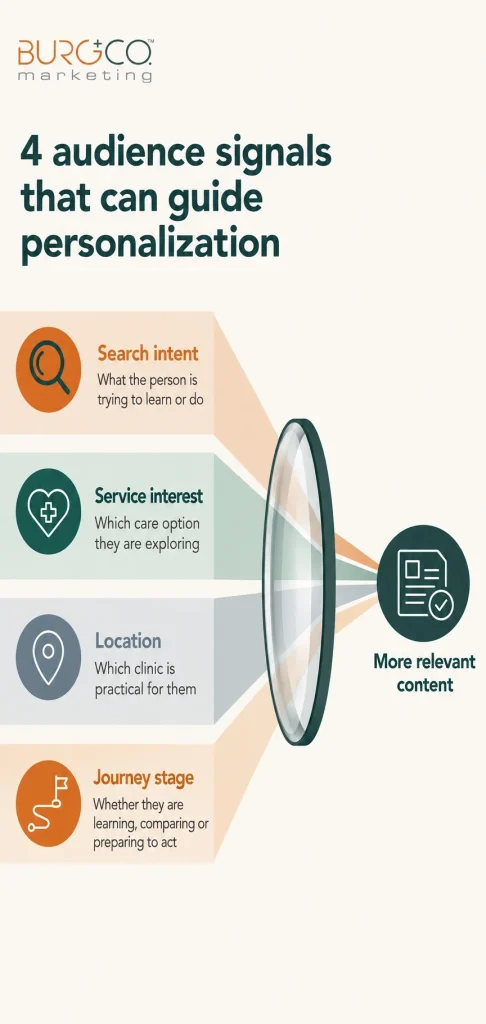
Useful audience segments may reflect:
- Search intent — What the person is trying to learn or do
- Service interest — Which care option they are exploring
- Location — Which clinic is practical for them
- Journey stage — Whether they are learning, comparing or preparing to act
That approach keeps marketing centered on the audience’s questions.
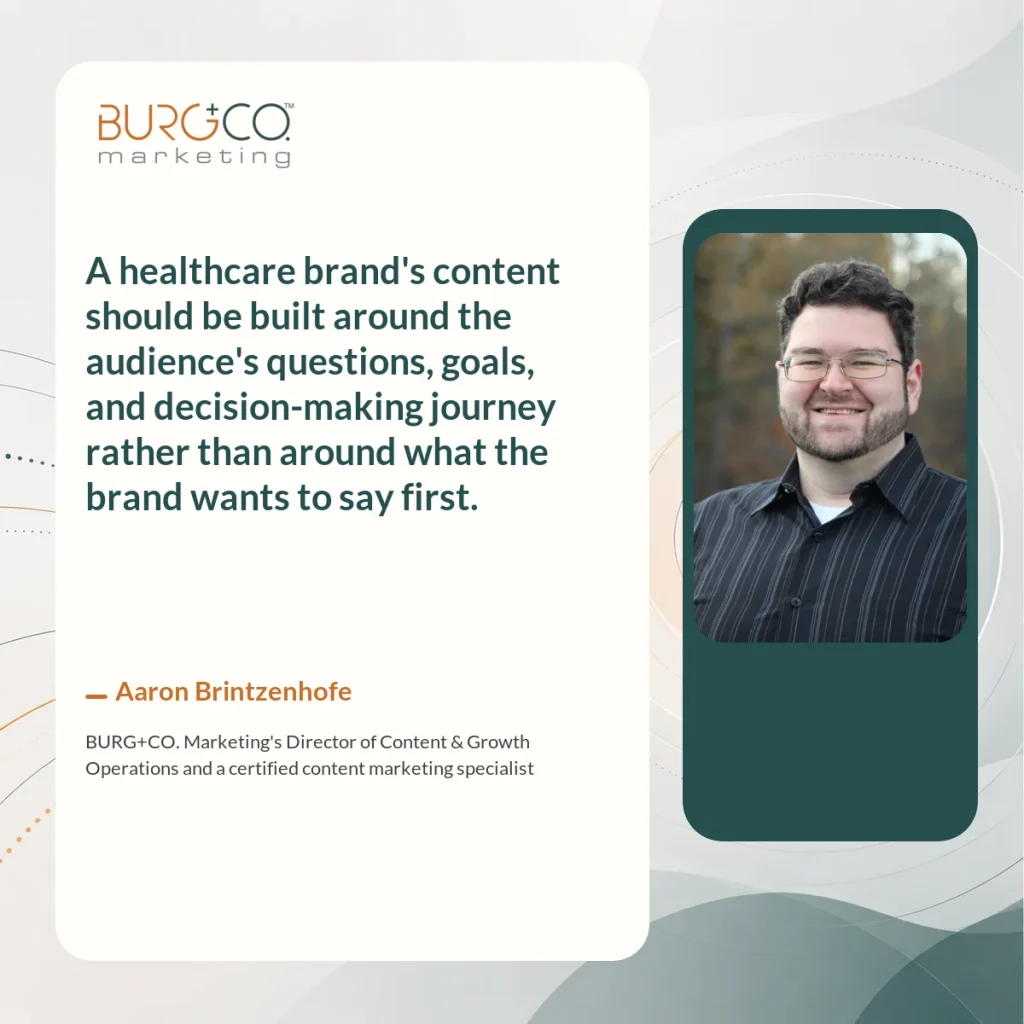
“A healthcare brand’s content should be built around the audience’s questions, goals, and decision-making journey rather than around what the brand wants to say first.”
— Aaron Brintzenhofe, BURG+CO. Marketing’s Director of Content & Growth Operations and a certified content marketing specialist
-
It helps patients feel understood
Healthcare decisions can feel personal, stressful or confusing. Messaging that acknowledges the reader’s likely priorities can create a more considerate experience.
This doesn’t require guessing how someone feels. It means developing content from real audience research, frequently asked questions, search behavior and feedback. When people quickly recognize that a resource addresses their concern, they have a stronger reason to continue reading.
-
It reduces friction across digital experiences
Personalization can also improve how people navigate a website. A location-specific landing page might highlight nearby services, hours and contact options. A service page might direct readers to related FAQs, provider profiles or scheduling information.
These choices support a clearer conversion strategy by helping visitors understand what to do next.
-
It creates stronger connections across channels
Patients may encounter your organization through search, email, video, social media or an AI-generated answer. Personalization can keep those interactions connected.
The goal isn’t to repeat the same message everywhere. It’s to maintain a consistent voice while adapting the information to each audience and channel. That gives patients a more coherent experience as they move between touchpoints.
-
It makes engagement data more actionable
Personalization allows marketers to compare how defined audiences respond to content. Instead of reviewing only total traffic, your team can examine which messages support useful actions.
Metrics may include:
- Click-through rates
- Time spent with key content
- Video engagement
- Calls and form submissions
- Appointment requests
- Conversion rates by audience or landing page
These indicators should be interpreted in context. An email click and a completed appointment request don’t carry the same value.
The table below connects common personalization choices with practical questions for your strategy.
| Personalization choice | Patient-focused purpose | Question to evaluate |
| Audience-specific content | Answer more relevant questions | Does this content match a demonstrated need? |
| Location pages | Make nearby care easier to explore | Can visitors quickly find the correct clinic? |
| Journey-based calls to action | Offer an appropriate next step | Does the action fit the reader’s readiness? |
| Channel-specific messaging | Fit how people use each platform | Is the message useful in this setting? |
| Segmented measurement | Reveal meaningful behavior patterns | Are we measuring qualified actions? |
-
It supports patient-centered growth
Personalization works best when relevance, measurement and trust support the same goal. The strategy should help the right people find useful information and take a suitable next step.
One client described the value of working with a marketing partner that understands its organization:
“As a healthcare marketing executive, I’m most interested in partnering with external service providers and vendors who just ‘get it’. And that’s Burg + Co.! Our company has partnered with Burg + Co for nearly a year, and in that time they’ve helped my company and I strategize and execute marketing initiatives that have not only increased ROMI, but they’re an absolute delight to work with. Each member of their team thinks and works on behalf of their client, and I’ve come to rely on their collective domain expertise regarding digital marketing best practices. Cannot recommend Burg + Co. enough. KB and her team are an impressive outfit, and I’m thrilled to continue working with them. 5-stars, all around!”
— Kateigh Axness Williams
Individual experiences vary, but the takeaway is valuable: A strategy becomes more relevant when the marketing team understands the organization behind it.
Effective personalization is less about flashy technology and more about understanding people. When your strategy reflects patient intent, removes friction and measures meaningful actions, engagement can become more useful to both your audience and your organization.
BURG+CO. can help you connect audience insights, content, SEO and conversion strategy.
Want expert support with your digital marketing? Connect with BURG+CO. today to explore how we can help your healthcare brand grow.
FAQs about personalized healthcare
What is personalized healthcare marketing?
It is the practice of adapting marketing content or experiences to defined audience needs, interests, locations or journey stages.
Why can personalization improve engagement?
Relevant messages can help people find useful answers faster. This may encourage them to read, click or take another meaningful action.
What information can healthcare marketers use for personalization?
Organizations may use data such as location, content interests, search intent and communication preferences. Data use should follow applicable privacy rules, consent requirements and platform policies.
How should healthcare providers measure personalized marketing?
Providers can review click-through rates, content engagement, qualified calls, form submissions and appointment requests by segment or campaign.
Can small healthcare practices use personalization?
Yes. A small practice can begin with location pages, service-specific content, segmented email lists or different calls to action for different journey stages.
Is personalized healthcare marketing HIPAA-compliant?
It can be, but compliance depends on the data, communication and organizations involved. Healthcare providers should obtain appropriate legal and compliance guidance.
What is the difference between personalization and segmentation?
Segmentation organizes people into groups with shared characteristics. Personalization adapts an experience using information about a segment or individual.
Can personalized content support SEO?
Yes. Content built around specific questions and search intent can make a website more useful. It still needs sound keyword research, technical SEO and clear structure.
How can AI support healthcare marketing personalization?
AI tools may help teams analyze patterns or adapt content. Human review remains important for accuracy, privacy, brand voice and patient-centered communication.
Where should a healthcare organization start?
Start with one audience, one meaningful need and one measurable goal. Test the approach, review the results and expand only when the strategy proves useful.