
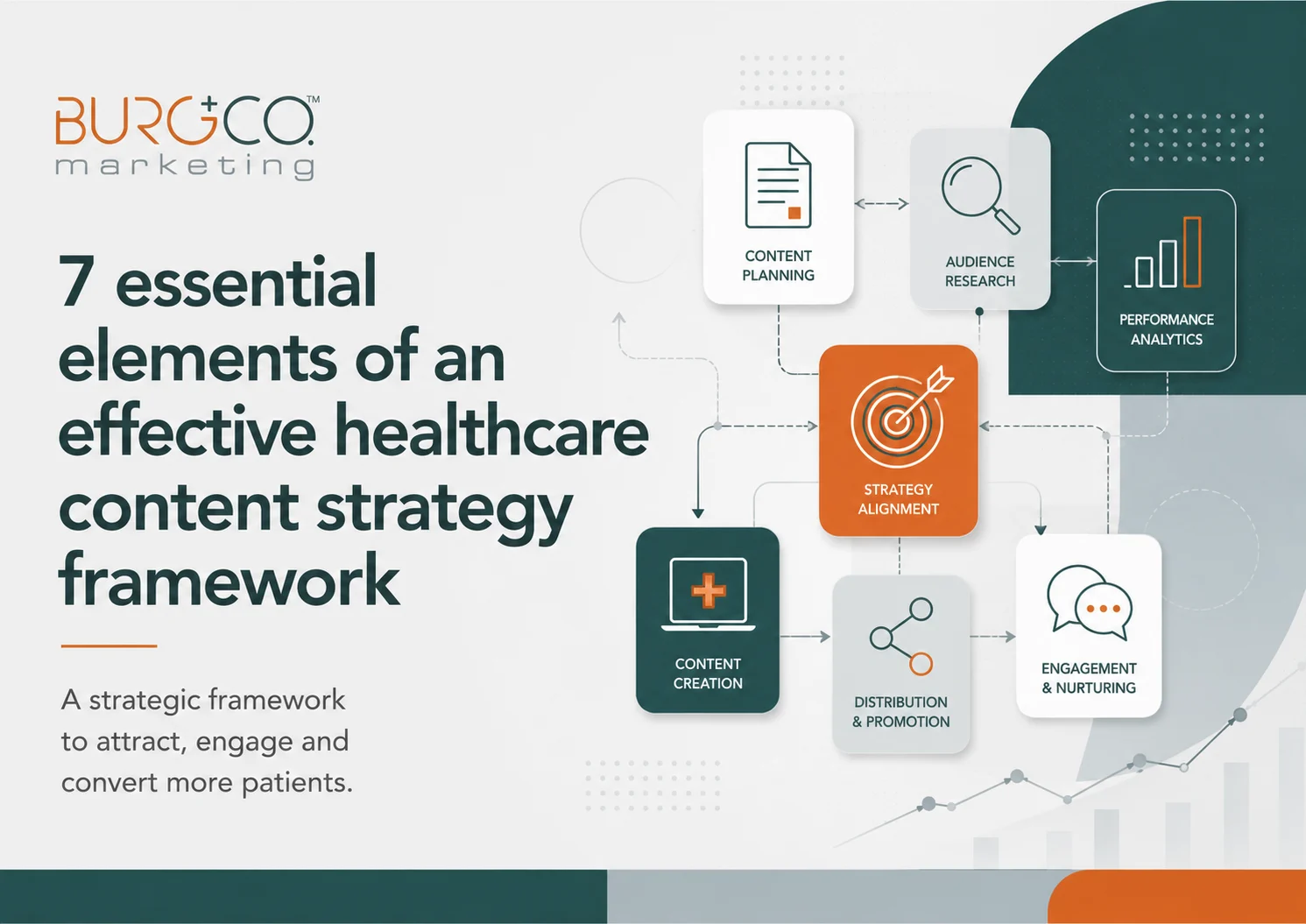
A content strategy framework gives your healthcare brand a repeatable way to plan, create, optimize and measure content without turning every blog, service page or FAQ into a one-off scramble. For providers, that matters because your content is not just filling space on your website. It is helping people understand care, compare options, trust your team and take a thoughtful next step.
A strong healthcare content strategy framework also keeps your marketing grounded. It helps you avoid “post and pray” content, disconnected campaigns and fluffy metrics that look pretty in a dashboard but do not move the right needle. Cute little graphs are fun. Meaningful strategy is better.
We’re here to talk you through what a content strategy framework is before we guide you through seven elements your framework should include if you want content that’s clear for patients and useful for search engines.
What is a content strategy framework?
A content strategy framework is the structure your team uses to decide what content to create, who it is for, how it supports your goals, where it should live and how success will be measured.
For healthcare providers, that framework should connect five big areas:
- Patient needs
- Business goals
- SEO, AEO and GEO visibility
- Website experience
- Conversion paths
Google’s guidance on helpful, reliable, people-first content reinforces the same idea: Content should primarily benefit people, not exist only to manipulate search rankings.
In other words, your content should be findable, but it also has to be genuinely useful once someone finds it.
7 elements to include in your content strategy framework
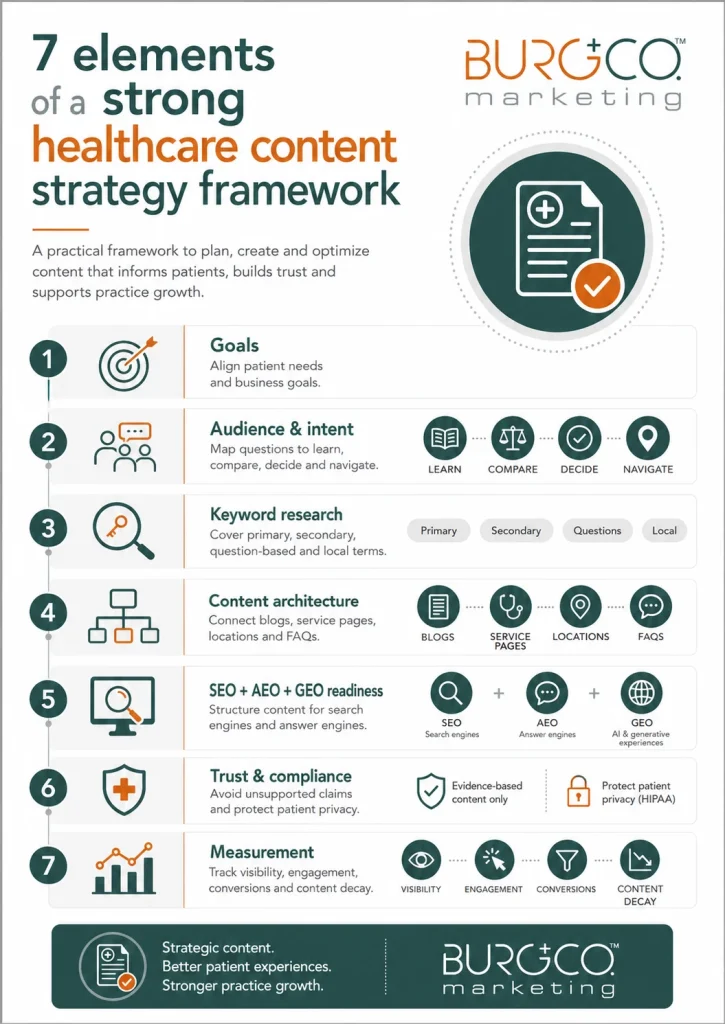
As you start building your framework with your content team, here are a few things to consider including for effective marketing efforts:
-
Clear business and patient goals
Start with the boring-but-important question: What are we trying to accomplish?
Your content goals should support both your organization and the people you serve. A healthcare content plan might aim to:
- Increase visibility for priority services — Such as therapy, physical therapy, dental care or specialty programs
- Support new locations — Especially when your organization is expanding into new service areas
- Improve patient education — So people can better understand symptoms, services and next steps
- Strengthen conversion paths — By helping visitors move from search to scheduling
- Build trust — Through clear, accurate and useful information
This is where a B2B content strategy framework can learn from patient-centered thinking. Yes, you are marketing a healthcare organization. But the reader is still a person who may be confused, busy, cautious or overwhelmed. A good framework acknowledges both truths.
-
A well-defined audience and search intent
Healthcare content should never be built only around what your organization wants to say. It should be built around what your audience needs to understand before they feel ready to act.
That audience might include:
- Prospective patients
- Parents, spouses or caregivers
- Referral partners
- Benefits managers or employers
- Internal stakeholders
- Community partners
Each audience may search differently. A prospective patient may ask, “Why does my knee hurt when I run?” A caregiver may ask, “How do I know if my teen needs therapy?” A referral partner may want proof that your practice is credible, accessible and easy to work with.
Your content marketing strategy framework should map these questions to search intent. That means sorting content by what the reader wants to do:
- Learn — They need basic education
- Compare — They are weighing care options
- Decide — They are close to taking action
- Navigate — They need practical details like insurance, location or scheduling
When you know the intent, you can create content that meets the moment.
-
Keyword and topic research with healthcare nuance
Keyword research still matters. So does topic research. The trick is not treating keywords like little magic beans you sprinkle into content and wait for growth to happen.
For healthcare brands, keyword research should include:
- Primary keywords — The main search terms you want to target
- Secondary keywords — Related phrases that support topical depth
- Question-based keywords — Natural patient questions that can support FAQ and AEO visibility
- Local modifiers — City, neighborhood or “near me” searches when location matters
- Service and condition pairings — Searches that connect symptoms, concerns or treatment options
But healthcare content also needs judgment. You do not want to overstate what a service can do, imply a diagnosis or make the reader feel pushed into care. Clear, helpful language usually wins over dramatic language.
-
A content architecture that is easy to crawl and easy to use
Content strategy is not just what you publish. It is also where that content lives and how it connects.
A strong content architecture helps search engines understand your site and helps people find what they need without feeling like they wandered into a digital broom closet.
Your framework should define how different content types work together:
| Content type | Purpose in the framework | Example use |
| Service pages | Explain what you offer and support conversions | Physical therapy, psychiatry, dental implants or addiction treatment |
| Condition or concern pages | Help people understand what they may be experiencing | Anxiety symptoms, back pain causes or sleep concerns |
| Blog articles | Answer specific questions and build topical authority | “What to expect at your first therapy appointment” |
| Location pages | Support local search and access details | Clinic-specific services, directions and contact information |
| FAQs | Answer quick questions for users and AI-powered search experiences | Insurance, scheduling, symptoms and treatment basics |
If every new idea becomes a blog, your framework may be missing stronger service pages, location pages or FAQ support.
-
AEO and GEO readiness for AI search platforms
A content strategy framework should now account for more than traditional search results. People are asking questions in Google AI experiences, ChatGPT, Gemini and other answer engines. Your content needs to be structured so both humans and AI systems can understand it.
That doesn’t mean chasing every shiny AI tactic. It means getting the fundamentals right:
- Use clear headings — Make each section easy to interpret
- Answer direct questions — Especially in definitions, FAQs and service explanations
- Include specific context — Such as who the content is for, what service it supports and when to seek professional guidance
- Keep information accurate — Update high-value pages regularly
- Use natural language — Write the way patients actually ask questions
Google’s guidance on generative AI features says foundational SEO still matters and that valuable, non-commodity content is important for visibility in AI-powered search experiences.
For healthcare providers, this matters because accuracy and trust are not optional extras. They are the whole game.
-
Compliance-conscious messaging and patient trust
Healthcare content must be persuasive, but it also has to be careful. That doesn’t mean bland. It means grounded.
Your content strategy framework should include rules for:
- Claims — Avoid promises, guaranteed outcomes or unsupported results
- Patient privacy — Do not use protected health information without proper authorization
- Testimonials — Use approved testimonials carefully and avoid implying typical results
- Calls to action — Encourage helpful next steps without pressure or scare tactics
- Clinical language — Educate without diagnosing the reader
HHS guidance explains that HIPAA addresses certain uses and disclosures of protected health information for marketing purposes. The FTC also provides guidance on health-related advertising claims, including the importance of truthful, non-misleading claims supported by appropriate evidence.
This is also where BURG+CO.’s approach to content strategy becomes especially relevant for healthcare teams.
“Strong healthcare content strategy connects SEO, patient education, site experience, and conversion paths so marketing can support measurable practice growth.”
— Aaron Brintzenhofe, BURG+CO. Marketing’s Director of Content & Growth Operations and a certified content marketing specialist
That connection is important. Content should support the full journey from the first question to the confident next step.
-
Measurement, reporting and refinement
A framework is not finished when content goes live. That is when the learning starts.
Your reporting should look beyond traffic alone. Traffic is useful, but it does not tell the whole story. A healthcare content strategy should measure the signals that connect visibility to real practice goals.
Useful metrics may include:
- Organic sessions — Are more people finding the content through search?
- Keyword visibility — Are priority pages appearing for relevant terms?
- Engagement — Are readers staying, scrolling or clicking deeper?
- Assisted conversions — Is content supporting appointment requests, calls or form fills?
- Internal link performance — Are users moving from education to service pages?
- Content decay — Are important pages losing visibility over time?
The goal isn’t to build a report that looks impressive. The goal is to learn what is helping patients, what is supporting growth and what needs to be adjusted.
That steady refinement can matter for organizations working in competitive healthcare markets.
“Kelly and her team are one of the best in the business! We’ve partnered with Burg&Co for the past 3+ years and look forward to furthering our work together. Would strongly recommend for any prospect looking for SEO expertise regardless of industry vertical but particularly in health / digital health.”
— Tim Ming, co-founder of Growth Vanguard
This testimonial reflects one client’s experience and shouldn’t be read as a guaranteed or typical result. It does show why healthcare and digital health brands often need a strategy partner who understands both visibility and trust.
At BURG+CO. Marketing, we help healthcare brands build organic content strategies that connect SEO, AEO, GEO, patient education and conversion-focused website experiences. Our goal is not to create content for content’s sake. It is to help conscientious healthcare organizations reach more of the people who need them.
Want expert support with your digital marketing? Connect with BURG+CO. today to explore how we can help your healthcare brand grow.
FAQs about content strategy framework
What is the main purpose of a content strategy framework?
The main purpose is to give your team a clear process for planning, creating, publishing and measuring content. It helps make sure each piece supports your audience, search visibility and business goals.
Why do healthcare providers need a content strategy framework?
Healthcare providers need a framework because content has to balance patient education, search performance, compliance awareness and conversion goals. Without structure, content can become inconsistent or disconnected from patient needs.
How is a content strategy framework different from a content calendar?
A framework explains the strategy behind your content. A calendar organizes when content will be published. You need the framework first so the calendar is based on goals, not random topics.
Should healthcare content be written for SEO or patients?
It should be written for patients and optimized for search. Strong healthcare SEO starts with useful, accurate and clear content that answers real questions.
How often should healthcare organizations review their content strategy?
Most healthcare organizations should review performance monthly and complete deeper content audits at least once or twice a year. High-value pages may need updates more often.
What should be included in a healthcare content brief?
A content brief should include the primary keyword, secondary keywords, audience, search intent, title, outline, CTA, internal link targets and any compliance or brand notes.
What types of content should healthcare providers prioritize?
Start with core service pages, location pages, FAQs and high-intent educational articles. These content types usually support both patient needs and organic search visibility.
Can AI help with healthcare content strategy?
AI can help with research organization, topic clustering and draft support. However, healthcare content still needs human review for accuracy, empathy, compliance and brand voice.
What makes healthcare content trustworthy?
Trustworthy healthcare content is clear, accurate, specific, easy to navigate and careful with claims. It should help readers understand their options without diagnosing them or promising outcomes.
How do you measure whether a content strategy is working?
Look at organic visibility, traffic quality, engagement, internal clicks, conversions, appointment requests, calls and content updates over time. The best metrics connect content performance to real business goals.