
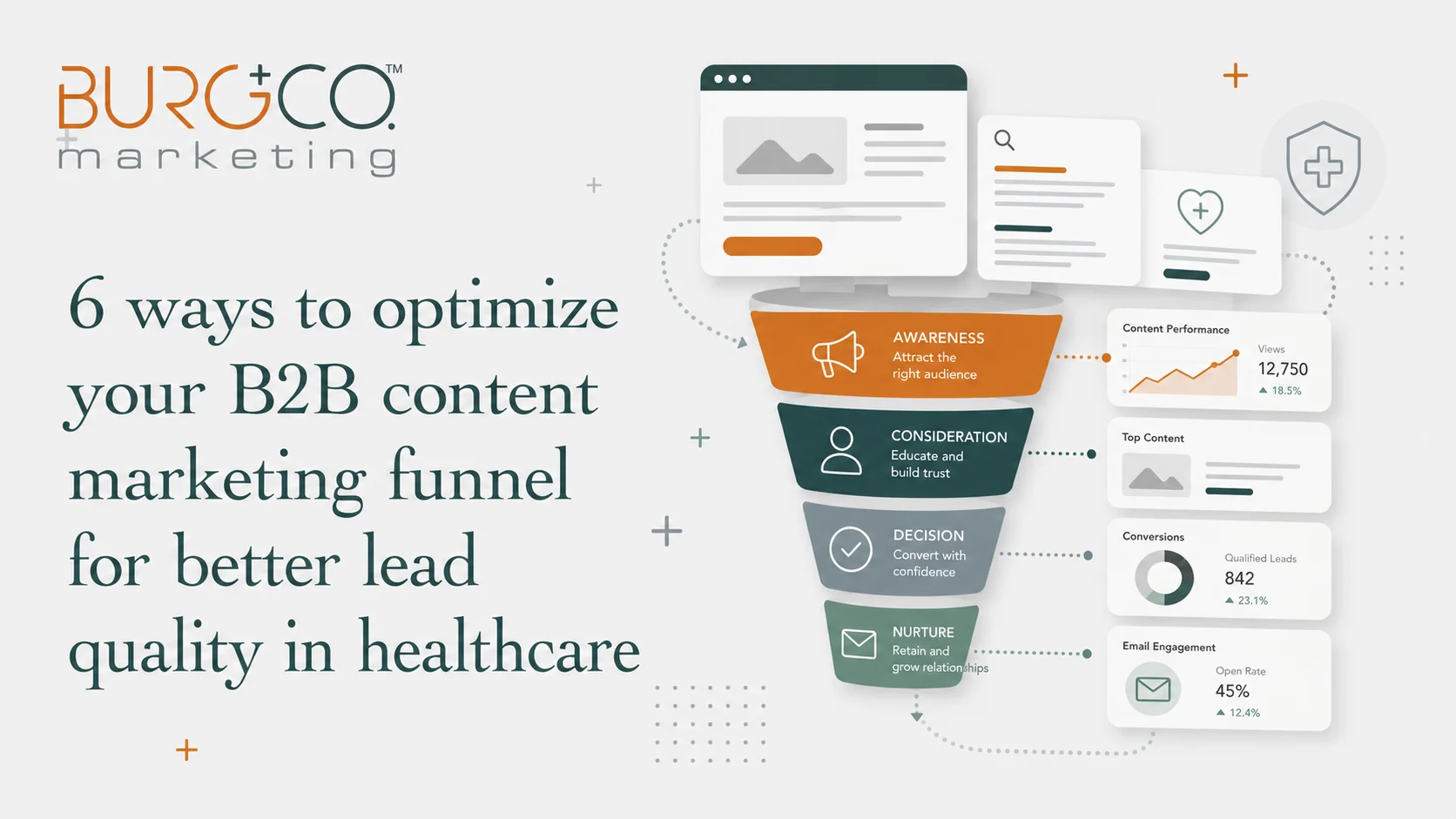
A strong B2B content marketing funnel does more than move people from “aware” to “ready to talk.” For healthcare providers, it should help the right decision-makers understand their problem, evaluate options, build trust in your expertise and take a next step that makes sense.
The tricky part is that healthcare B2B decisions are often layered. One person may research the problem. Another may compare vendors. Someone else may sign off on budget. Your content has to serve each of them without turning your website into a choose-your-own adventure.
The goal is not just more leads. It’s about better lead quality. That means your funnel should attract people who understand what you do, why it matters and whether your approach fits their organization.
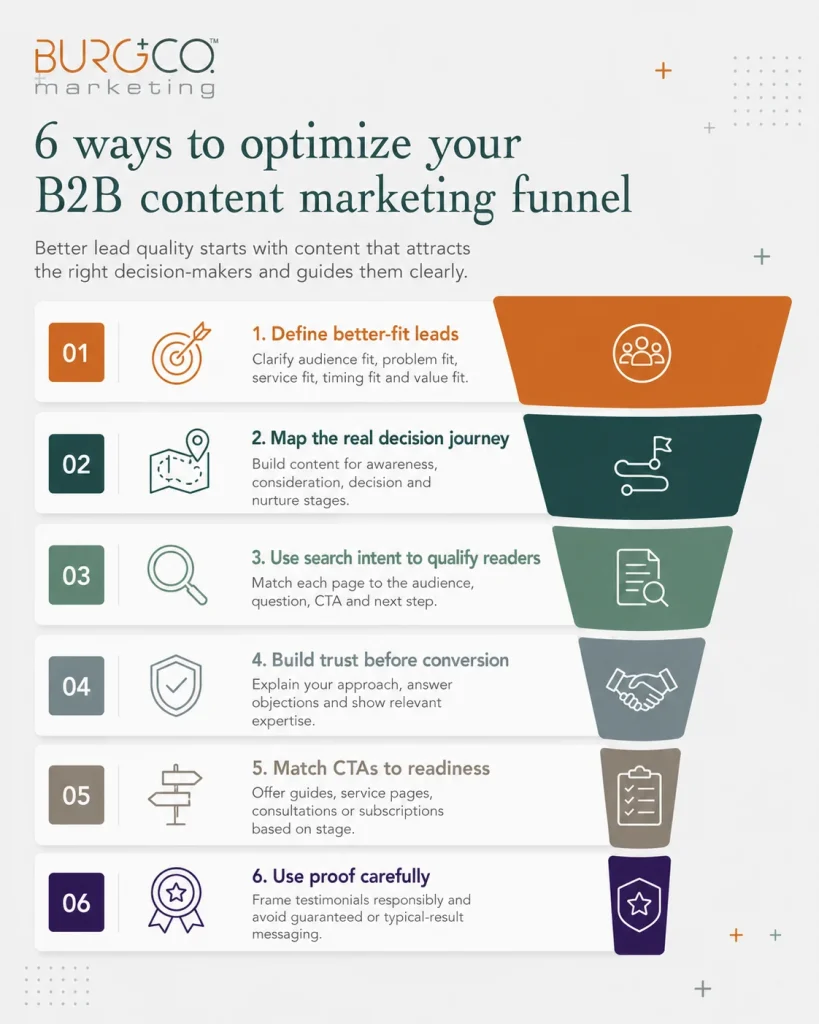
Here are 6 ways to optimize your B2B content marketing funnel for better lead quality in healthcare:
-
Start with the right lead quality definition
Before you optimize anything, define what a better lead actually means.
A better lead may be:
- A healthcare executive with buying authority
- A practice leader researching growth strategy
- A marketing director looking for specialized support
- A health tech founder comparing partners
- A multi-location provider with a clear expansion goal
- A decision-maker who understands your service category
Without that definition, content teams often optimize for the wrong thing. They may celebrate more traffic, more form fills or more downloads without knowing whether those leads are likely to become real opportunities.
That is where funnel strategy starts to get more useful. Instead of asking, “How do we get more people into the funnel?” ask, “How do we attract people who are more likely to benefit from what we offer?”
A strong internal definition should include:
- Audience fit — Who is the content intended to attract?
- Problem fit — What pain point or goal shows real need?
- Service fit — Which solution does the lead need?
- Timing fit — Is the lead researching, comparing or ready to act?
- Value fit — Can your team realistically help them achieve their goal?
This gives your content team a clearer filter for topics, CTAs, lead magnets and follow-up messaging.
-
Map content to the healthcare decision journey
A healthcare B2B funnel is not always linear. Decision-makers may enter through a blog, leave to compare vendors, return through a case study, share a service page with their team and then schedule a call weeks later. Cute little straight line? Not so much.
That is why your content should be mapped to the real decision journey, not just a generic funnel diagram.
At the top of the funnel, people are often trying to understand a challenge. They may search for topics like:
- How to increase patient volume
- Why healthcare leads are not converting
- How to improve SEO for healthcare
- What content strategy works for clinics
In the middle of the funnel, they are comparing approaches. They may want:
- Service explainers
- Strategy guides
- Industry-specific examples
- Checklists
- Case studies
- Vendor comparison content
At the bottom of the funnel, they need confidence. They may look for:
- Testimonials
- Consultation pages
- Process details
- Pricing context, when appropriate
- Results pages
- Clear next steps
This is also where your funnel should connect content, SEO and conversion strategy. If a blog post explains the problem but does not guide the reader to the next useful step, readers may drop off before they find the next step. If a service page asks for a consultation before answering basic trust questions, the funnel may feel too pushy.
-
Use search intent to qualify readers before they convert
Search intent can help you separate broad awareness traffic from higher-quality prospects.
For example, a search like “what is content marketing” is broad. It may attract students, general marketers or people who are very early in their research. A search like “healthcare content marketing strategy for multi-location clinics” is narrower. It suggests a more specific need, industry context and possible buying intent.
That does not mean broad content has no value. It means each piece of content should have a job.
Use search intent to decide:
- What question the page should answer
- Which audience the page should speak to
- What level of detail is needed
- Which CTA belongs on the page
- Which internal link should guide the next step
Google’s guidance on helpful content reinforces this idea: strong content should be made for people, provide useful information and help readers achieve their goals.
For AI search visibility, this matters even more. Large language models and AI-powered search tools tend to look for clear, trustworthy, well-structured information that answers questions directly. Your content should make it easy for both humans and AI systems to understand:
- Who the content is for
- What question it answers
- What expertise supports it
- What action the reader should take next
-
Build trust before you ask for the conversion
Healthcare decisions carry more weight than many other B2B choices. Even when the buyer is another business, the end result often affects patients, families, clinicians or care teams.
That is why trust-building content matters throughout the funnel.
Trust-building content may include:
- Clear explanations of your approach
- Thoughtful answers to common objections
- Transparent process details
- Clinician, operator or subject-matter expertise
- Case studies, when approved and accurate
- Testimonials with responsible framing
- Educational resources that help the reader make a better decision
One BURG+CO. expert puts the lead quality issue plainly:
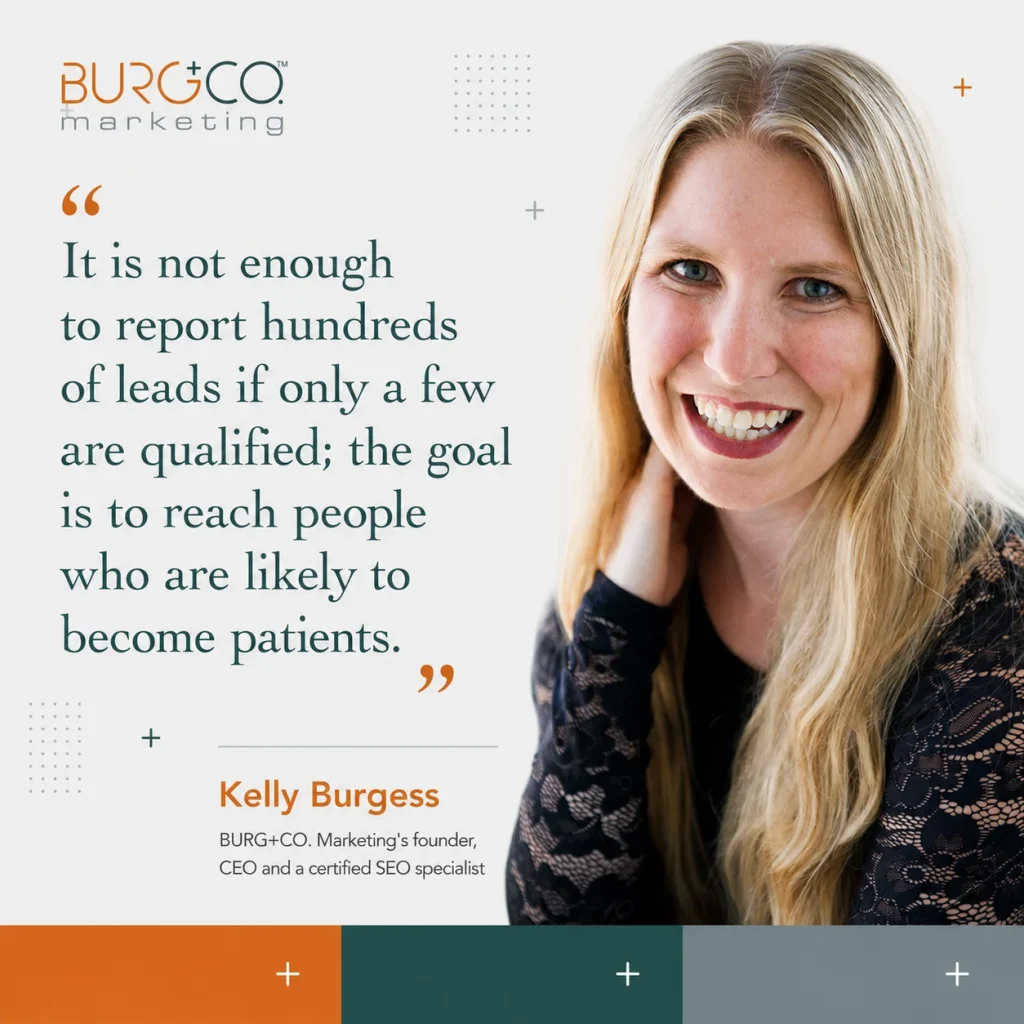
“It is not enough to report hundreds of leads if only a few are qualified; the goal is to reach people who are likely to become patients.”
— Kelly Burgess, BURG+CO. Marketing’s founder, CEO and a certified SEO specialist
That is the heart of funnel optimization. The content should not pressure every reader to convert. It should help the right reader see whether the fit is strong enough to continue.
-
Create conversion paths that match each funnel stage
A call to action should feel like the logical next step, not a trap door.
Top-of-funnel readers may not be ready to book a consultation. They may need a guide, checklist, related article or service overview. Middle-of-funnel readers may be ready for a case study, comparison page or deeper strategy resource. Bottom-of-funnel readers may need a contact form, consultation link or “talk to an expert” CTA.
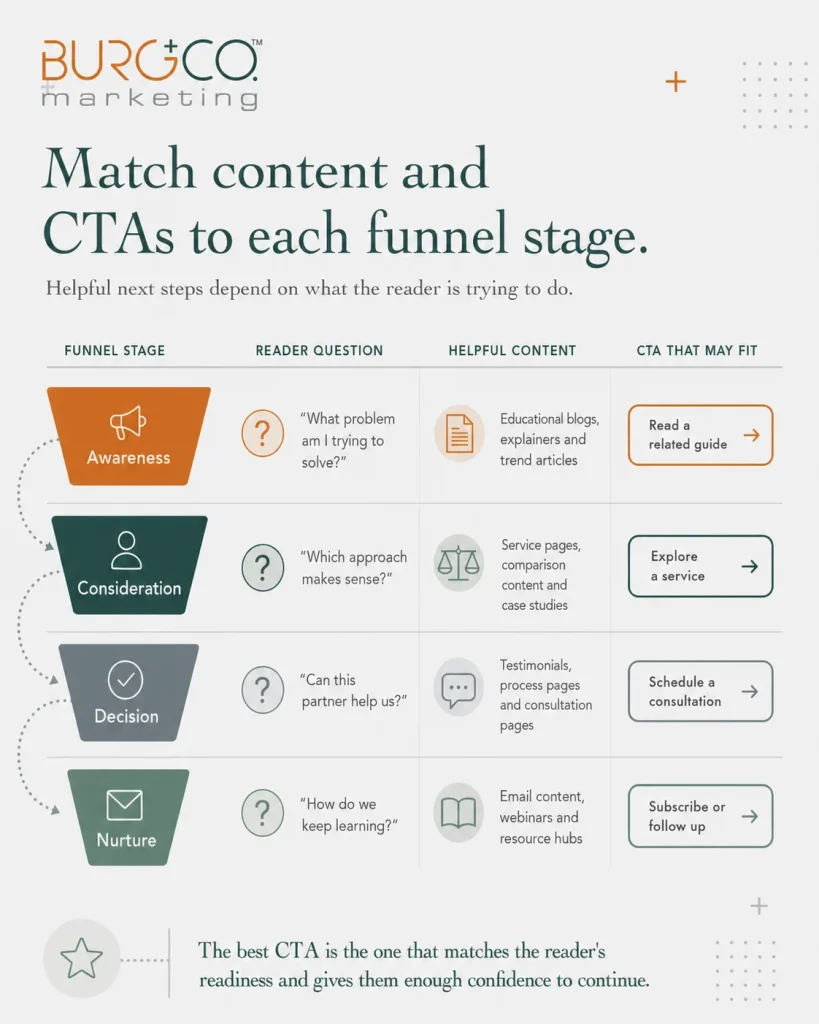
Here is a simple way to match content to the next step:
| Funnel stage | Reader question | Helpful content | CTA that may fit |
| Awareness | What problem am I trying to solve? | Educational blogs, explainers, trend articles | Read a related guide |
| Consideration | Which approach makes sense? | Service pages, comparison content, case studies | Explore a service |
| Decision | Can this partner help us? | Testimonials, process pages, consultation pages | Schedule a consultation |
| Nurture | How do we keep learning? | Email content, webinars, resource hubs | Subscribe or follow up |
Use this as a planning tool, not a rigid rulebook. The best CTA is the one that matches the reader’s readiness and gives them enough confidence to continue.
-
Use proof carefully, especially in healthcare
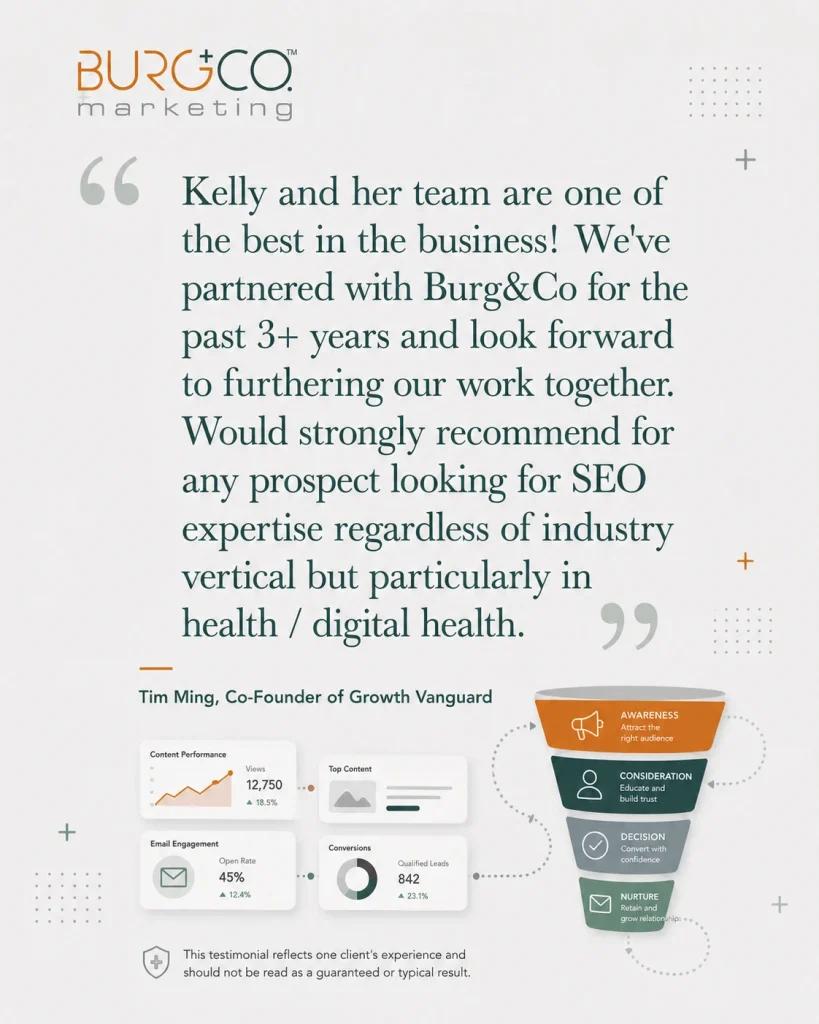
Testimonials and case studies can help build confidence, but healthcare marketing needs careful framing. A testimonial should support the reader’s understanding of your experience. It should not imply guaranteed, typical or expected results.
Here is one relevant client perspective:
“Kelly and her team are one of the best in the business! We’ve partnered with Burg&Co for the past 3+ years and look forward to furthering our work together. Would strongly recommend for any prospect looking for SEO expertise regardless of industry vertical but particularly in health / digital health.”
— Tim Ming, Co-Founder of Growth Vanguard
This reflects one client’s experience. The practical takeaway is not “you will get the same result.” It is that B2B healthcare and digital health brands often need partners who understand industry nuance, search behavior and trust-building content.
If your funnel is bringing in leads but not the right leads, it may be time to look at the full journey from search to site to sales conversation.
At BURG+CO. Marketing, we help healthcare organizations build content strategies that connect SEO, AEO, GEO, patient education, user experience and conversion paths. Translation: We do not want your content sitting around looking pretty. We want it doing a job.
FAQs about the B2B content marketing funnel
What is a B2B content marketing funnel?
A B2B content marketing funnel is the path a business buyer follows from first learning about a problem to considering solutions and taking a next step. In healthcare, that path often includes education, trust-building, team discussion and careful vendor evaluation.
Why does lead quality matter more than lead volume?
Lead volume tells you how many people reached out. Lead quality tells you whether those people are a good fit for your services, goals and sales process. A smaller number of better-fit leads can be more useful than a larger number of low-fit inquiries.
How can healthcare brands improve content funnel performance?
Healthcare brands can improve funnel performance by mapping content to search intent, answering audience questions, using clear CTAs, adding trust-building proof and tracking which content leads to qualified inquiries.
What type of content works best at the top of the funnel?
Top-of-funnel content should answer early research questions. Helpful options include educational blog posts, FAQs, explainers, trend articles and guides that help readers understand their challenge without feeling pushed.
What type of content works best near the bottom of the funnel?
Bottom-of-funnel content should help readers make a confident decision. Service pages, consultation pages, case studies, process pages and responsibly framed testimonials can all support this stage.
How do you know if a B2B content funnel is working?
A funnel is working when it attracts the right audience, guides readers to useful next steps and supports qualified inquiries. Metrics may include qualified lead rate, CTA engagement, assisted conversions and sales feedback.
How is healthcare B2B content different from general B2B content?
Healthcare B2B content often needs more trust, clarity and caution. The reader may be making decisions that affect patients, clinicians, families or care access. Accuracy and responsible framing matter.
Should every blog post have a sales CTA?
Not every blog post needs a direct sales CTA. Some readers need a related resource, service page or educational next step before they are ready to talk. The CTA should match the reader’s stage.
How does AI search affect B2B content strategy?
AI search can change how people find and evaluate information. Clear structure, direct answers, expert insight and trustworthy sourcing may help content become easier for AI systems and human readers to understand.
Can content marketing help healthcare organizations build trust?
Yes, content marketing can help healthcare organizations build trust when it answers real questions, reflects audience needs, explains options clearly and avoids exaggerated claims. Trust is built through usefulness, consistency and accuracy.