

Healthcare patient acquisition costs in 2026 are about more than ad spend. Your true cost includes the people, platforms, content and follow-up systems required to turn interest into scheduled care. A strong healthcare marketing strategy should help you reach qualified people while creating a clearer path from search to appointment.
The catch? Cutting marketing activity without understanding performance can lower spending and patient volume at the same time. The better goal is to remove waste, improve lead quality and help more qualified people complete the journey.
What is patient acquisition cost in healthcare?
Patient acquisition cost, or PAC, is the amount your organization spends to acquire one new patient. A basic formula is:
Total patient acquisition spending ÷ New patients acquired = Patient acquisition cost
Your total spending may include:
- Paid media — Search, display, social and programmatic advertising
- Organic marketing — SEO, content, local listings and digital PR
- Technology — Analytics, call tracking, CRM and scheduling tools
- Labor — Internal staff, agencies and intake support
- Conversion work — Website testing, landing pages and user experience improvements
The denominator matters just as much. Dividing spending by leads can make performance look better than it is. Whenever possible, measure the number of people who schedule, attend or become admitted patients.
5 ways to lower patient acquisition costs
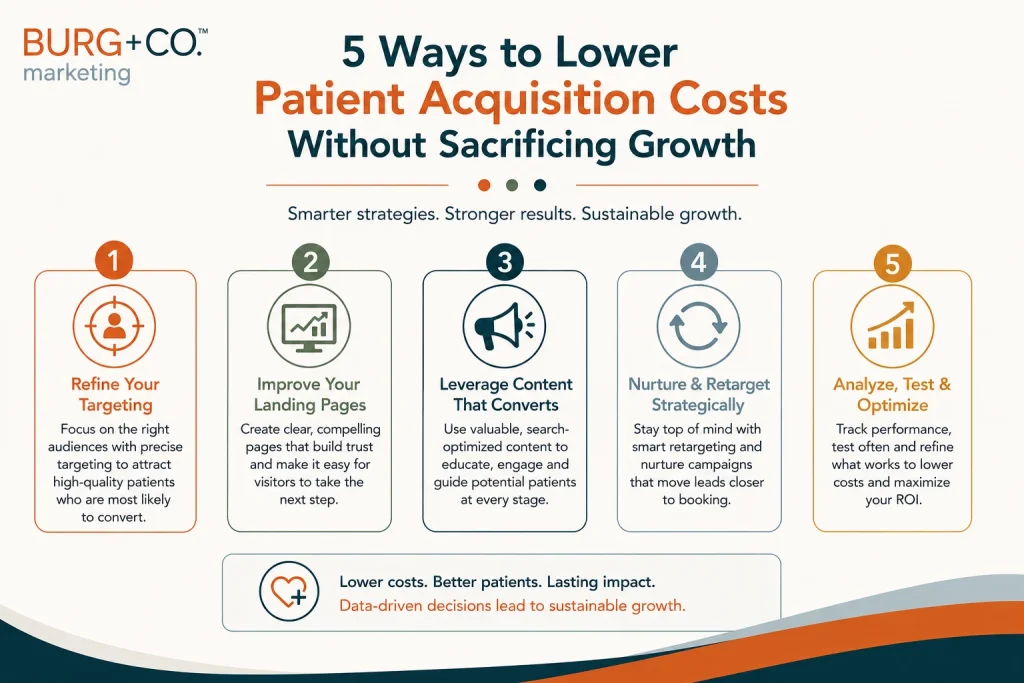
If you’re unsure how to make your patient acquisition approach more budget-friendly, here are a few strategies worth considering:
-
Measure patients, not just leads
A low cost per lead can hide an expensive patient acquisition process. One channel may generate plenty of forms but few qualified patients. Another may create fewer inquiries that convert at a much higher rate.
Connect marketing data with:
- Qualified inquiry volume
- Scheduled appointments
- Admissions or completed first visits
- No-show rates
- Revenue by source
- Patient lifetime value
This helps your team see which channels support actual growth instead of dashboard confetti.
The distinction is central to useful healthcare marketing measurement:
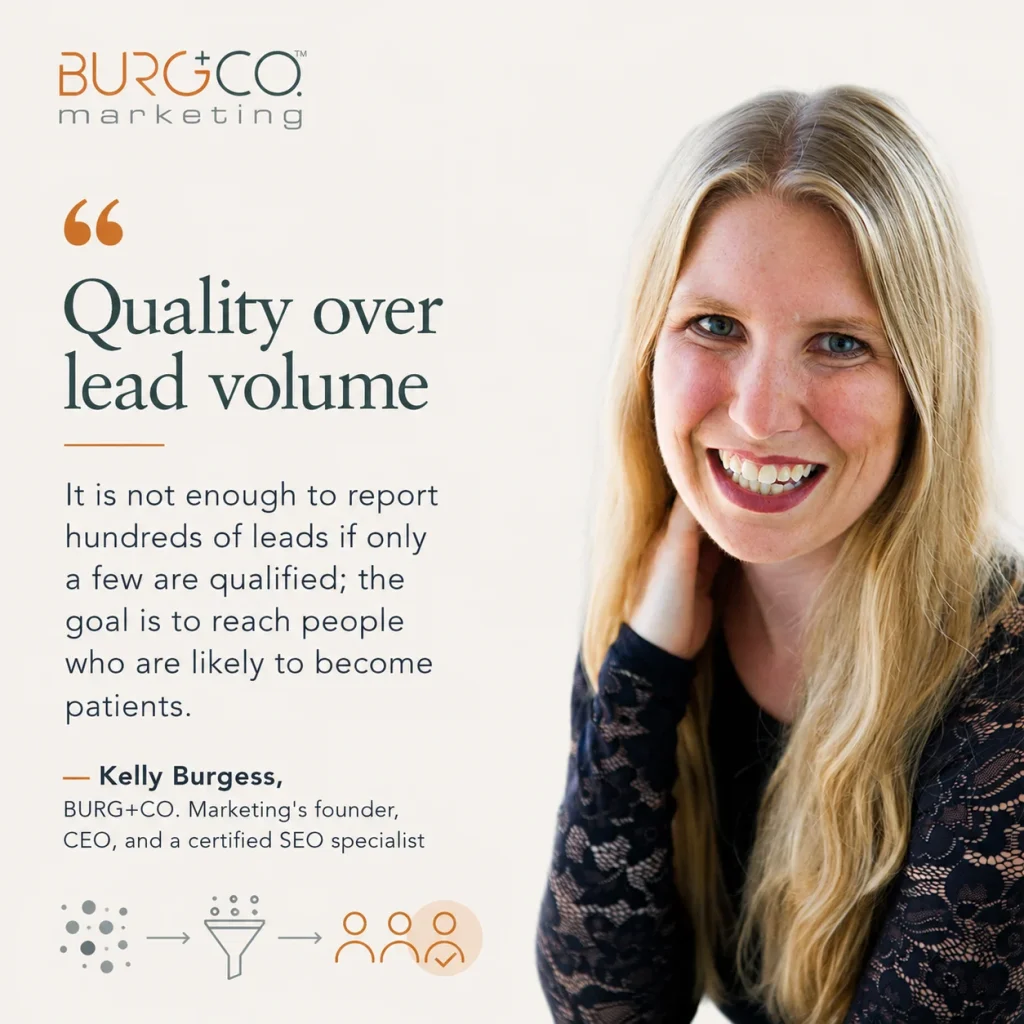
“It is not enough to report hundreds of leads if only a few are qualified; the goal is to reach people who are likely to become patients.”
— Kelly Burgess, BURG+CO. Marketing’s founder, CEO and a certified SEO specialist
Once this information is visible, you can adjust spending based on patient quality rather than lead volume alone.
-
Reduce your dependence on paid acquisition
Paid advertising can produce visibility quickly, but every click requires more budget. If paid media is your only reliable source of patients, cost increases can place your entire growth plan under pressure.
Organic visibility works differently. SEO, useful content and local search assets can continue attracting patients after publication. They still require investment, but they are not purchased one click at a time.
The goal is not to cancel paid media tomorrow. Use it for short-term demand while building organic assets that may reduce long-term dependency.
-
Focus on high-intent searches
More traffic does not automatically mean more patients. Your strategy should prioritize the terms people use when they are actively comparing providers, programs or services.
High-intent searches often include:
- A service or treatment
- A geographic location
- Insurance or payment questions
- Availability questions
- Provider or program comparisons
- Clear next-step language
A smaller amount of qualified traffic may create more value than a large audience searching for information your organization cannot serve.
-
Improve conversion before buying more traffic
When a website is difficult to use, increasing traffic can simply increase the number of people who leave.
Review:
- Page speed and mobile usability
- Calls to action
- Form length
- Scheduling steps
- Insurance information
- Service and location details
- Navigation between educational and conversion pages
Heatmaps, scroll data and journey analysis can show where people hesitate or leave. Even modest changes can help you capture more value from traffic you already paid or worked to earn.
-
Reallocate budget with a balanced scorecard
Do not make budget decisions using one metric. Review cost, quality and capacity together.
The table below offers a qualitative framework for evaluating each channel:
| Question | What to review | Why it matters |
| Is the channel reaching the right people? | Search intent, location and service fit | Poor audience fit increases wasted spending |
| Are inquiries becoming patients? | Appointment, admission and show rates | Lead volume alone can hide weak performance |
| Can the organization serve more demand? | Provider capacity, wait times and location availability | Marketing should support realistic operational capacity |
| Is the channel building a lasting asset? | Evergreen content, rankings, reviews and referral relationships | Durable assets may reduce paid dependency |
| Is performance measured consistently? | Attribution rules, call tracking and CRM data | Inconsistent measurement can distort comparisons |
Use this scorecard to identify where a channel needs improvement before eliminating it. A paid campaign may need better targeting. An organic program may need stronger conversion pages. A high-performing source may simply need more capacity.
Lower patient acquisition costs with a connected growth strategy
Lowering healthcare patient acquisition costs in 2026 is not about finding one bargain channel. It is about connecting visibility, trust, website performance, intake and measurement.
One client’s experience reflects the value of clear reporting and an integrated partnership:
“We partnered with Burg & Co for about two years, and they were an outstanding team to work with from start to finish. One of the things we appreciated most was how clear and actionable their reporting was — it made it easy for us to understand performance, track progress, and make informed decisions. Whenever we needed additional clarification, they were always responsive and took the time to explain things in a way that made sense for our team. Beyond their technical expertise, what really set them apart was their approach as a partner. They were genuinely invested in our success, brought thoughtful recommendations to the table, and consistently made us feel supported. It never felt like we were just another client — they truly operated as a trusted extension of our marketing team.”
— Katarina McDoom, Recruitment & Marketing Specialist at Forever Fit Physical Therapy & Wellness

Individual experiences vary, but the takeaway is useful: Better decisions become easier when teams can clearly understand what is working and why.
BURG+CO. Marketing helps healthcare organizations connect SEO, content, website experience and meaningful patient-growth measurement. We look beyond clicks and form fills to help internal teams build a more predictable acquisition strategy.
Ready to examine what your patient acquisition budget is really producing? Schedule a complimentary consultation with BURG+CO.
FAQs about healthcare patient acquisition costs
What is a good patient acquisition cost for healthcare?
There is no universal target. A sustainable cost depends on specialty, reimbursement, margin, patient lifetime value, competition and capacity.
How do you calculate patient acquisition cost?
Add the relevant marketing, sales, technology and labor costs for a set period. Divide that total by the number of new patients acquired during the same period.
Is cost per lead the same as patient acquisition cost?
No. Cost per lead measures inquiries. Patient acquisition cost measures how much it costs to acquire a person who actually becomes a patient.
Can SEO lower patient acquisition costs?
SEO may improve long-term efficiency by creating search visibility that does not require payment for every click. Results depend on strategy, competition, content quality and conversion performance.
Should healthcare providers stop using paid advertising?
Not necessarily. Paid media can support immediate visibility. It often works best alongside organic marketing, conversion optimization and accurate patient-level measurement.
Why are patient acquisition costs increasing?
Costs may rise because of competition, advertising prices, weak targeting, poor conversion rates, operational friction or incomplete attribution.
How often should patient acquisition costs be reviewed?
Review trends monthly and conduct deeper quarterly evaluations. Avoid making major decisions based on a few days of data or very small patient counts.
What costs should be included in patient acquisition calculations?
Include relevant media, agency, content, technology, labor and conversion expenses. Use the same rules each reporting period so comparisons remain meaningful.
Does patient retention affect acquisition costs?
Retention does not change the original acquisition expense, but it affects lifetime value and the amount your organization can sustainably invest in growth.
What is the fastest way to reduce patient acquisition costs?
Start by checking measurement accuracy, lead quality, intake follow-up and website friction. These areas can reveal waste before your team cuts productive marketing activity.