
A healthcare website can attract plenty of visitors and still lose potential patients before they take action. Patient journey mapping helps providers see the website through a visitor’s eyes, from the first search to the moment someone schedules, calls or fills out a form. That perspective can shape better website design around the questions, concerns and next steps people actually have.
A patient journey map is a visual or written model of the stages, questions, emotions and interactions someone may experience while deciding whether to choose a provider. In healthcare, that journey can include search, education, comparison, trust-building, appointment scheduling and follow-up. Agency for Healthcare Research and Quality, or AHRQ, describes patient experience as spanning interactions across the healthcare system and identifies journey mapping as one way organizations can gather information about those experiences.
Here are five ways patient journey mapping can help healthcare providers turn more website visits into meaningful next steps.
1. It reveals where visitors lose momentum
A journey map makes it easier to identify where people encounter friction. A visitor may arrive on a service page but struggle to understand whether the service fits their needs. Someone else may be ready to schedule but encounter a long form, unclear button or missing phone number.
Those gaps matter because every extra point of confusion gives a high-intent visitor another reason to leave. Journey mapping helps teams inspect the full path instead of evaluating pages in isolation.
2. It aligns content with real patient questions
People rarely arrive on a healthcare website ready to convert immediately. They may first want to understand symptoms, services, insurance, treatment options, provider qualifications or what an appointment will be like.
Mapping those questions by stage helps healthcare teams create content that answers the right concern at the right time. That can include educational articles for early research, service pages for comparison and clear scheduling information for people who are ready to act.
3. It helps build trust before the conversion
Healthcare decisions can feel personal and high stakes. Visitors may need reassurance that a provider understands their concerns before they are willing to share contact information.
A useful journey map identifies where trust questions appear and what information could help answer them. That may include provider bios, treatment explanations, insurance details, patient resources and clear expectations about what happens after someone reaches out.
Patient journey research by the AHQR includes information access, communication quality, coordination and trust among important areas of the patient experience. Those same principles can help healthcare marketers think more carefully about the digital experience before an appointment.
4. It creates clearer next steps at every stage
Not every visitor needs the same call to action. Someone reading an introductory blog post may benefit from another educational resource. Someone comparing services may be ready to request an appointment.
Patient journey mapping helps healthcare providers match calls to action to visitor intent instead of repeating the same conversion prompt everywhere. This creates a more natural path from learning to deciding.
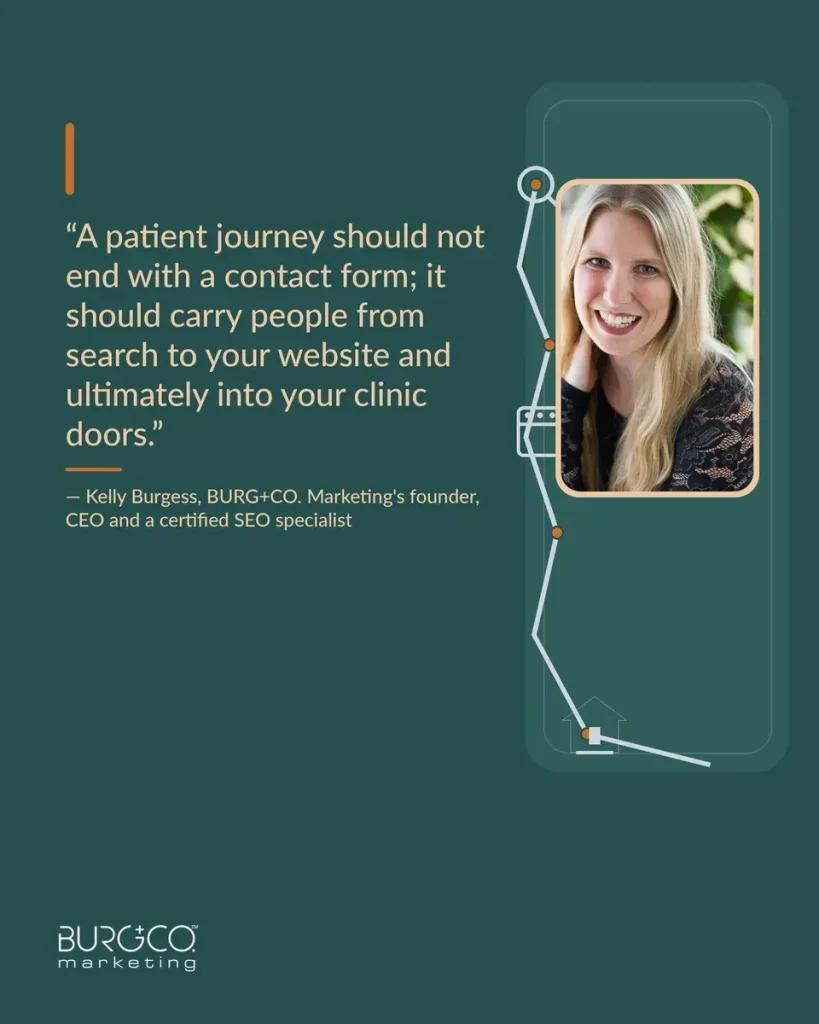
A useful way to think about the goal is captured in this BURG+CO. perspective:
“A patient journey should not end with a contact form; it should carry people from search to your website and ultimately into your clinic doors.”
— Kelly Burgess, BURG+CO. Marketing’s founder, CEO and a certified SEO specialist
5. It turns website optimization into an ongoing process
A journey map should not be treated as a one-time diagram. Search behavior, service offerings, patient expectations and website performance can change.
Teams can revisit the map alongside analytics, heat maps, form data and qualitative feedback to test where improvements are needed. BURG+CO.’s website design and management services use tools such as heat mapping and A/B testing to evaluate how users interact with pages and where conversion elements may be missed.
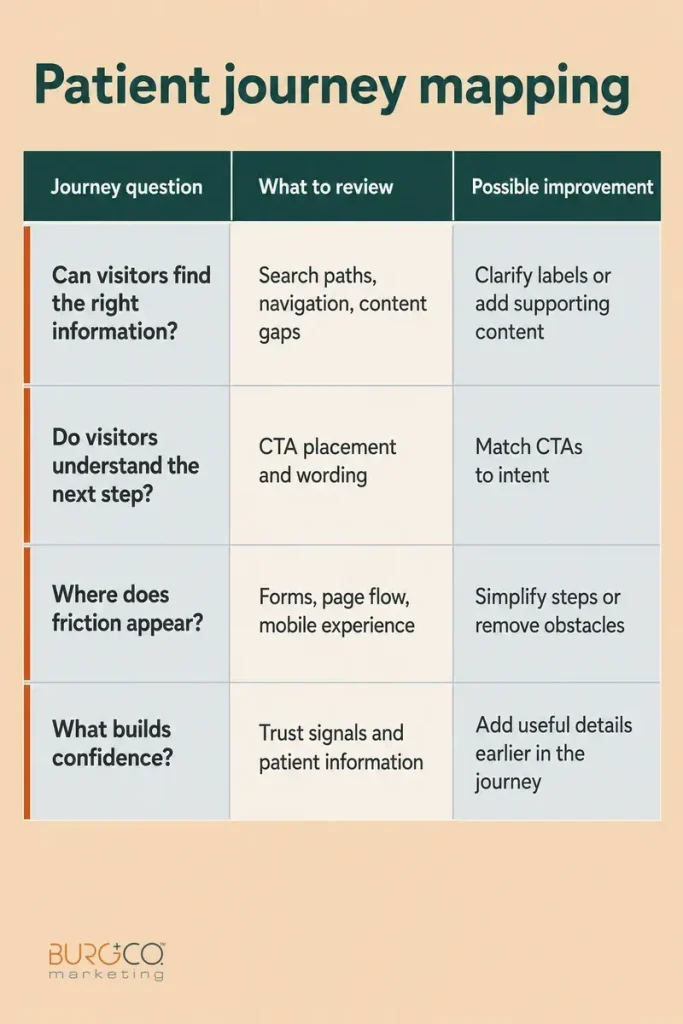
A clear mapping process also helps teams decide what to review:
| Journey question | What to review | Possible improvement |
|---|---|---|
| Can visitors find the right information? | Search paths, navigation, content gaps | Clarify labels or add supporting content |
| Do visitors understand the next step? | CTA placement and wording | Match CTAs to intent |
| Where does friction appear? | Forms, page flow, mobile experience | Simplify steps or remove obstacles |
| What builds confidence? | Trust signals and patient information | Add useful details earlier in the journey |
Shared decision-making guidance from AHRQ also emphasizes that healthcare decisions should account for patients’ values, goals, preferences and circumstances. That is a useful reminder for marketers: a patient journey should support decision-making rather than simply push people toward a conversion.
One approved client example shows how conversion-focused website improvements can translate into more inquiries:
“Burg + Co. Marketing more than doubled our website form fills and phone calls last year. We started at about 20 new requests per month and ended at more than 50 new requests.”
— Whatcom Physical Therapy
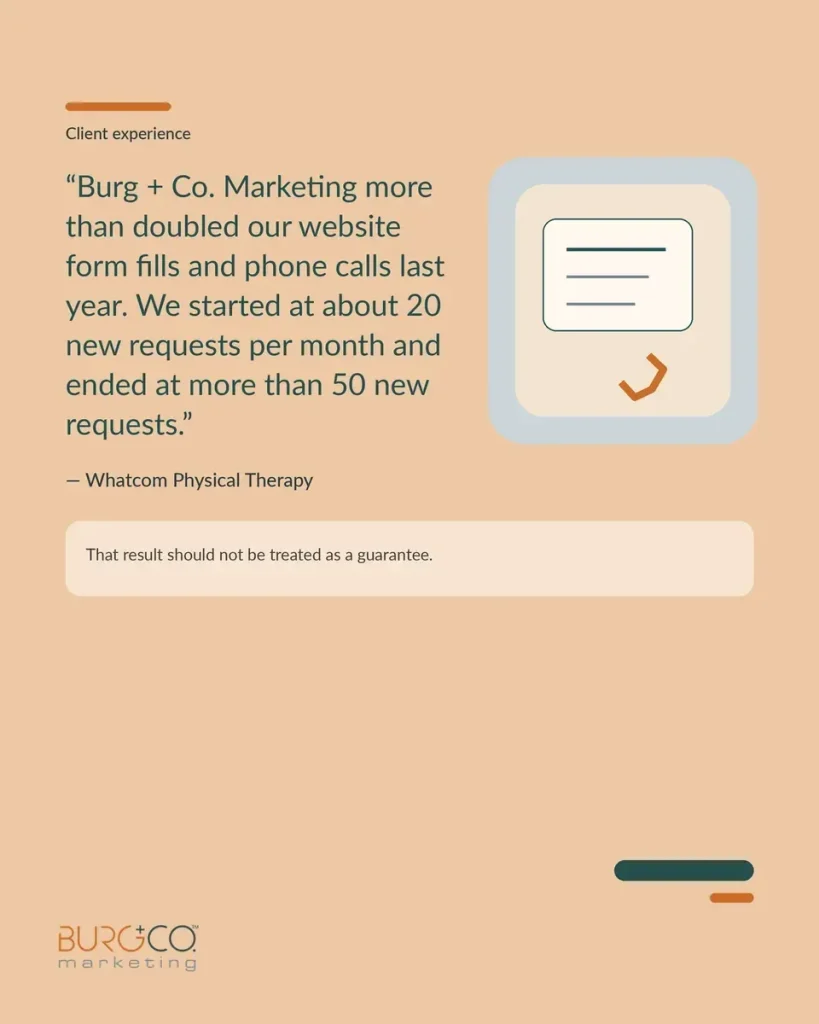
That result should not be treated as a guarantee. It does show why healthcare marketers should look beyond traffic and examine whether their digital experience helps visitors become patients.
The strongest healthcare websites do more than attract traffic. They help people find useful information, build confidence and understand what to do next. Patient journey mapping gives marketing teams a structured way to see those moments and improve them.
If your healthcare website is generating traffic but not enough patient inquiries, BURG+CO. can help you examine the path from search to conversion and identify where the experience can be clearer. A thoughtful conversion strategy can turn more of your existing visibility into meaningful patient connections.
Want expert support with your digital marketing? Connect with BURG+CO. today to explore how we can help your healthcare brand grow.
FAQs about patient journey mapping
What can patient journey mapping reveal about a healthcare website?
Patient journey mapping can show where visitors find useful information, encounter confusion or leave before taking a meaningful next step. Healthcare teams can use those insights to review content, navigation, forms and calls to action.
How can patient journey mapping improve healthcare website content?
A journey map connects content to the questions people may have at different stages of their decision. It can help teams identify where educational content, service information, trust-building details or scheduling guidance may be missing.
Why is trust important in the online patient journey?
Healthcare decisions often require people to share personal information and choose a provider they feel comfortable with. Clear service information, provider details, expectations and other trust signals can help visitors make informed decisions.
Should every page use the same call to action?
Not necessarily. A visitor researching a condition may need more educational information, while someone reviewing a service page may be ready to schedule. Patient journey mapping can help marketers match calls to action with likely visitor intent.
How often should healthcare providers update a patient journey map?
There is no single required schedule. Healthcare teams can revisit their maps when analytics, user feedback, service changes or website updates suggest that patient behavior or needs may have changed.
What is patient journey mapping in healthcare marketing?
Patient journey mapping is the process of outlining the stages and interactions someone may experience while moving from initial awareness to choosing a healthcare provider. It can include search, website visits, education, comparison, scheduling and follow-up.
What stages can be included in a patient journey map?
The stages depend on the organization and audience. A healthcare journey might include awareness, research, consideration, decision, appointment scheduling and continued engagement after care begins.
What information should healthcare marketers use to create a patient journey map?
Teams can draw from website analytics, search behavior, form data, call data, user feedback and other approved sources of audience insight. The goal is to base the map on observed needs and behavior rather than assumptions alone.
How is patient journey mapping different from a marketing funnel?
A marketing funnel often organizes audiences by broad stages such as awareness, consideration and conversion. A patient journey map can provide more detail about the questions, interactions, barriers and experiences people encounter within and between those stages.
Can patient journey mapping help improve conversions?
It can help marketers identify opportunities to reduce friction and create clearer paths toward actions such as calling, requesting an appointment or completing a form. The effect on conversions will depend on the website, audience, implementation and other factors.