

A potential patient sees a paid social post, reads one of your articles, checks your reviews and returns through a Google search before requesting an appointment. Which channel deserves credit? Healthcare teams can use marketing attribution models to better understand how each interaction supports the patient journey and contributes to growth.
Attribution isn’t about finding one channel to praise — or blame. It’s about building a clearer picture of how people discover, evaluate and choose a healthcare provider. That picture can help your team make smarter budget decisions, improve patient education and avoid cutting a valuable channel simply because it didn’t receive the final click.
Read on to learn the basics about marketing attribution models, how they can help your healthcare team and what models you should incorporate into your strategy.
What is a marketing attribution model?
A marketing attribution model is a method for assigning credit to the touchpoints that influence a conversion. A conversion might include:
- Requesting an appointment
- Calling an admissions or scheduling team
- Completing an online screening
- Downloading a patient resource
- Registering for a webinar
- Submitting a partnership inquiry
Google defines attribution as assigning credit for an important action to different ads, clicks and other factors along a user’s path. An attribution model determines how that credit is distributed.
Healthcare journeys are rarely neat little funnels. People may research symptoms privately, return weeks later, involve a family member and speak with several providers before choosing care. Referral sources, insurance questions, urgency and trust can also shape the process.
That complexity is exactly why one reporting view is rarely enough.
Why attribution matters for healthcare growth teams
Marketing attribution can help connect channel activity to meaningful business outcomes. Instead of stopping at impressions, clicks or form fills, a growth-focused team can examine which efforts tend to support qualified inquiries, scheduled appointments and actual patient volume.
The right framework may help your team:
- Protect valuable early-stage channels — A blog or video may introduce your organization even when another channel receives the final conversion credit
- Spot reporting blind spots — A high-performing campaign may look weak if phone calls, offline referrals or admissions are not connected
- Compare channel roles — Paid search may capture urgent demand while organic content builds awareness and trust
- Improve budget discussions — Leaders can evaluate channels based on their role in the full journey rather than one isolated metric
- Strengthen patient pathways — Attribution data may reveal where people need clearer information or a simpler next step
This distinction matters when leadership asks whether marketing is moving the right numbers.
“Most healthcare organizations ask about SEO ROI, but very few are measuring the right thing.”
— Kelly Burgess, BURG+CO. Marketing’s founder, CEO, and a certified SEO specialist

Traffic is useful. Leads are useful. But neither number tells the full story unless your team can connect them to qualified patients, admissions, appointments or another clearly defined growth goal.
5 marketing attribution models to understand
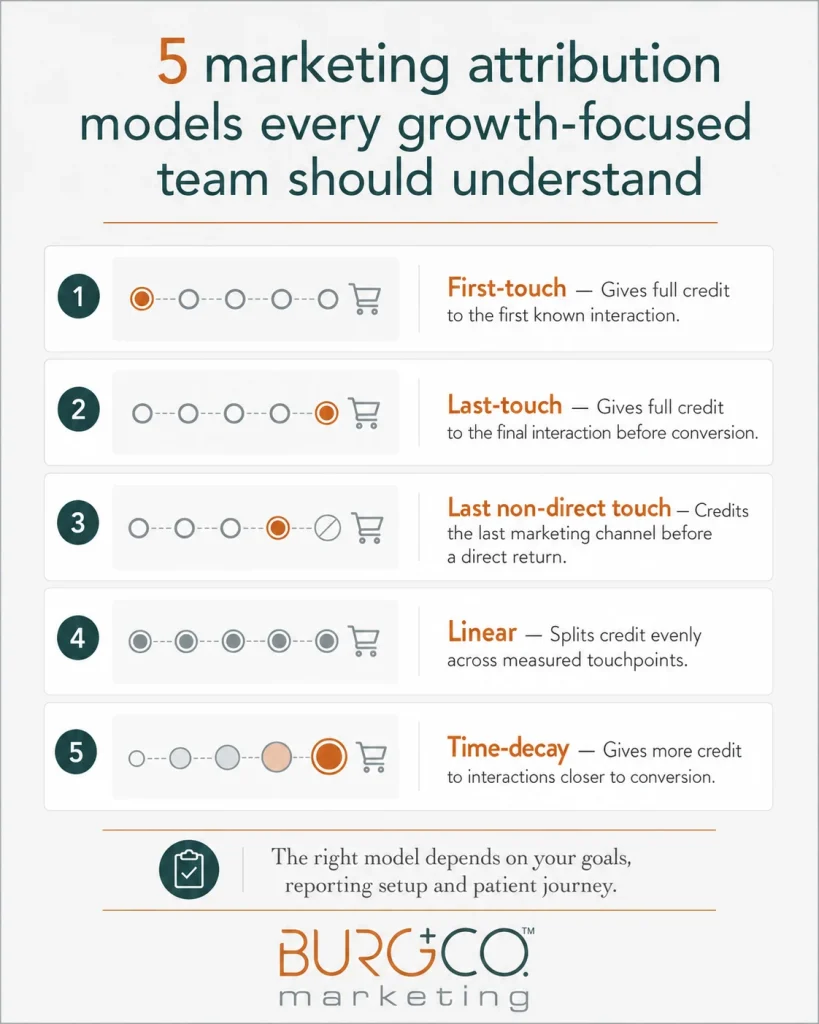
The table below compares five commonly discussed approaches. Some are available directly inside analytics platforms. Others are better used as conceptual reporting models or through specialized tools.
| Attribution model | How it assigns credit | When it may be useful | Main limitation |
| First-touch | Gives full credit to the first known interaction | Evaluating awareness and discovery channels | Ignores everything that happens later |
| Last-touch | Gives full credit to the final interaction before conversion | Understanding which channel closes the measured action | Undervalues early and middle touchpoints |
| Last non-direct touch | Gives credit to the last known marketing channel before a direct return | Reducing the tendency to credit bookmarked or typed-in visits | Still focuses on only one interaction |
| Linear | Divides credit evenly across measured touchpoints | Showing the combined role of several channels | Treats every interaction as equally influential |
| Time-decay | Gives more credit to interactions closer to conversion | Evaluating longer journeys with several recent touchpoints | May undervalue early trust-building activity |
The goal isn’t to declare one model the universal winner. Each answers a different question. Your reporting may use one primary model while comparing it with another to test whether your conclusions change.
Here’s a deeper dive into each one:
-
First-touch attribution
First-touch attribution gives all credit to the first recorded interaction. This might be an organic search result, a digital ad, a social post or a referral site.
It can help answer, “What first introduced people to our organization?”
That makes it useful for evaluating awareness. However, it doesn’t explain what helped someone build enough trust to contact you. A patient may discover your organization through Instagram but convert after reading several treatment pages and searching your brand name.
-
Last-touch attribution
Last-touch attribution credits the final interaction before conversion. It’s simple, familiar and easy to explain in a meeting.
The problem? Simple doesn’t always mean complete.
A branded search may receive full credit even though a prospective patient first discovered the provider through a physician referral, educational video or nonbranded article. Last-touch reporting is useful for identifying conversion-stage channels, but it shouldn’t automatically guide the entire budget.
-
Last non-direct-touch attribution
People often return directly after they already know a brand. They may type in the URL, use a bookmark or revisit a saved page.
Last non-direct attribution ignores that direct return and assigns credit to the most recent identifiable marketing source. This can offer a more useful view than standard last-touch attribution, especially when direct traffic is common.
Still, it remains a single-touch model. It tells you which known channel came last, not which combination of interactions influenced the decision.
-
Linear attribution
Linear attribution divides credit evenly across every measured touchpoint.
Suppose someone follows this path:
- Organic article
- Email newsletter
- Paid search ad
- Appointment request
A linear model gives each marketing interaction an equal share of the credit. This can remind stakeholders that several channels worked together.
However, equal credit may not reflect equal influence. A quick social click and an in-depth treatment page visit may count the same even when their roles were very different.
-
Time-decay attribution
Time-decay attribution gives more credit to touchpoints that happened closer to the conversion.
This model may be helpful for longer consideration cycles. It recognizes that recent interactions can influence action while still preserving some credit for earlier activity.
Yet healthcare teams should be careful about assuming the latest touchpoint was the most important. An educational resource viewed several weeks earlier may have established the trust that made later action possible.
How healthcare organizations can choose a model
Start with the business decision your team needs to make. Don’t start with whichever dashboard looks the fanciest.
Ask:
- Are we evaluating awareness or conversion activity?
- Are we trying to understand one campaign or the full patient journey?
- Can we connect marketing sources to qualified inquiries or admissions?
- Are phone calls and offline activity included?
- Do we have enough clean data for algorithmic attribution?
- Could privacy rules limit the data we collect or combine?
- Would comparing two models change our budget decision?
Healthcare organizations must also consider privacy, consent and appropriate data handling. Attribution technology should be reviewed with legal, compliance and technical stakeholders before protected or sensitive information is collected, shared or combined.
Better attribution starts with better reporting from BURG+CO.
Even the right model cannot solve disconnected systems. Your team may need to align analytics, call tracking, customer relationship management data, scheduling systems and admissions reporting.
Clear reporting can make that work far easier for internal teams to understand and use.
“We partnered with Burg & Co for about two years, and they were an outstanding team to work with from start to finish. One of the things we appreciated most was how clear and actionable their reporting was — it made it easy for us to understand performance, track progress, and make informed decisions. Whenever we needed additional clarification, they were always responsive and took the time to explain things in a way that made sense for our team. Beyond their technical expertise, what really set them apart was their approach as a partner. They were genuinely invested in our success, brought thoughtful recommendations to the table, and consistently made us feel supported. It never felt like we were just another client — they truly operated as a trusted extension of our marketing team.”
— Katarina McDoom, Recruitment & Marketing Specialist at Forever Fit Physical Therapy & Wellness
That experience isn’t a promise of identical results. It does show why attribution reports should lead to understandable decisions, not just produce more columns.
The smartest approach is usually to compare perspectives, connect reporting to meaningful outcomes and remain honest about what your data can — and cannot — prove.
BURG+CO. Marketing helps healthcare teams connect SEO, content, user experience and conversion strategy to the outcomes that matter.
Let’s turn your digital marketing goals into real growth. Contact BURG+CO. today to learn how we support healthcare practices like yours.
FAQs about marketing attribution models
What is the simplest marketing attribution model?
Last-touch attribution is one of the simplest models. It gives full conversion credit to the final recorded interaction before someone takes action.
Which attribution model is best for healthcare marketing?
There is no single best model for every healthcare organization. The right choice depends on the patient journey, available data, reporting goals and privacy requirements.
What is the difference between first-touch and last-touch attribution?
First-touch attribution credits the initial interaction. Last-touch attribution credits the final interaction before the measured conversion.
Can a healthcare organization use more than one attribution model?
Yes. Comparing models can show whether a channel appears more or less valuable under different assumptions. This can support better budget discussions.
Is data-driven attribution always more accurate?
Not necessarily. It can provide useful insight, but its output depends on tracking quality, available data and the platform’s methodology.
What is a marketing touchpoint?
A touchpoint is an interaction between a person and a brand. Examples include an ad click, website visit, email, video view, phone call or referral.
What is a conversion in healthcare marketing?
A conversion is a defined action tied to a marketing goal. It might be an appointment request, qualified call, screening submission, referral inquiry or admission.
How does attribution differ from marketing mix modeling?
Attribution usually analyzes user- or journey-level touchpoints. Marketing mix modeling uses aggregated data to estimate how broader marketing investments affect outcomes over time.
Can attribution track offline patient activity?
It may be possible when call, scheduling, CRM or admissions data is connected appropriately. The process should follow applicable privacy, security and consent requirements.
How often should an attribution model be reviewed?
Review it when tracking changes, channels shift or business goals evolve. Regular model comparisons can also help your team identify outdated assumptions.