
Voice search optimization is not just about getting your website to answer, “Hey Google, where’s the nearest clinic?” It is about helping your healthcare brand show up when patients and families ask specific, high-intent questions in the moments when they are ready to act, compare options or take the next step.
Voice search has changed how people phrase searches. Instead of typing “physical therapy shoulder pain,” someone might ask, “Who offers physical therapy for shoulder pain near me?” Instead of searching “teen anxiety treatment,” a parent might ask, “How do I find a teen anxiety treatment program that takes insurance?”
Those are not casual searches. They are high-intent queries. They often include a need, location, service, timeline or trust concern. For healthcare providers, that means voice search optimization should not be treated like a shiny side project. It should be built into your broader SEO, answer engine optimization (AEO) and conversion strategy.
What is voice search optimization?
Voice search optimization is the process of shaping your website content so it can better answer spoken, conversational searches. These searches often sound more like real questions than traditional keywords.
For example:
- Traditional search — “IOP for depression”
- Voice search — “What is an IOP for depression and how do I know if I need one?”
- Traditional search — “PT near me”
- Voice search — “Where can I find a physical therapist near me who treats knee pain?”
- Traditional search — “urgent mental health care”
- Voice search — “What should I do if my teen needs mental health help today?”
The goal is not to stuff your site with every possible voice query. Please do not build a Frankenstein page full of awkward question variations. The goal is to create clear, useful content that matches how people actually ask for help.
That matters even more in healthcare, where people may be searching during stressful, private or emotionally loaded moments.
Why voice search matters for healthcare providers
Healthcare searches are often personal. People want answers that feel specific, accurate and trustworthy. They may also want to know if your practice is nearby, open, covered by insurance or able to help with a specific concern.
Voice search can influence visibility for:
- Local service searches — “Who offers pelvic floor therapy near me?”
- Decision-stage searches — “What type of treatment program is right for anxiety?”
- Insurance and access searches — “Does this clinic take my insurance?”
- Symptom-related searches — “Why does my back hurt when I cough?”
- Comparison searches — “What is the difference between PHP and IOP?”
Google says local results are mainly based on relevance, distance and popularity. It also notes that complete and detailed business information can help Google better understand and match a business to relevant searches.
That does not mean voice search is only a local SEO play. It also overlaps with AI-powered search, featured snippets, structured data, mobile UX and content quality.
A strong voice search strategy should answer the question behind the question. What is the patient really trying to figure out? What would make them feel safe enough to take the next step?
4 voice search optimization strategies
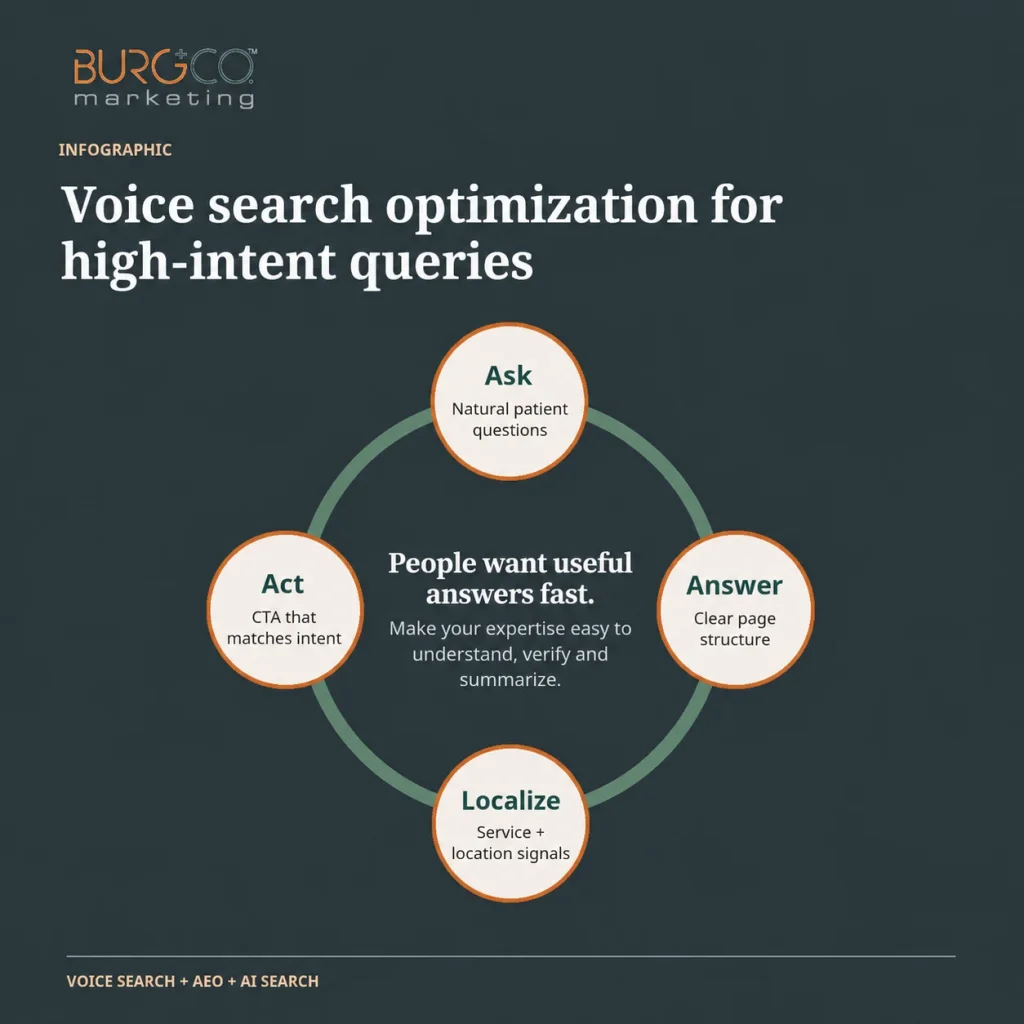
If you’re not sure how to approach voice search optimization, here are a few strategies worth trying out:
-
Build content around natural patient questions
Voice searches tend to sound like conversation. That means your content should include natural questions and direct answers.
Start by gathering the questions your patients, caregivers or referral partners already ask. Look at:
- Intake call questions
- Contact form submissions
- Sales and admissions team notes
- Google Business Profile questions
- Search Console queries
- Internal site search data
- FAQs from service-line teams
Then group those questions by intent.
| Voice search intent | Example question | Content opportunity |
| Find a provider | “Who offers outpatient therapy near me?” | Local service pages with clear location and service details |
| Understand care options | “What is the difference between PHP and IOP?” | Educational blog articles and program comparison pages |
| Check fit | “Is physical therapy good for shoulder pain?” | Condition or symptom pages with treatment context |
| Reduce friction | “Does this clinic take insurance?” | Access, billing and admissions content |
| Take action | “How do I schedule an appointment?” | Clear CTAs and conversion paths |
-
Write clear answers near the top of key pages
Voice search and AI search both depend on clarity. Your page should not make readers dig through six paragraphs of setup before finding the answer. Save the scenic route for road trips.
For important questions, place a short, direct answer near the top of the page. Then expand with helpful detail below.
A good structure might look like this:
- Clear question as a heading — “What is voice search optimization?”
- Direct answer — One to three sentences that define the concept
- Supporting detail — Examples, use cases and next steps
- Conversion path — A relevant CTA that helps the reader act
Google’s guidance on people-first content emphasizes creating helpful, reliable information for people rather than content made mainly to manipulate rankings.
For healthcare brands, this is especially important. Content should never overpromise, oversimplify clinical concerns or make someone feel pushed into care. It should help them understand their options and decide what step makes sense.
-
Strengthen local SEO signals
Many voice searches have local intent, even when the person does not say a location out loud. Someone asking, “Who treats vertigo?” may still expect nearby results.
To optimize for local voice searches, make sure your website and local listings clearly communicate:
- Services offered
- Conditions or concerns treated
- Locations served
- Hours and appointment options
- Insurance or payment information, when appropriate
- Provider credentials
- Contact information
- Accessibility details
Your Google Business Profile should also stay current. That includes hours, service categories, photos, reviews and business descriptions.
For multi-location healthcare brands, each location page should answer location-specific questions. A patient should not have to guess whether your Tampa office offers the same services as your Nashville office. Search engines should not have to guess either.
-
Connect voice search to AEO and AI search
Voice search, answer engine optimization and generative engine optimization all share a big idea: People want useful answers fast.
Google’s generative AI search guidance says SEO best practices still apply because AI features are rooted in core Search ranking and quality systems. It also emphasizes valuable, non-commodity content and clear technical structure.
This is where healthcare brands need to think beyond keywords. Your content should make your expertise easy to understand, verify and summarize.
That means:
- Answering questions directly
- Using clear headings
- Defining terms in plain language
- Showing clinical or professional review when relevant
- Including original insight from your team
- Connecting related pages through internal links
- Keeping location and service information consistent
A relevant BURG+CO. perspective puts this shift plainly.
“AI systems are not just looking for keywords. They are looking for sources that are clear, trustworthy, structured, and easy to understand.”
— Kelly Burgess, BURG+CO. Marketing’s founder, CEO, and a certified SEO specialist

What healthcare providers should avoid
Voice search optimization can go sideways when brands optimize for machines and forget the humans.
Avoid:
- Keyword stuffing — Repeating “voice search optimization” until the page sounds robotic
- Thin FAQ pages — Adding lots of low-value questions with shallow answers
- Unsupported clinical claims — Suggesting symptoms always mean one condition or that one service guarantees an outcome
- Fake local relevance — Creating city pages with no real service or location detail
- Dead-end content — Answering questions without giving readers a useful next step
- Generic AI content — Publishing content that sounds like every other healthcare marketing article online
Healthcare content should be specific, helpful and grounded in trust. Voice search optimization works best when it helps real people find real answers.
A client perspective also reflects why clear partnership and reporting matter in digital marketing strategy.
“We partnered with Burg & Co for about two years, and they were an outstanding team to work with from start to finish. One of the things we appreciated most was how clear and actionable their reporting was — it made it easy for us to understand performance, track progress, and make informed decisions. Whenever we needed additional clarification, they were always responsive and took the time to explain things in a way that made sense for our team. Beyond their technical expertise, what really set them apart was their approach as a partner. They were genuinely invested in our success, brought thoughtful recommendations to the table, and consistently made us feel supported. It never felt like we were just another client — they truly operated as a trusted extension of our marketing team.”
— Katarina McDoom, Recruitment & Marketing Specialist at Forever Fit Physical Therapy & Wellness
Voice search optimization is really about listening better. Patients and families are already asking clear, urgent and practical questions. Your job is to make sure your website answers them in a way that is accurate, human and easy to find.
BURG+CO. Marketing helps healthcare brands build organic strategies that connect SEO, AEO, content structure, user experience and conversion paths.
Looking to elevate your healthcare marketing strategy? Reach out to our team for personalized insights and next steps.
FAQs about voice search optimization
What is voice search optimization?
Voice search optimization helps your website answer spoken search queries. These searches are often longer, more conversational and more question-based than typed searches.
Why does voice search matter for healthcare providers?
Voice search matters because patients and families often ask urgent, specific questions before choosing care. Clear answers can help your brand appear in more high-intent search moments.
How is voice search optimization different from traditional SEO?
Traditional SEO often focuses on typed keywords. Voice search optimization focuses more on natural questions, local intent, direct answers and mobile-friendly experiences.
Does voice search optimization help with AI search?
It can support AI search visibility when paired with strong SEO. Clear structure, helpful answers, original expertise and trustworthy content can make pages easier for AI systems to understand.
What types of healthcare pages should be optimized for voice search?
Service pages, location pages, FAQs, blog articles, insurance pages and contact pages can all benefit from voice-friendly content. Start with pages tied to high-intent patient questions.
What are high-intent queries?
High-intent queries are searches that suggest someone may be close to taking action. They often include words about services, locations, appointments, insurance, availability or provider fit.
Should every page have an FAQ section?
No. FAQ sections are helpful when they answer real questions. They should not be added just to fill space or chase rankings.
Can voice search optimization guarantee more patients?
No. Voice search optimization cannot guarantee patient growth. It can support visibility, clarity and user experience as part of a broader organic strategy.
How do healthcare brands find voice search questions?
Teams can review intake calls, contact forms, Search Console data, Google Business Profile questions, sales notes and common provider questions. The best ideas often come from real patient language.
How often should voice search content be updated?
Review important pages regularly, especially when services, locations, insurance information or patient questions change. Content should stay accurate, useful and aligned with current search behavior.